Wondering how unqualified leads hurt sales team morale? Ask the SDR who called 200 dead contacts last month. Sales ignoring marketing leads is just the visible symptom. Scroll down for the cause.
Why Sales Ignoring Marketing Leads Hurts Pipeline More than You Think
Demand
Jun 28, 2026

Every B2B marketing team has seen the pattern. The dashboard says 3,000 MQLs shipped to sales this quarter. Sales worked maybe 900 of them. The rest sat untouched, unmarked, and eventually recycled back into a nurture list nobody reads.
This is not a discipline problem on the sales side. It is a signal problem on the marketing side. When sales ignoring marketing leads becomes the norm, the root cause almost always traces back to what counts as a ‘lead’ in the first place.
What Makes Sales Stop Trusting Marketing Leads?
Sales reps remember every dead-end call to a contact who had no budget, no timeline, and no idea why he was on the list. After enough of those, reps stop treating marketing leads as opportunities and start treating them as noise. That erosion of trust is not sudden. It builds over quarters of mismatched expectations.
Here is what typically breaks the trust between sales and marketing teams:
- Form fills without intent: Someone downloads a PDF. His name enters the CRM. An SDR calls. The prospect says, “I was just reading.” Multiply that by hundreds of leads per quarter, and sales stops picking up the phone.
- Scoring based on demographics, not behavior: A VP at a Fortune 500 company fills out a webinar form. The lead scoring accuracy model gives him a high score because of title and company size. But he has no active buying needs. The score rewarded who he is, not what he is doing.
- No context in the handoff: Sales receives a name, a company, and a lead source. No information about what content the prospect consumed, how many times he visited the site, or whether his account is showing research activity in the category.
- Volume targets that reward noise: When marketing gets measured on MQL count, the system bends toward filling the funnel with anyone who raises a hand, regardless of readiness.
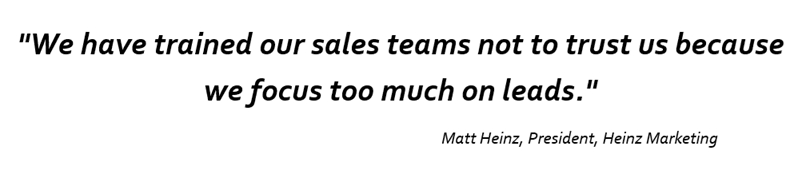
That trust deficit is measurable. MarketingSherpa data shows that 79% of marketing leads never convert into sales. The primary cause is a lack of proper nurturing and qualification.
Why Does the MQL Model Keep Producing Leads Sales Cannot Use?
The MQL quality issues most teams face come down to a structural mismatch between how marketing defines a lead and how sales define an opportunity.
Here are the patterns that keep repeating:
-
Marketing qualifies on engagement (opened an email, clicked a link, attended a webinar). Sales qualifies on buying signals (budget confirmed, timeline established, stakeholders identified).
-
The MQL-to-SQL conversion rate across B2B has dropped to a median of 9.8%, according to Forrester and Demand Gen Report data. That means roughly 90% of what marketing sends over never gets accepted by sales.
-
Lead scoring models often miss timing entirely. A perfect-fit account that downloaded a guide six months ago is not the same as an account researching your category right now.
If this sounds familiar, the problem is not unique to your team. This blog on why lead gen fails breaks down how the MQL keeps failing, and the structural issues run deep.
What Happens When SDR Teams Keep Getting Unqualified Leads?
The cost of sending unqualified leads to sales goes beyond missed quota. It creates a chain reaction that damages the entire revenue operation.
Here is what happens downstream:
-
SDR burnout: Reps who spend their days calling contacts who have no interest or no budget lose motivation fast. High turnover on SDR teams is often a symptom of a lead disqualification rate problem, not a hiring problem.
-
Slower pipeline velocity: When sales has to sort through unqualified leads to find the real opportunities, response time to genuinely interested accounts suffers. Research shows that leads contacted within five minutes are 21x more likely to qualify than those contacted after 30 minutes.
-
The blame cycle: Marketing says sales is not working the leads. Sales says the leads are junk. Neither team is wrong. The system that defines, scores, and routes those leads is the actual problem.
-
Rising cost per opportunity: When your SDR lead follow up effort is spread across 3,000 contacts instead of focused on 500 high-intent accounts, your cost per qualified opportunity climbs while conversion stays flat.
How Do You Fix the Lead Qualification Process?
The fix is not a new tool. It is a different approach to what counts as qualified.
Here are the structural changes that move the needle:
Replace Demographic Scoring with Behavioral Signals
A lead’s job title tells you who he is. His behavior tells you what he is doing. Repeat visits to pricing pages, consumption of comparison content, and engagement from multiple people at the same account are stronger indicators of buying readiness than any firmographic field.
Machintel’s signal-based marketing and intent data services combine first-party behavioral data with third-party intent signals to help teams distinguish between contacts who are browsing and accounts that are actively in a buying cycle.
Add Intent Data Before Leads Reach Sales
Intent data tells you which accounts are researching your category right now, even if they have not visited your site. Layering B2B buyer intent data into your qualification process means sales only receives leads from accounts showing active buying behavior.
For a deeper look at how intent data changes lead gen economics, read this.
Build a Shared Definition of ‘Qualified’
If marketing and sales do not agree on what makes a lead worth pursuing, the handoff will always break. Sit down with sales leadership and define shared criteria:
- What behavioral signals indicate buying readiness?
- What account-level activity should trigger a sales outreach?
- What disqualifies a lead, regardless of title or company size?
When both teams use the same definition, the sales and marketing trust gap starts to close.
What Should You Measure Instead of MQL Volume?
When your primary KPI is MQL count, you optimize for volume. When your primary KPI is pipeline contribution, you optimize for quality.
Here is the measurement shift that aligns both teams:
| Metric | Old Model | New Model |
|---|---|---|
| Primary KPI | MQL volume | Pipeline created |
| Lead quality signal | Form fills | Intent + behavior |
| Sales feedback | Quarterly survey | Weekly scoring loop |
| Cost metric | Cost per lead | Cost per opportunity |
| Alignment check | MQL-to-SQL rate | Pipeline velocity |
This shift in measurement is where sales and marketing alignment actually starts, not with a workshop or a Slack channel, but with shared numbers.
For a deeper look at how teams make this transition, read The 90-day Demand Creation Strategy B2B Teams Actually Need Now.
How Does an Integrated Partner Solve What Fragmented Vendors Cannot?
Most demand gen programs run through four or five vendors. One handles data. Another runs content syndication. A third manages ABM. A fourth provides lead lists. Every handoff between them is a place where context gets lost and lead quality drops.
This fragmentation is a core reason why sales ignoring marketing leads is so common. The lead gen partner does not see the intent data. The ABM vendor does not know what content the account consumed. Nobody has a single view of what moved an account from awareness to opportunity.
Machintel’s demand generation services bring lead generation, ABM, audience data, content marketing, and brand awareness under one operation. When campaign strategy, targeting, and qualification run through a single integrated partner, leads arrive with the context sales needs to act. The handoff stops being a blind toss and starts being an informed introduction.
To understand how demand creation and lead capture work together, see Lead Generation Vs Demand Generation: Know the Difference to Win.
What Is the First Step to Getting Sales to Work Your Leads Again?
Rebuilding trust between sales and marketing does not happen through a single campaign fix or a new tool purchase. It starts with small, measurable changes that prove to sales that the leads coming their way are worth the call.
Here are five moves that get that process started:
- Audit your last 100 leads that sales ignored: Find out why. Was it bad fit, bad timing, or no context? The answer tells you where to fix first.
- Run a pilot with intent-scored leads: Pick 50 accounts flagged by intent signals and 50 from your standard list. Track which group converts faster. Let the data make the case.
- Add a ‘how did you hear about us’ field to your demo form: The answers will tell you which demand creation efforts are working, even if they do not show up in attribution dashboards.
- Hold a joint pipeline review every week: Not a monthly MQL report. A weekly conversation about which accounts are moving, which are stuck, and what marketing can do to help.
- Cut your MQL target in half and measure the pipeline instead: Fewer leads, better leads, more revenue. That is the math that earns sales trust back.
If your demand gen program is producing volume without a pipeline, the problem is structural. Talk to Machintel about building a qualification process that gives sales the leads they actually want to call.
FAQs
How do you get executive buy-in for reducing MQL targets?
Show the cost-per-opportunity math. When 90% of MQLs never convert, the volume looks good on a slide but costs more per actual deal than a smaller, intent-qualified list. CFOs respond to cost efficiency, not lead counts.
What is the right ratio of marketing leads to sales-accepted leads?
There is no universal number, but top-performing B2B teams see 25-40% of marketing leads accepted by sales. If your acceptance rate is below 15%, your qualification criteria need reworking.
How long should sales give a lead before marking it as unresponsive?
Most B2B buying cycles require 5-8 touchpoints. If an SDR makes two calls and one email, that is not enough to determine if the lead is dead. But the touches need to be relevant, not just persistent.
Can AI fix the lead quality problem on its own?
AI can score and prioritize faster than any human team. But AI trained on bad data produces confident, fast, wrong outputs. Clean data, clear ICP definitions, and agreed-upon qualification criteria come first. AI amplifies what you give it.
What role does content play in improving lead quality?
Ungated, problem-focused content builds brand familiarity before a prospect enters a buying cycle. When a lead arrives already knowing your point of view, the sales conversation starts at a different level. Gated content captures names. Ungated content builds the trust that makes those names worth calling.