Account-level intent scores aggregate individual contact signals into a composite score that looks like organizational buying intent but is not. One contact downloading a report, another opening two emails, and anonymous IP page views do not combine into a buying committee signal. Multi-contact threshold requirements fix this: an account is flagged only when a minimum number of identified contacts in relevant job titles show related research behavior within a defined window.
The Account Aggregation Error: Why Intent Scores Mislead SDR Teams
Demand
Oct 20, 2026

In This Article
- Why Individual Contact Signals Are Not Buying Signals
- What Account-level Intent Actually Looks Like
- The Multi-contact Threshold as Signal Definition
- Threshold Calibration by Program Type
- The Role Weighting Requirement
- The SDR Trust Problem
- What the Campaign Execution Standard Looks Like
- The Multi-contact Minimum in Practice
- FAQs
Consider an illustrative scenario. An SDR team worked 200 intent-flagged accounts in Q1.
Eleven meetings. Three opportunities. Zero closed.
The intent data was accurate. Every account had generated signals. Every flag in the dashboard was based on real behavior. The signals were individual contact-level activity: one contact who downloaded a report, another who opened two emails, a few page views from company IP ranges on topic-tagged publisher pages. Each piece of activity had been aggregated into an account-level intent score. The score looked like organizational buying intent.
It was not.
When the same account list was rerun with a two-contact minimum threshold, requiring at least two verified contacts in relevant roles to show correlated research behavior within a 14-day window, 200 accounts reduced to 34.
Those 34 accounts were worked next and generated nine meetings in the first four weeks. The data had not changed. The definition of what counted as an account-level signal had changed. That definitional shift is ‘The Account Aggregation Error’: the gap between aggregating individual contact signals into a score and detecting actual buying committee behavior.
Why Individual Contact Signals Are Not Buying Signals
An individual contact downloading a gated report generates a signal about that person’s behavior on that occasion. It says nothing reliable about the company’s active vendor evaluation status.
Consider the range of reasons a VP of Marketing might download a demand gen benchmarks report. Evaluating vendors for a current budget cycle. Preparing a board presentation on marketing ROI. Benchmarking the current agency’s performance. General professional reading. Following up on content mentioned at a conference. Responding to a colleague’s recommendation.
The signal is identical in every case. A verified contact downloaded a specific asset on a specific date. Without additional context about what else is happening at the account, the signal has no reliable predictive value for organizational buying intent.
This is not a data quality problem. The signal is accurate. The interpretation error is treating individual contact behavior as an organizational buying signal.
The same logic applies to topic taxonomy signals aggregated at the account level. When dozens of page views from a company’s IP range appear on demand gen topic pages in a month, those page views came from multiple employees for multiple unrelated reasons: professional development, market research, conference follow-up, newsletter click-throughs. The aggregated count is an accurate measurement of employee content consumption. It is not a buying committee signal.
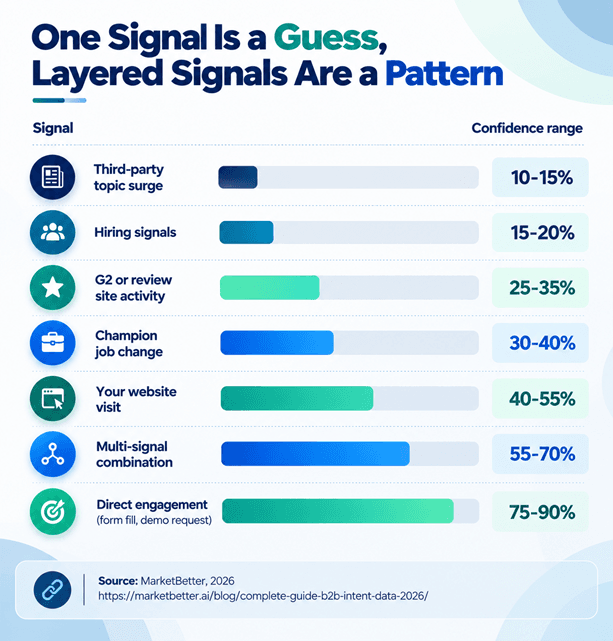
Aggregating noise does not produce signal. Ten individually weak contact-level signals combined into an account score do not become a reliable buying indicator. The predictive validity of the aggregation is bounded by the predictive validity of the inputs.
What Account-level Intent Actually Looks Like
A buying committee in active vendor evaluation produces a distinct behavioral pattern at the account level.
- Multi-contact: Multiple people at the account independently research the same category. Not one person who downloaded several assets, but two or more people who each independently sought and consumed category content.
- Role-relevant: The contacts showing research behavior are in roles relevant to the purchase decision. Demand gen managers, marketing operations leads, VP Marketing, CMO. Not software engineers, product managers, or finance contacts who happen to read industry content.
- Correlated timing: The research happens within a concentrated time window. Multiple people researching the same category within a 14-day window is a different signal from the same research spread over six months. Concentrated multi-contact research in a short window is the behavioral signature of an active evaluation in progress.
- Pattern progression: Buying committee research shows progression from category education to vendor comparison to implementation and pricing content. The progression of research topics within the account’s behavioral record is evidence that an evaluation is under way.
This pattern is qualitatively different from individual professional activity. It is an organizational behavior, and it is the pattern that Behavioral Cluster Intent is designed to detect: multi-contact, multi-session, time-bounded, role-relevant.
The Multi-contact Threshold as Signal Definition
The minimum multi-contact threshold is not a quality filter applied on top of account-level intent. It is the definition of what an account-level intent signal actually is.
Without the threshold, ‘account-level intent’ is a misnomer. An aggregated collection of individual contact signals is not account-level intent. It is a score describing how many employees at the company engage with industry content. That is a different measurement from buying committee activity.
The threshold changes the signal type. Two or more verified contacts in relevant roles showing correlated research in a 14-day window is a different measurement than the sum of all contact activity at the account. The former is a buying committee pattern. The latter is employee content consumption.
Many signal providers do not apply a multi-contact threshold by default. The account-level scores they surface aggregate all contact activity, treating individual downloads and page views as components of a buying signal. Third-party intent data already runs at 40-60% false positive rates (Abmatic).
For context on how topic taxonomy signals feed into this aggregation problem, see The Topic Taxonomy Problem: Why Intent Data Signals Aren’t What You Think. The aggregation error compounds when the inputs are already low-quality.
Threshold Calibration by Program Type
The appropriate threshold varies by target account profile.
ABM programs targeting named enterprise accounts: Three or more contacts in relevant roles within a 14-day window. Buying committees at enterprise accounts are larger. A higher threshold requires meaningful committee engagement, not just one or two contacts showing activity.
Demand gen programs targeting broad account universes: Two or more contacts within a 14-day window. The lower minimum keeps the threshold workable across a broad account universe.
Mid-market targets (200-999 employees): Two contacts minimum. Buying committees at this scale are typically smaller.
Enterprise targets (1,000+ employees): Three contacts minimum. Larger companies generate more background noise from general employee browsing. A higher threshold is necessary to distinguish buying committee activity from routine content consumption.
Where program type and company size point to different minimums, use the higher one.
The threshold is a program design decision, not a vendor default. Many programs run on vendor defaults that have no multi-contact minimum. Setting the threshold explicitly, before the program runs, is the operational change that closes ‘The Account Aggregation Error’.
The Role Weighting Requirement
The multi-contact threshold alone is insufficient without role relevance weighting.
Three contacts at an account showing research behavior in the marketing technology category is a different signal depending on the roles:
VP Marketing, Demand Gen Manager, Marketing Ops: this is the buying committee for a marketing technology purchase.
Software engineer, product manager, finance analyst: these are employees who read marketing technology content, not a buying committee for a marketing technology purchase.
Without role weighting, the threshold count can be satisfied by contacts in completely irrelevant functions.
The SDR Trust Problem
The pattern in the opening example is common enough to be predictable. An SDR team works a list of intent-flagged accounts and finds that most show no sign of an evaluation. Every flag after that gets discounted, including the ones that are real.
The multi-contact threshold does not just improve false positive rates. It gives SDRs a reason to believe the flag, because each flagged account carries evidence they can check: named contacts, their roles, and the dates of their research.
Trust in the data is a program outcome, not just a quality metric.
Watching an SDR team stop believing the flags, including the ones that are real, is a quiet way for an intent program to fail. Machintel’s demand generation team works with B2B marketers on that problem, flagging accounts only when multiple named contacts in the right roles are researching together. Every flag then arrives with evidence the SDR can check.
What the Campaign Execution Standard Looks Like
The SDR receives an account with buying committee evidence, not an aggregate score. That evidence includes the named contacts, their roles, the research each one did and when it happened.
The first conversation can then be built around the roles that engaged and the topics they researched, instead of a single download.
‘The Account Aggregation Error’ is fixable. The fix is a program design decision made before the campaign runs: set the multi-contact threshold, require role relevance and define the window.
The Multi-contact Minimum in Practice
What does a two-contact minimum look like in practice, and why does it matter?
An account with 500 employees has dozens of people reading industry content every week. At any given time, three or four employees might visit pages related to marketing technology, demand generation, or B2B software. This activity appears in topic taxonomy intent data as ‘high intent’ because the page visits exceed baseline frequency.
None of it reflects a buying decision.
A two-contact minimum with job title relevance keeps most of this noise out of the signal. The definition asks: did two or more contacts at this account, in roles relevant to a B2B demand generation purchase (marketing leadership, demand gen, revenue marketing, marketing operations), conduct correlated research within a defined window?
At an account genuinely in evaluation, this pattern is present. A demand generation manager researches content syndication options. A CMO reads a market analysis. A VP Marketing downloads a vendor comparison guide. These are different people, in relevant roles, researching the same category in a concentrated period. That is a buying committee in motion.
At an account not in evaluation, this pattern is rarely present. Individual employees may read industry content, but without the role correlation and research concentration, no pattern emerges.
The threshold eliminates a large share of false positives at the cost of some signal volume. Programs running a two-contact minimum with role relevance will flag fewer accounts than programs without a threshold. The accounts they do flag are more likely to convert.
The trade-off is explicit: lower signal volume, higher signal quality, better SDR conversion. For demand generation programs under budget pressure to show pipeline outcomes, the trade-off is straightforward.
FAQs
What is the difference between topic taxonomy intent and behavioral cluster intent?
Topic taxonomy intent flags an account when company IPs visit pages tagged to a category. Behavioral cluster intent tracks multiple named contacts at the same account consuming related content across sessions within a time window. The first is a page view counter. The second is a buying signal.
How can a B2B marketer identify which type of intent data they are purchasing?
Ask the vendor three questions: how contact identification is handled, whether they can show the specific contacts behind a high-intent flag, and how many distinct contacts are required before an account is flagged. A vendor selling behavioral cluster intent can answer all three precisely.
Why do false positive rates matter in intent data programs?
False positives consume SDR capacity without producing meetings. At the 40-60% false positive rates typical of third-party intent data, a team working 100 intent signals per week spends 40-60 hours on accounts that were never in evaluation (Abmatic). That is the direct cost. The indirect cost is the pipeline that was not built with those hours.