Topic taxonomy intent data generates high false positive rates because it measures page view activity from anonymous IP ranges, not identified buyer research. Behavioral cluster intent tracks named contacts by job title across multiple sessions within a defined time window. The production mechanism is different. The predictive validity is different. Teams that diagnose signal type before purchasing are better placed to reduce false positive rates and improve SDR conversation quality.
The Topic Taxonomy Problem: Why Intent Data Signals Aren't What You Think
Demand
Oct 15, 2026

In This Article
- How Topic Taxonomy Intent Data Is Produced
- The Three-tier Reality of Intent Data
- Why the Production Mechanism Determines Signal Quality
- What the Conversion Data Shows
- The Practical Diagnostic
- The Language That Obscures the Difference
- The Operational Cost of Staying at Tier 1
- The Behavioral Cluster Standard
- FAQs
The marketing ops director pulled up the intent dashboard and showed the SDR manager what ‘high intent’ looked like in practice.
Forty-seven intent events at a target account. 30-day window. High surge score. Immediate SDR outreach recommended.
Then she showed the underlying data.
Forty-seven events came from six unique page views across three days. All from the same company IP range. No contact identification. No job title. No indication of seniority. The SDR had been calling that company for six weeks. Zero response.
The data was accurate. The forty-seven events were correctly recorded. The problem was not a measurement error. The problem was that forty-seven anonymous page views from an unidentified IP range was never a buying signal. The vendor accurately measured something that was not intent and sold it as intent data.
This is ‘The Topic Taxonomy Problem’: the structural gap between what topic taxonomy intent data measures and what buying behavior actually looks like. The gap is not accidental. It is built into the production mechanism of the data.
How Topic Taxonomy Intent Data Is Produced
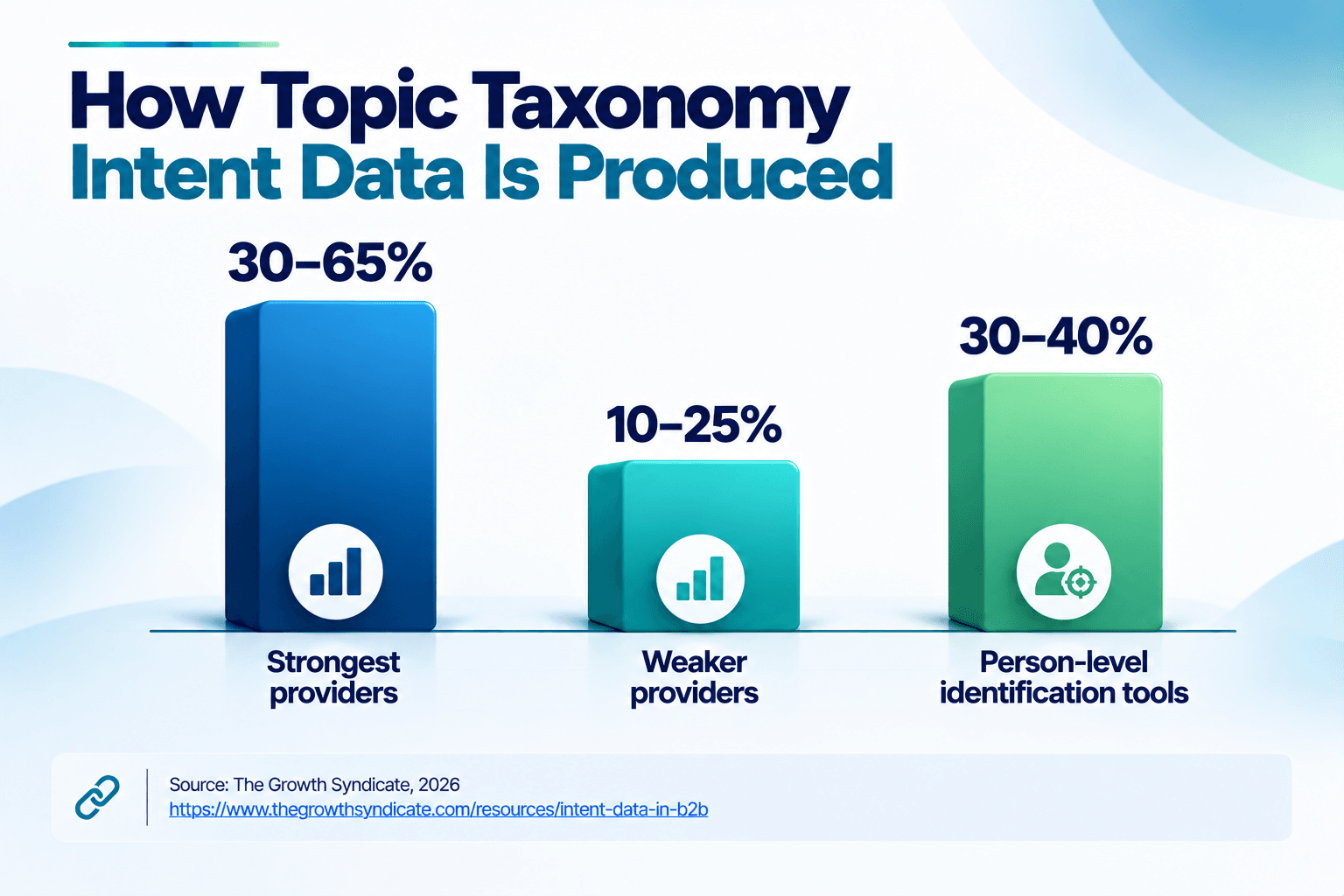
A 98.9% false positive rate in intent signals (Global IT Research citing DemandScience, 2026) only makes sense once you understand exactly how the data is produced.
A data aggregator builds a publisher network: hundreds or thousands of B2B media sites, content syndication platforms, and trade publications. Each page in the network is tagged to topic categories. A page about cloud infrastructure is tagged ‘cybersecurity’. A page about attribution models is tagged ‘marketing technology’.
IP tracking is implemented across the network. When any device at a company’s IP range visits a tagged page, the event is recorded: company IP, topic tag, timestamp.
IP addresses are then resolved to company names using IP-to-company databases. This mapping is less accurate for mid-market accounts than for large enterprises. When a company accumulates enough page views in a topic category within a time window, the algorithm runs a surge calculation comparing current period volume to prior period volume. A company is flagged as ‘showing intent’ when topic engagement rises above baseline.
What the final signal actually represents: this company’s IP addresses appeared on topic-tagged pages more than usual this period.
That is all the signal contains. One event from a junior marketing coordinator reading an industry blog on their lunch break carries the same signal weight as twenty research sessions from a VP of Marketing evaluating vendors. The algorithm cannot distinguish between them because it has no contact-level data.
The Three-tier Reality of Intent Data
The intent data market contains three product types, and they differ sharply in signal quality. Many buyers cannot tell which type they are purchasing.
Tier 1: Topic Taxonomy Matching
A common type. IP-to-company resolution against a publisher page network with topic tags applied. False positive rates run high. At a 1,000-person company, employees read about every topic category every week. The signal is indistinguishable from background browsing.
Tier 2: Content Consumption Tracking
An account that downloads a whitepaper in a category is scored as in-market. One contact. One event. No pattern. A single-contact asset download in a twenty-person buying committee does not indicate the committee is evaluating vendors. It indicates one person found the content relevant enough to download.
Tier 3: Behavioral Cluster Intent
Multiple contacts at the same account, consuming related content, across multiple sessions, within a bounded time window, with job titles correlated to the purchase decision. This is what buying committee research looks like in behavioral data. This is the signal worth activating on.
Many teams believe they are buying Tier 3 without checking.
Why the Production Mechanism Determines Signal Quality
The Behavioral Cluster Intent framework identifies accounts in active evaluation through multi-contact, multi-session behavioral data. The difference with topic taxonomy is structural, not a matter of degree.
Topic taxonomy cannot identify individuals. Without individual identification, there is no way to filter by job title, weight by role relevance, or distinguish the VP of Marketing from the marketing intern. The signal is always a company-level aggregate of anonymous IP activity.
Behavioral cluster signals are contact-level from the start. The system knows which person engaged, in which role, on which date. Job title filtering is built into the signal. A cluster of research activity from demand gen directors, marketing ops managers, and a VP Marketing at the same account carries a fundamentally different signal weight than the same volume of anonymous page views from the same company IP range.
Recency precision also differs. Topic taxonomy surge calculations compare period-over-period page view counts. Behavioral cluster systems apply recency weighting within shorter windows because contact-level data allows more granular time-stamping. Signals from the last seven days are scored higher than signals from three weeks ago.
The noise floor is different. At a 1,000-person company, random browsing generates a baseline level of topic page views that has nothing to do with vendor evaluation. Topic taxonomy cannot separate signal from noise because it has no information about who is browsing. Behavioral cluster detection does not depend on page view volume. It requires a minimum number of relevant-role contacts showing a correlated pattern.
What the Conversion Data Shows
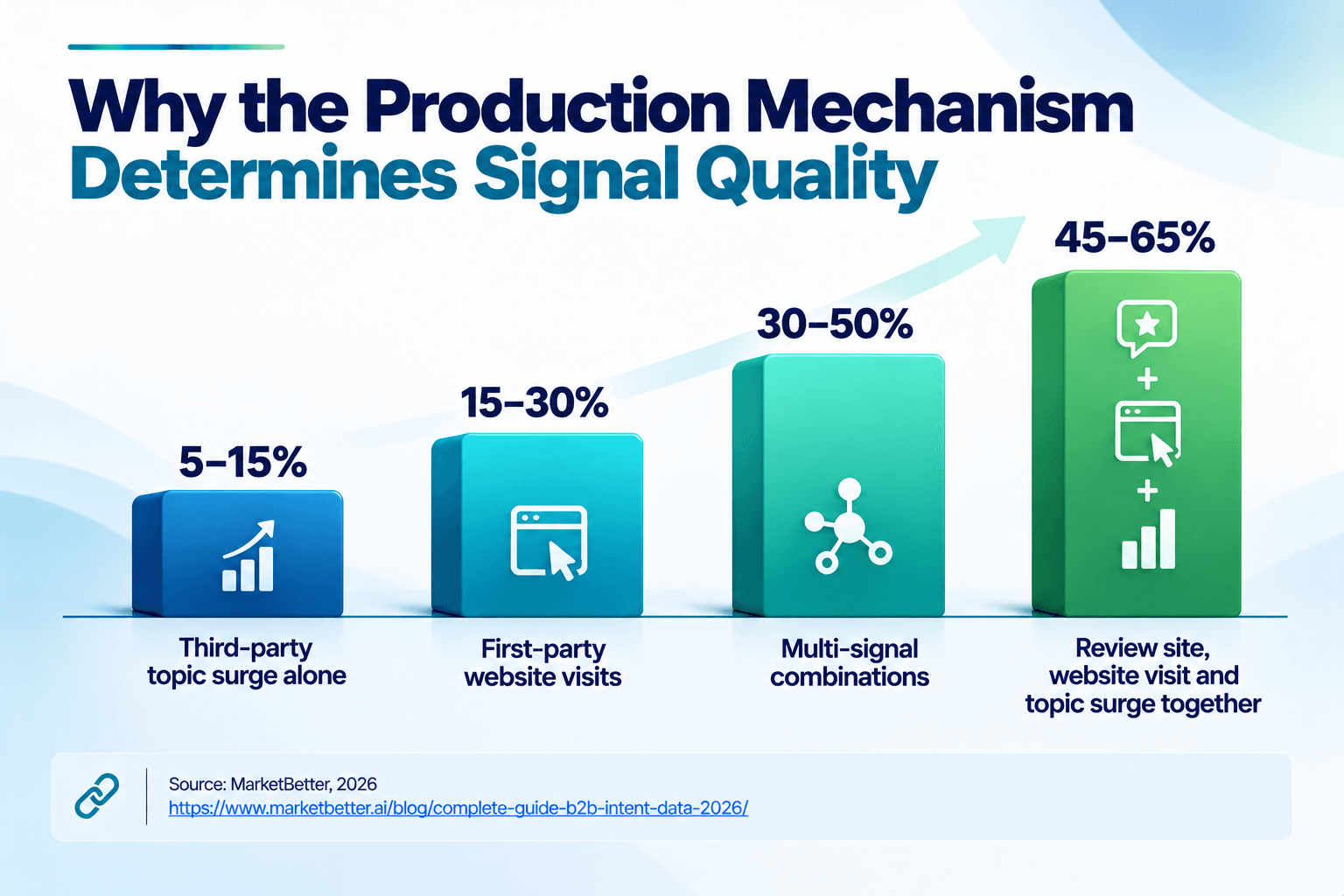
The structural difference above shows up at the meeting stage. In one modeled SDR workflow, conversion to meeting was 3% on third-party category research and 8% on first-party site visitors, about 2.7x higher (MarketBetter, 2026).
A topic signal shows that someone at the account read about a category. A behavioral signal shows who engaged, in which role, and how often. The same SDR hours produce more meetings when the signal points at real buyers.
Behavioral signals indicate active evaluation. Outreach that reaches a company during active vendor evaluation is more likely to enter pipeline than outreach triggered by a page view pattern that predates evaluation by weeks.
The Practical Diagnostic
‘The Topic Taxonomy Problem’ can be diagnosed before a full vendor audit. Three questions, asked in sequence, identify which type of data your current program is running on:
How is contact identification handled?
If the answer involves IP-to-company resolution without contact-level tracking, you are looking at Tier 1 topic taxonomy. IP-to-company matching resolves page views to account names. It does not identify which person at that account was browsing. If there is no individual contact identification in the signal production, there is no behavioral data in the output.
Can you show me the specific contacts whose behavior contributed to a high-intent account flag?
If the vendor cannot provide contact-level signal data (name, job title, company, engagement event, date), the data is IP-level taxonomy. Genuine behavioral cluster data exists at the contact level. If the vendor cannot show it, it does not exist in the product.
What is the minimum number of distinct contacts required for an account to be flagged as high intent?
Topic taxonomy systems typically have no contact minimum because they do not track contacts. Behavioral cluster systems do. A minimum of two or three identified contacts with relevant job titles showing correlated research activity is the structural difference between Tier 1 and Tier 3.
A vendor who reframes these questions or redirects to coverage numbers and confidence scores is selling Tier 1.
The Language That Obscures the Difference
The intent data market uses specific language patterns that make Tier 1 products difficult to distinguish from Tier 3.
Surge signals: An account ‘surges’ on a topic when its engagement rises above baseline. In Tier 1 terms: an account that viewed two topic-related pages last month viewed six this month. A 3x surge. It describes a few extra page views from employees browsing technology news.
Coverage claims: “100 million intent signals per month.” Volume obscures quality. The number has no meaning without knowing what share are genuine multi-contact behavioral clusters.
Confidence scores: A 92% confidence score on a topic taxonomy match means the algorithm is 92% confident the account’s IP appeared on those pages. It says nothing about purchase intent.
Exclusivity language: “First-mover advantage.” The flagged account may have received SDR outreach from several vendors the same week.
Most organizations chase intent signals that don’t convert, and 87% say so (DemandScience State of Performance Marketing, 2026). The inability to answer “What exactly did we measure?” is the clearest warning sign.
The Operational Cost of Staying at Tier 1
A high false positive rate means most intent-flagged accounts are not in active evaluation. SDR hours go to those accounts first, and the pipeline those hours could have built goes unbuilt.
Account damage compounds. Accounts that were not in evaluation still received outreach, which can weaken the first impression before the real buying window opens.
Attribution corruption operates at the strategy level. When false positive accounts enter reporting as intent-sourced, the program looks like it is underperforming for reasons that have nothing to do with the SDRs or the messaging.
The Behavioral Cluster Standard
A behavioral cluster signal meets five conditions:
- Multiple contacts at the same account
- Correlated research across multiple sessions
- Job titles relevant to the purchase decision
- Recency within a defined time window
- A coherent pattern at the account level
Meeting this standard requires a verified contact database and contact-level behavioral tracking infrastructure.
FAQs
What is the difference between topic taxonomy intent and behavioral cluster intent?
Topic taxonomy intent flags an account when company IPs visit pages tagged to a category. Behavioral cluster intent tracks multiple named contacts at the same account consuming related content across sessions within a time window. The first is a page view counter. The second is a buying signal.
How can a B2B marketer identify which type of intent data they are purchasing?
Ask the vendor three questions: how contact identification is handled, whether they can show the specific contacts behind a high-intent flag, and how many distinct contacts are required before an account is flagged. A vendor selling behavioral cluster intent can answer all three precisely.
Why do false positive rates matter in intent data programs?
False positives consume SDR capacity without producing meetings. When most intent signals are false positives, SDR hours go to accounts that were never in evaluation. That is the direct cost. The indirect cost is the pipeline that was not built with those hours.