Only 5% of the total addressable market is actively in a purchase evaluation at any given time. Most B2B demand gen programs compete primarily for that minority. The ‘Capture-Only Trap’ is what happens when a program has no mechanism to reach the 95% that will eventually buy. Content syndication, designed correctly, serves both functions: reaching in-market buyers through qualifying programs and reaching out-of-market buyers through editorial publication networks that build brand familiarity before the evaluation begins.
Demand Creation Vs Demand Capture B2B: Fix the Imbalance
Content
Nov 18, 2026

In this article:
The demand gen team is running intent data, paid search, review site optimization, and competitor displacement campaigns. CAC is climbing. Win rates are falling. When deals do come in, buyers already have a preferred vendor and the shortlist is effectively set. The program is working exactly as designed and the results are getting worse.
This is the ‘Capture-Only Trap’. It is not a campaign execution problem. It is a strategy problem: the program is built to compete for 5% of the market, against every other vendor running the same playbook, while the 95% that will eventually buy forms its preferences without any influence from the program.
Why Demand Capture Dominates B2B Demand Gen Budgets
Demand capture is the dominant model in B2B demand generation because it is measurable. A buyer searches for demand generation software. They visit the vendor’s website. They download a content asset. They fill out a form. The MQL appears in the CRM. The attribution chain from campaign to contact is visible, attributable, and reportable in a 90-day window.
Many B2B companies allocate 70% or more of their marketing budgets to short-term activations (The Drum, 2025). The allocation reflects measurement bias, not strategic intent. Finance and leadership fund what they can measure. Demand capture metrics (CPL, MQL rate, pipeline influenced from in-market contacts) are visible and attributable. Demand creation metrics (brand familiarity, category association, shortlist inclusion rate among buyers who were reached before the evaluation) are longer-cycle and harder to connect to a specific campaign.
The result is that the measurement system determines the strategy. Programs optimize for the metrics that are easiest to report, not the metrics that reflect total market opportunity.
Where Demand Capture Falls Short
Demand capture tactics intercept buyers at the moment they are generating in-market signals: searching for product category keywords, researching vendors on review platforms, triggering intent data thresholds. These tactics work because the buyer is already in motion.
The structural constraint is market size. At any given moment, only 5% of the total addressable market is actively in a purchase evaluation (Ehrenberg-Bass Institute, 2021). Demand capture is competing for that fraction. The other 95% is invisible to capture tactics because they are not generating the signals those tactics track.
Three compounding problems follow from this constraint:
First, crowding: In-market buyers generate intent signals visible to every vendor tracking the same signals. A buyer researching content syndication platforms receives outreach from every content syndication vendor at the same time. The attention is divided. The CAC for in-market contacts tends to rise as the vendor count pursuing them grows.
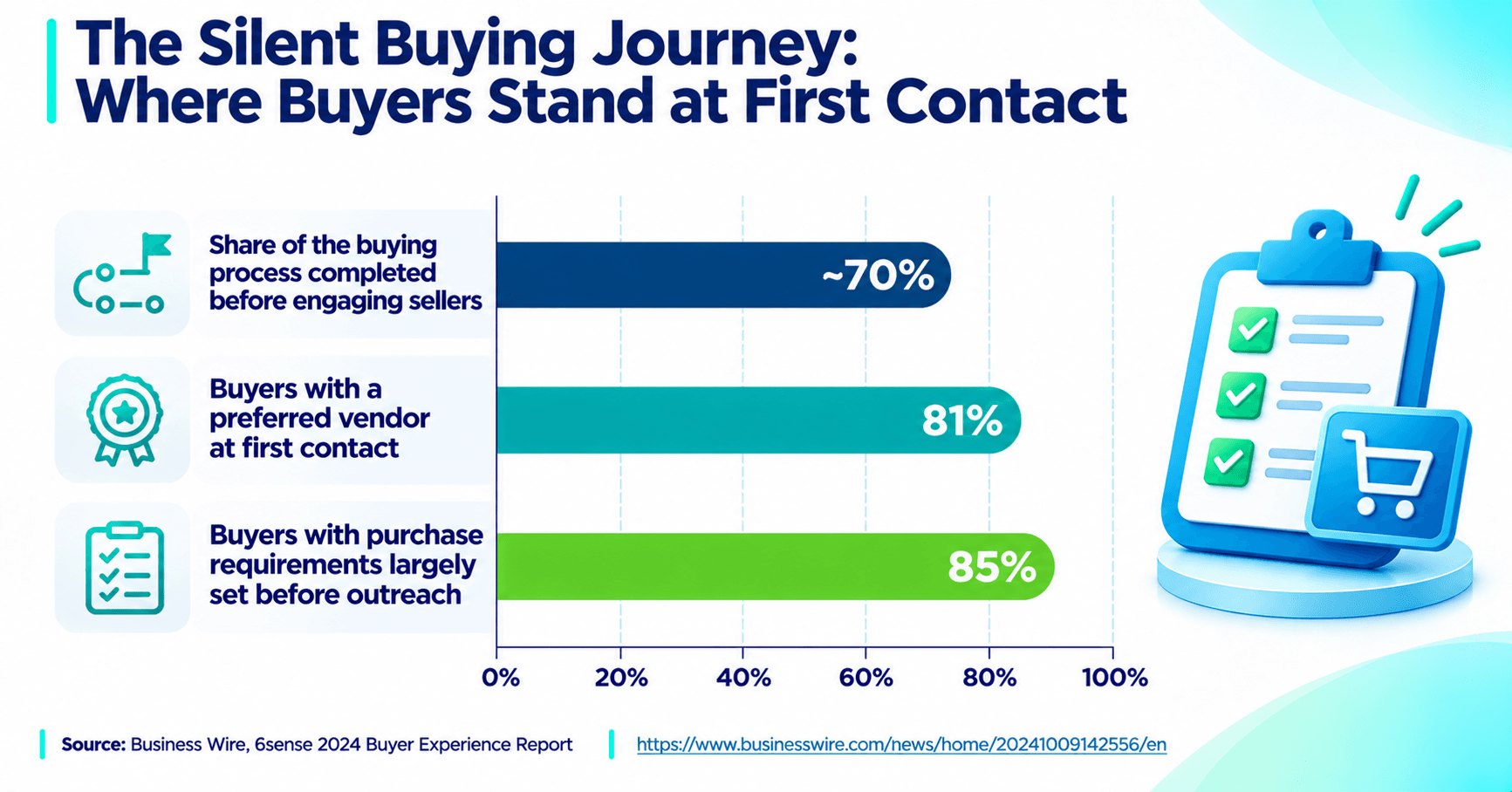
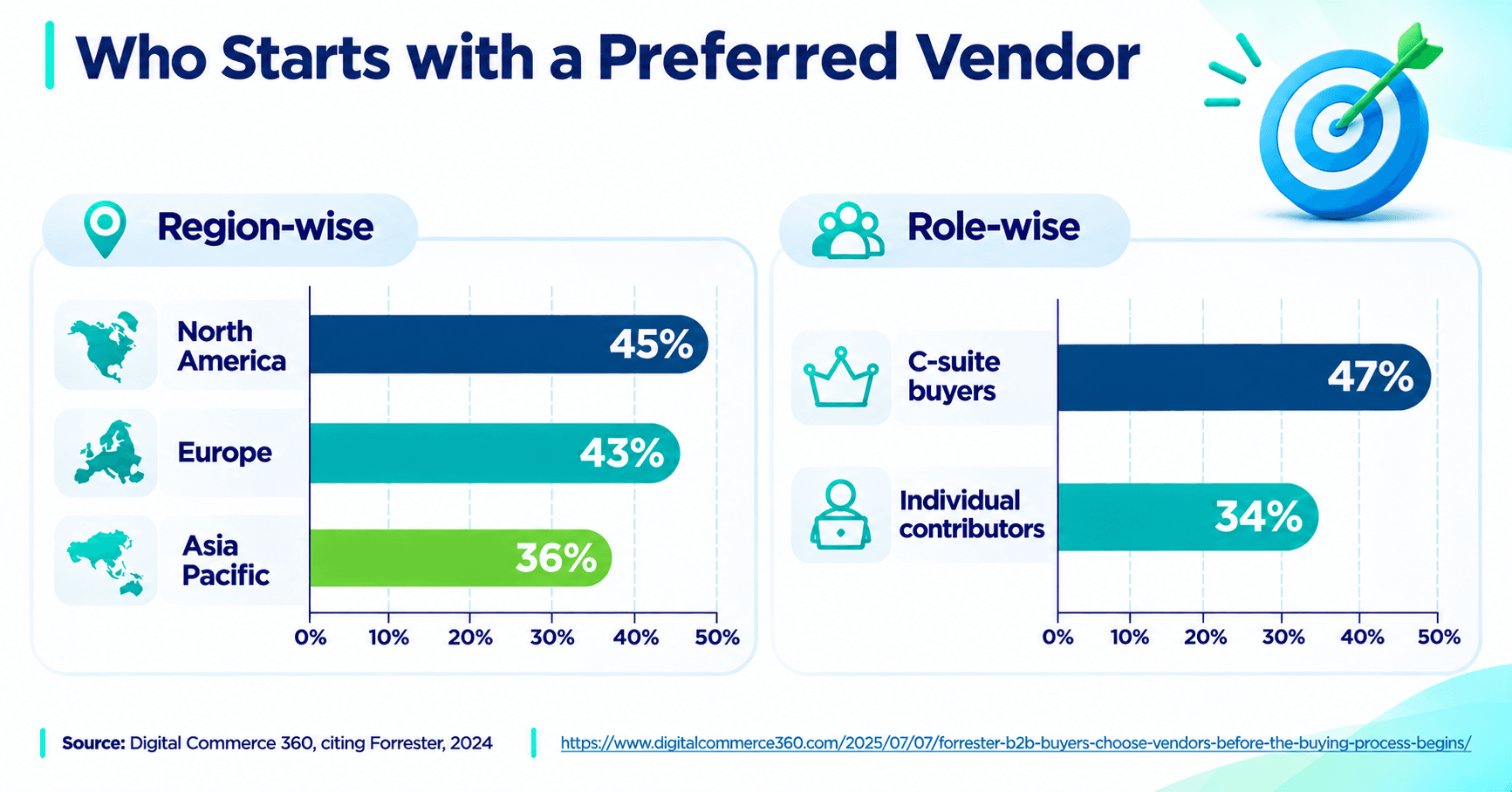
Second, shortlist timing: 41% of B2B buyers have already selected a single preferred vendor before formal evaluation begins (Forrester, 2024). A program that only activates when a buyer is already in evaluation is, by definition, trying to build familiarity and trust on the same timeline as the final decision. Vendors already familiar to the buyer when the evaluation starts have a structural advantage that cannot be overcome with faster SDR follow-up.
Third, attribution compression: Programs evaluated on 90-day windows show demand capture performance but show demand creation performance as zero or near-zero, because creation contacts are not in an evaluation stage when they engage. The measurement system systematically undervalues the work that builds the pipeline two or three quarters out.
If your reporting shows strong capture results but nothing on the buyers reached before their evaluation began, Machintel’s demand generation approach integrates brand building with demand capture. Explore Machintel’s demand generation services.
What Demand Creation Actually Does and Why It Is Under-invested
Demand creation works on the 95% of the market that is not yet in an active purchase evaluation: buyers who are not yet researching solution categories, not yet generating intent signals, and not yet visible to demand capture tactics. The mechanism is content placed in channels those buyers are already using, before a purchase need activates.
A demand generation manager reading an industry benchmark report in a category publication is consuming content that may be months or even years before they enter a formal evaluation. The content creates category familiarity and brand association. When the evaluation begins, the vendor who was present during that independent research phase starts with an advantage that no amount of in-market outreach can replicate.
B2B organizations that invest in demand creation programs alongside demand capture build a larger pool of future buyers than organizations that focus exclusively on demand capture. The returns on demand creation show up over the full evaluation window, not in the first reporting quarter.
These returns do not show up in 90-day reports because the reports are not designed to capture them. Demand creation is a different investment horizon: the program launched in Q1 contributes to evaluations that begin in Q4 or the following year. The payoff conflicts with quarterly accountability structures that fund only what is measurable in the current period. The under-investment in demand creation is structural, not strategic.
Watching the cost of reaching in-market buyers rise while every competitor chases the same few of them leaves a team wondering where else to look. Machintel helps B2B demand generation teams reach the many buyers who are not searching yet, through the publications they already read. The program then builds a pool of buyers who know the brand before they start comparing vendors.
The Portfolio Allocation Framework
Demand creation and demand capture are not competing strategies. They serve different segments of the same market at different time horizons. Most B2B organizations should run both, with allocation between them determined by market maturity and current brand awareness.
In a mature, established category where buyers reliably search for solutions, demand capture has more addressable in-market volume. Established vendors with strong brand recognition can allocate more to capture because their demand creation work is already accumulating.
In an emerging category, or for a vendor with low brand awareness in a category, demand creation is the higher priority. The share of the in-market pool that demand capture can win is small partly because the vendor has not participated in shaping the category conversation. A new entrant competing only on demand capture is fighting for recognition at the same moment the buyer is comparing vendors.
A reasonable starting point for established B2B technology vendors with moderate brand awareness is to move 30-40% of demand generation investment into demand creation and keep 60-70% in demand capture. The exact split should reflect two questions: what percentage of the current pipeline came from buyers who were already familiar with the company before the evaluation began, and what is the current cost to acquire an in-market contact compared to 12 months ago.
If the answer to the first question is low and the answer to the second is rising, the allocation to demand creation is too low.
What Machintel Sees Across 4,000+ Campaigns Annually
Machintel is a B2B marketing agency with over 25 years of experience and a 95% client retention rate. Across 4,000+ campaigns annually, the consistent pattern in underperforming demand gen programs is allocation concentrated in demand capture without a corresponding demand creation investment.
Machintel’s demand generation approach integrates brand building with demand capture, so programs reach buyers whether they are in-market or not. The Digital Demand Creation and Capture (D2C2) framework orchestrates integrated multichannel campaigns around that balance.
The capture program protects this quarter’s pipeline. The creation program builds next year’s.
B2B demand gen has become a competition for the smallest segment of the market. The 95% that will eventually buy is reachable now, before the evaluation begins.
Stop chasing the same 5-10% with the same tactics as every other vendor.
Want to see what a dual-horizon demand program looks like for your budget? Talk to our team or explore our demand generation services.
FAQs
What is the difference between demand creation and demand capture in B2B?
Demand capture targets buyers who are already in an active purchase evaluation, using tactics such as intent data, search, and review site optimization. Demand creation reaches buyers who are not yet evaluating, through content placed in channels they already use, so the brand is familiar when a purchase need appears. Only about 5% of B2B buyers are in the market at any given time (Ehrenberg-Bass Institute, 2021), which is why capture-only programs reach a small share of the total market.
How does content syndication serve both demand creation and demand capture?
The program configuration decides the function. For demand capture, syndication distributes evaluation-stage content, uses qualifying fields to identify active evaluations, and routes contacts to SDR sequences. For demand creation, it distributes content through publisher networks with genuine editorial readership, so buyers who are not yet evaluating become familiar with the brand before the evaluation begins.
How should B2B teams measure demand creation if it does not show up in 90-day reports?
Track brand recall, category familiarity, and the share of evaluation-stage buyers who already knew the brand before the evaluation began. Review results by cohort over the full evaluation window, because buyers reached in one quarter often enter evaluation two or three quarters later.