Only 8% of companies report strong alignment between sales and marketing. The result is ‘The Definition Nobody Agrees On’: marketing delivers against criteria it controls, sales rejects against judgment it trusts, and nobody revisits the definition because doing so requires both teams to admit the current one is wrong. The ‘Pipeline Accountability Model’ ends the loop by making the MQL definition jointly owned, documented, and reviewed quarterly against pipeline conversion data.
MQL Definition B2B: Why the Blame Loop Exists and What Ends It
Demand
Sep 16, 2026

In this article
- The Scene That Opens Every Pipeline Review
- Why Sales Rarely Gets a Say in the MQL Definition
- The Structural Mechanics of the Blame Loop
- What the Numbers Look like When the Definition Is Wrong
- Why Nobody Revisits the Definition
- The Pipeline Accountability Model: A Jointly Owned Definition
- What Quarterly Definition Review Changes
- Final Thoughts
- FAQs
The Scene That Opens Every Pipeline Review
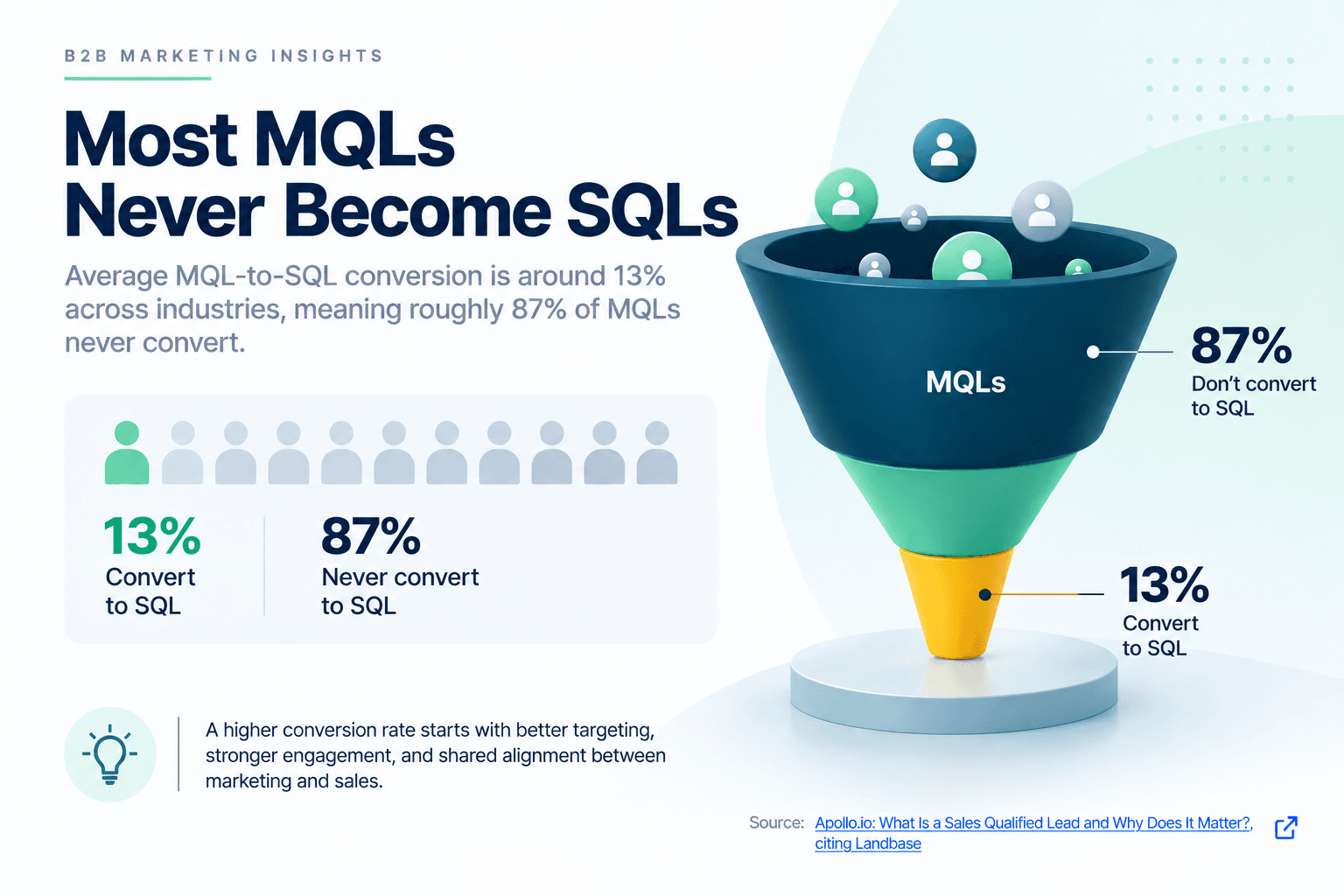
A VP of Sales joined a company in week two and sat through his first pipeline review. Marketing had delivered 800 MQLs in the quarter. Sales had worked 110 of them. Nine were in active pipeline.
He asked three questions:
- Where did the other 690 go?
- Why were 110 worked and not 800?
- What does ‘qualified’ mean on this list?
Nobody in the room had complete answers. The SDR team knew which contacts they had discarded but not why in aggregate. Marketing knew the scoring criteria but had never tracked the discard rate. The definition of ‘qualified’ was in the HubSpot setup from three years prior. No sales representative had been involved in setting it.
This is ‘The Definition Nobody Agrees On’. Marketing operates against a definition it owns. Sales applies judgment that is not captured in the definition. The handoff produces a volume number that marketing reports as success and sales treats as noise. The pipeline does not move. The blame loop starts.
Why Sales Rarely Gets a Say in the MQL Definition
Only 8% of companies report strong alignment between sales and marketing (ZoomInfo). Sales is rarely consulted on how MQLs get defined. The definition is rarely reviewed once set.
74% of B2B marketers use lead scoring to determine MQLs, but 53% say sales regularly rejects them as not ready (Demand Gen Report, 2024 Benchmark Survey, cited in IntentAmplify). The criteria reflect what marketing can measure and deliver: page visits, content downloads, email opens, form fills, lead score accumulations. They do not reflect what sales needs to close a deal: budget authority, active evaluation, decision timeline, organizational fit.
The two sets of criteria are not the same. A contact who scored 85 points through content engagement may have no budget, no active project, and no authority to advance a purchase. A contact who scored 40 points but called the sales line asking about pricing may be in active evaluation. The scoring system rewards the former and misses the latter.
Marketing reports MQL volume. Sales reports pipeline. The two numbers have almost no relationship to each other. Both teams are reporting accurately against their own systems. The systems were never aligned.
The Structural Mechanics of the Blame Loop
The blame loop runs on a simple engine.
Marketing sets the definition. The criteria optimize for what marketing can track and deliver at volume. MQL numbers are achievable and improve quarter over quarter with program optimization.
Sales rejects the output. SDR teams learn from experience that most contacts on the marketing list do not meet their working definition of qualified. They apply their own filter. SiriusDecisions research, now maintained by Forrester, found that sales accepts only 42% of the leads marketing sources, meaning more than half are rejected before they’re ever worked.
Marketing reports success. The dashboard shows MQL volume delivered against target. The metric is green. The report is accurate. The pipeline number is flat.
Sales reports the gap. Pipeline is not moving. Marketing-sourced contacts are not converting. The SDR team is spending significant time filtering a list that was supposed to arrive pre-qualified.
Neither team changes the definition. Marketing cannot change the criteria unilaterally without sales agreement. Sales cannot change the handoff process without marketing’s cooperation. Both teams default to defending their own numbers. The definition stays wrong. The loop continues.
The cost of the loop is more than missed pipeline. Companies with aligned sales and marketing generate 208% more revenue from marketing than misaligned companies (MarketingProfs, cited by The Starr Conspiracy). 208%. The definition gap is not a process inefficiency. It is a revenue problem.
What the Numbers Look like When the Definition Is Wrong
800 MQLs delivered. 110 worked by SDRs. 9 in active pipeline.
The SDR team discarded 690 contacts. Each discard was a judgment call: wrong title, wrong company size, no active project signals, no budget signals, no response to initial outreach. Those judgments represent the real qualification criteria the sales team applies. None of them were in the HubSpot scoring model.
The 9 contacts in active pipeline came from the 110 worked. An 8.2% conversion rate from worked MQLs to pipeline. If the SDR team had worked all 800, the pipeline number would likely be similar. The issue is not SDR effort. It is that 86% of the delivered MQLs did not meet the sales team’s actual working definition of qualified.
Marketing spent a full quarter delivering 800 contacts that met its definition. Sales spent a full quarter filtering 690 contacts that did not meet its definition. Nine deals in pipeline. That is the operational output of ‘The Definition Nobody Agrees On’.
Multiply by four quarters. The annual cost of running on a definition neither team agreed on is not abstract. It is visible in the gap between MQL volume and pipeline, and in the SDR hours spent on discard decisions that a better definition would have prevented.
Why Nobody Revisits the Definition
The MQL definition is the one part of the demand gen process that nobody wants to revisit because revisiting it is organizationally uncomfortable.
For marketing, agreeing to a more restrictive definition means delivering fewer MQLs against a metric the team has been hitting. A lower MQL number in the next quarter’s report looks like underperformance even if it represents better qualification.
For sales, agreeing to a formal definition means committing to work the contacts that meet it. If those contacts still do not convert, the accountability shifts. The current arrangement allows sales to reject marketing leads without specifying a precise alternative standard.
For both teams, revisiting the definition requires admitting the current one is wrong. That admission implicates the programs built on it, the reporting that showed success against it, and the budget allocated based on that reporting.
The definition stays wrong because the short-term organizational cost of fixing it is higher than the short-term cost of continuing the loop. The long-term cost is the 208% revenue gap. But that is a quarterly review problem, and most teams are focused on this quarter.
The Pipeline Accountability Model: A Jointly Owned Definition
‘The Pipeline Accountability Model’ is Machintel’s framework for converting demand gen programs from contact-volume delivery to jointly owned pipeline accountability through shared qualification criteria and quarterly conversion review. See how Machintel applies the framework.
The framework changes the MQL definition from a marketing-owned configuration to a shared document with four components:
Component 1: Explicit qualification criteria with sales sign-off: The definition specifies the ICP firmographic requirements (company size, industry, geography), the role requirements (title, seniority, function), the behavioral signals that indicate active evaluation beyond content engagement, and the disqualifying factors that take a contact off the list regardless of score. Sales signs off on this document. Marketing builds the scoring model to reflect it.
Component 2: A documented discard protocol: Every MQL that sales works and discards gets a discard reason tag from a defined list: wrong title, wrong company, no active project, no response, already a customer, already lost. These tags accumulate as data. The discard pattern is the feedback signal the definition needs to improve.
Component 3: Quarterly conversion review: Every quarter, the MQL-to-pipeline conversion rate is calculated for each discard reason category. If 40% of discards are tagged “no active project,” the behavioral signal requirements in the definition are not capturing project signals accurately. The definition is updated to reflect what the conversion data shows.
Component 4: Shared pipeline contribution target: Marketing and sales agree on a pipeline contribution target that marketing demand gen is accountable for, separate from the MQL volume target. The definition is calibrated to deliver the contacts most likely to hit the pipeline contribution number, not the contacts most likely to hit the MQL volume number.
What Quarterly Definition Review Changes
The first quarterly review under the model typically reveals three things:
The discard reason data shows which criteria in the definition are generating false positives at scale. Contacts who score high but get discarded consistently for the same reason are telling the scoring model it is measuring the wrong signals for that discard pattern.
The conversion rate by lead source shows which channels are delivering contacts that convert versus contacts that get discarded. Channel optimization under the old definition meant maximizing MQL volume per channel. Under the model, it means maximizing pipeline contribution per channel.
The pipeline contribution number against the agreed target gives both teams a shared outcome to discuss rather than separate metrics to defend. Marketing’s success is not MQL volume. It is pipeline contribution against a target both teams set.
The discard rate does not go to zero. The definition will never be perfect.
Final Thoughts
The MQL definition in most B2B companies was set by marketing, has not been reviewed with sales, and is running a blame loop that keeps demand gen revenue well below what aligned teams achieve. That is not a relationship problem. It is a definition problem.
The ‘Pipeline Accountability Model’ fixes the definition before the next program launches. It makes the criteria joint, documents the discard pattern, reviews the conversion data quarterly, and ties marketing accountability to pipeline contribution rather than MQL volume. The gain is a better-working handoff process. It is a demand gen program whose output matches what sales can close, reviewed and updated every quarter until the discard rate is low enough that the pipeline number reflects the investment behind it.
FAQs
What is the most common reason B2B demand gen programs underperform?
The most common reason is a mismatch between the signal type purchased and the action it is supposed to trigger. Programs built on volume metrics cannot reliably identify accounts in active evaluation, so outreach volume rises while conversion rates fall.
How should a B2B marketing team measure demand gen program health before pipeline appears?
Track account coverage rate in your ICP segment, buying committee engagement depth, and stage progression velocity. These metrics show whether the program is building toward pipeline without requiring closed revenue to validate early-stage activity.
What is the single most effective change a demand gen team can make to improve pipeline quality?
Shift from contact-level metrics to account-level metrics. A program that counts individual opens and clicks will optimize for volume. A program that measures account engagement across multiple contacts will optimize for buying committee coverage, which is what produces pipeline.
Running a demand gen program that isn’t producing pipeline? Machintel runs 4,000+ campaigns annually. Talk to us about your qualification model.