Sales marketing alignment B2B fails because marketing has delivered enough low-quality contacts over enough consecutive quarters that sales made a rational decision to stop. The fix is not a better SLA or joint planning session. It is changing what gets delivered and tracking it through pipeline contribution, not MQL volume. ‘The Sales Trust Collapse’ is what follows when that does not happen. The ‘Pipeline Accountability Model’ is how it is reversed.
Sales Marketing Alignment B2B: Why Trust Is a Track Record Problem
Demand
Sep 10, 2026

Why the Trust Collapses
The VP of Sales told the CMO: “We got 11 conversations from 900 leads. My team stopped working your list six months ago.”
The CMO was surprised. The VP of Sales was not.
This conversation happens in B2B companies every quarter. More often, it surfaces in pipeline reviews when the marketing-sourced number is flat, or in a 1:1 when the VP of Sales mentions the SDR team is prioritizing outbound. Or when a new Demand Gen Director pulls 12 months of CRM data and finds that 9,600 MQL contacts produced 47 conversations and 8 pipeline opportunities.
The industry has named this as a sales-marketing alignment problem. It is more specific than that. It is ‘The Sales Trust Collapse’, and it has a specific cause.
Sales marketing alignment B2B fails, in most cases, because marketing has delivered enough low-quality contacts over enough consecutive quarters that sales made a rational decision to stop trying. The problem is not poor communication. The problem is that the track record did not earn trust.
The job marketing is hired to do in that alignment meeting is provide evidence that investment produces pipeline. MQL volume was never built to do that. The programs that rebuild the trust are the ones built around pipeline contribution from the start.
What the Numbers Say
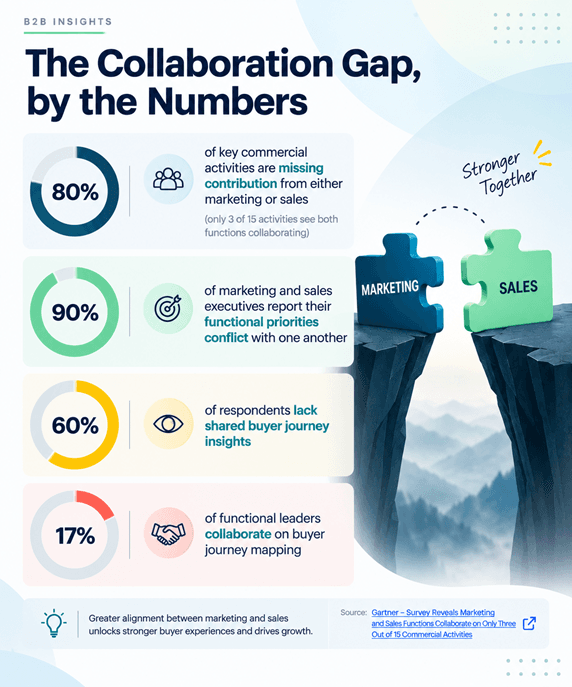
The scale of the trust collapse is measurable from multiple sources:
- Sales follow-up remains inconsistent across B2B. Conversica’s Sales Effectiveness Report found that 83% of companies had inadequate lead follow-up processes, and one in four didn’t respond to inbound leads at all.
- Lead quality compounds the problem. MarketingSherpa data shows that even though 61% of B2B marketers send leads straight to sales, only 27% of those leads turn out to be qualified, meaning sales teams are routinely working through a majority of leads that don’t fit.
- Alignment between the two functions is rare. Sales and marketing alignment statistics compiled by ZoomInfo put the share of B2B companies with strong alignment at just 8%.
These are not outlier findings from poorly run companies. They are survey data from practitioners across B2B markets. The trust collapse is the default condition.
The cost is significant. A sales and marketing alignment study by Aberdeen Group found that companies with strong alignment achieve 20% annual revenue growth, compared to a 4% decline for misaligned companies. That gap is a program quality problem.
How Trust Erodes Quarter by Quarter
Trust does not collapse in a single quarter. It erodes through a predictable sequence:
Quarter 1: Marketing delivers a batch of MQLs. SDRs work the list. Conversion rate is low. Sales flags it informally.
Quarter 2: Marketing delivers another batch. Criteria have not materially changed. SDRs work less of the list. They have found outbound works better. Nobody escalates it.
Quarter 3: The follow-up rate drops below 40%. SDRs touch each record once, log it as ‘attempted contact’, and move on. The CRM activity data looks acceptable.
Quarter 4: The VP of Sales reviews pipeline sourced from marketing. The number is flat. She stops bringing it up in the alignment meeting because nothing changes when she does.
By the time anyone names it as ‘The Sales Trust Collapse’, the list has been quietly abandoned for months.
The information failure compounds throughout. Marketing is optimizing for MQL volume because that is what it is measured on. Sales is deprioritizing the queue because that is the rational response to poor results. Neither team has visibility into what the other is experiencing. The feedback loop that would surface the problem does not exist in most B2B organizations, because nobody built it.
What the CRM Hides
Standard CRM reporting is not built to surface a silent boycott. Activity logs show touches. They do not show effort, intent, or if a real conversation happened. A follow-up rate of 22% looks like incomplete data hygiene. It is a signal that the sales team has written off the list.
In the secondary scene above, the new Demand Gen Director was not looking at bad data. She was looking at accurate data measuring the wrong thing. The 22% follow-up rate told her sales was not working the list. It did not tell her why.
Most demand gen teams measure output: leads delivered, emails sent, cost per lead. Sales teams measure input: conversations, qualified meetings, pipeline sourced. The two teams measure different things and call the mismatch an alignment problem.
It is a measurement problem that creates an alignment problem. When the two frames never meet in the same report, the gap between what marketing thinks it is delivering and what sales is experiencing keeps widening.
The Pipeline Accountability Model
The ‘Pipeline Accountability Model’ is Machintel’s framework for building sales-marketing alignment through shared CRM-verified pipeline metrics and pre-launch qualification agreements. See how it works.
The model starts from a different premise than standard alignment approaches. Instead of starting with process, it starts with measurement.
Four components:
- Pipeline contribution as the primary metric: Not MQL volume. Not cost per lead. Pipeline sourced from marketing, measured in qualified opportunities and revenue.
- Transparent follow-up tracking: Follow-up rate, conversation rate, and pipeline sourced are tracked together. A single touch does not count as a worked lead.
- Joint qualification criteria: The definition of a qualified lead is set with sales input, not by marketing alone. When sales has a voice in the criteria, follow-up rates improve.
- Quarterly reviews against pipeline: The alignment meeting reviews what the list produced, not how many contacts were delivered.
When all four are in place, marketing brings data on what worked. Sales brings data on what converted. The two sets point to the same program.
Why Standard Fixes Fall Short
The standard fixes for sales-marketing misalignment are process-level: shared SLAs, joint planning sessions, co-built ICPs, aligned dashboards. These are not wrong. They are insufficient when the underlying quality problem has not been addressed.
A shared SLA specifying response times does not fix a list of contacts with no buying intent. A joint planning session does not change what gets delivered in the next batch. A co-built ICP produces better criteria on paper, but if the program is optimizing for volume, the quality does not improve.
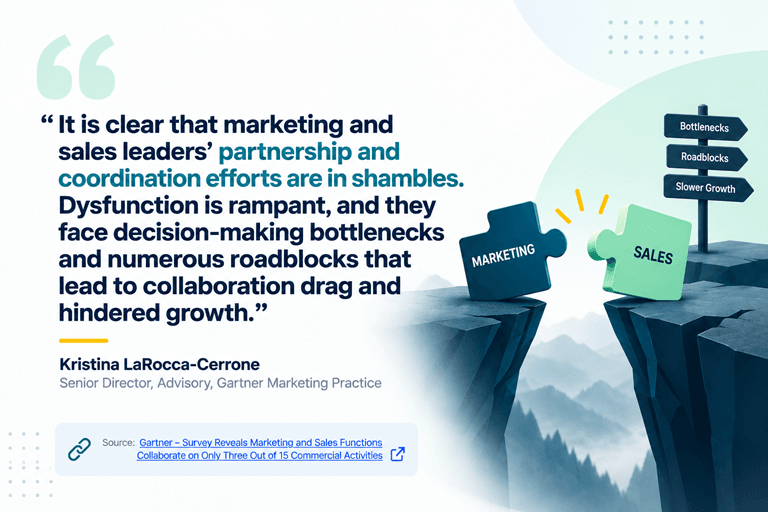
Process fixes work when trust already exists and the teams need coordination infrastructure. They do not work when the trust has collapsed because the list has underperformed for six consecutive quarters. In that case, process becomes one more thing that did not change anything.
The only fix that works is improving what gets delivered.
How Long Recovery Takes
Trust rebuilds on roughly the same timescale it eroded on, gradually, over multiple consecutive quarters of improved lead quality, not in a single campaign cycle.
The timeline can compress if the quality improvement is visible and material within the first 30 days. When sales sees conversations from the new queue starting to convert, the SDR team changes behavior faster. That conversation rate is the leading indicator to track, pipeline lags, conversation rate leads.
What Rebuilt Trust Looks Like
The signal that trust has been rebuilt is behavioral. It shows up in the alignment meeting in a specific way.
Instead of the CMO presenting MQL delivery numbers and the VP of Sales saying the list is not being worked, the conversation flips. The VP of Sales starts bringing data on what is converting. The SDR team reports that the marketing queue is their best source. Pipeline sourced from marketing climbs as a percentage of total pipeline.
When the lead quality improves consistently over two to three quarters, something changes in the alignment meeting: sales starts bringing their own data to prove the leads are working. That is what earned trust looks like.
Running a demand gen program that isn’t producing pipeline? Machintel runs 4,000+ campaigns annually. Talk to us about your qualification model.
Final Thoughts
The programs that produce pipeline are not the ones with the highest signal volume. They are the ones with the clearest definition of what a qualified account looks like and the discipline to act only when the evidence meets that standard.
Volume is easy to buy. Signal quality is not.
FAQs
What is the most common reason B2B demand gen programs underperform?
The most common reason is a mismatch between the signal type purchased and the action it is supposed to trigger. Programs built on volume metrics cannot reliably identify accounts in active evaluation, so outreach volume rises while conversion rates fall.
How should a B2B marketing team measure demand gen program health before pipeline appears?
Track account coverage rate in your ICP segment, buying committee engagement depth, and stage progression velocity. These metrics show whether the program is building toward pipeline without requiring closed revenue to validate early-stage activity.
What is the single most effective change a demand gen team can make to improve pipeline quality?
Shift from contact-level metrics to account-level metrics. A program that counts individual opens and clicks will optimize for volume. A program that measures account engagement across multiple contacts will optimize for buying committee coverage, which is what produces pipeline.
Why do sales teams stop working marketing leads?
When following up on a batch of contacts consistently produces one conversation for every 50 contacts worked, the SDR team makes a rational calculation: outbound produces better results per hour. They do not announce the decision. The follow-up rate drops and the CRM shows acceptable activity data.