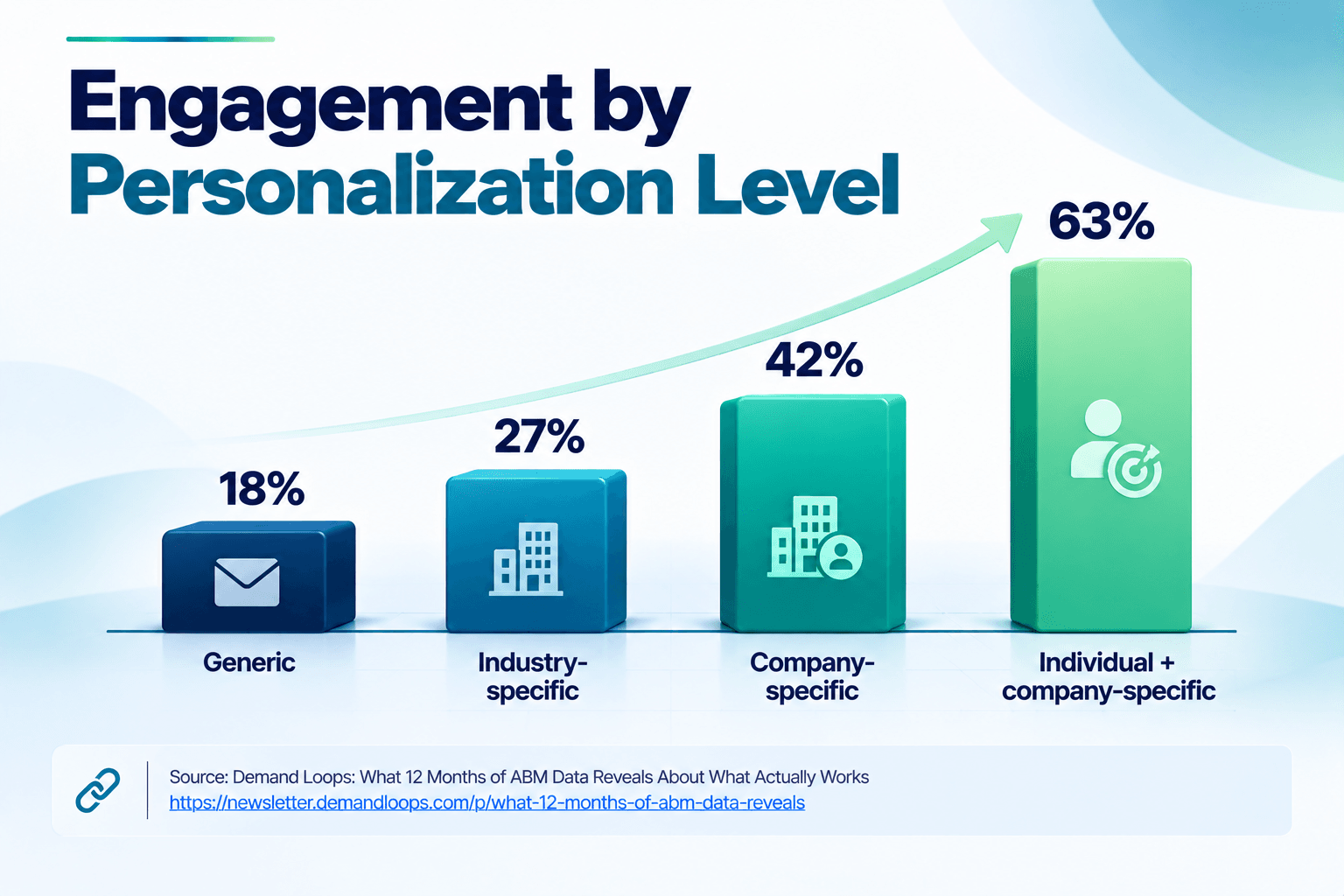
Only 49% of salespeople use intent data to personalize prospect communications. Meeting acceptance rose from 12% to 47% when accounts received three or more touches within 48 hours of showing buying intent. The handoff protocol needs to be built before the program launches, not after the first quarter comes back short.
The ABM Handoff Problem: Why Engagement Signals Disappear Before Reaching Sales
ABM
Oct 11, 2026

The ABM program ran for six months. Account coverage was strong. Four of the top-ten priority accounts had multi-contact engagement: two or more buying committee members consistently engaging across editorial and LinkedIn. The data was in the dashboard.
The SDR team received a weekly list of ‘ABM accounts to prioritize’, but no engagement context, buying committee information, or recommended approach by account.
The SDRs worked the list with the same email sequence they used for cold accounts.
One of the accounts had a VP of Marketing who had encountered Machintel content across three publications for four months. The SDR’s opening email was identical to every cold contact she received that week.
She deleted it.
The program had built significant context at that account. The follow-up treated the account as if none of it existed. The ABM investment was destroyed at the handoff.
The Scope of the Handoff Problem
65% of ABM programs report weak sales adoption as their primary challenge (ITSMA). That is not a sales motivation problem. It is a systems problem. The signals are not reaching sales in a format they can act on.
Only 43% of B2B organizations have a formal SLA between sales and marketing (Prospeo, 2026). In the other 57%, the handoff is informal: a shared dashboard, a weekly list, a Slack message when something looks interesting. None of those formats produce consistent sales follow-up because none of them give sales what they need to know what to do next.
‘The ABM-to-Sales Handoff Failure’ is the breakdown between account engagement and the sales conversation that engagement was designed to enable. Revenue is not created when an account engages with the program. It is created when that engagement converts to a pipeline-qualified sales conversation. The handoff is where that conversion happens or does not.
Buying Committee Syndication is Machintel’s framework for reaching every decision-maker in a target account before the formal evaluation begins. See how it works.
Four Ways the Handoff Breaks
Failure 1: Different Account Lists
Marketing builds programs based on firmographic criteria and intent data. Sales builds priority lists from relationship history and pipeline judgment. In most programs, these lists overlap by 30 to 50%.
The consequence: marketing runs full program intensity at accounts sales is not prioritizing. Sales ignores engagement signals from accounts outside their active territory.
The signals the program generates at those accounts produce no pipeline. Sales was never going to act on accounts they did not know were in the program. Almost 40% of media spend is wasted on non-targeted marketing efforts (LatentView).
Failure 2: Sales Does Not Have Usable Engagement Data
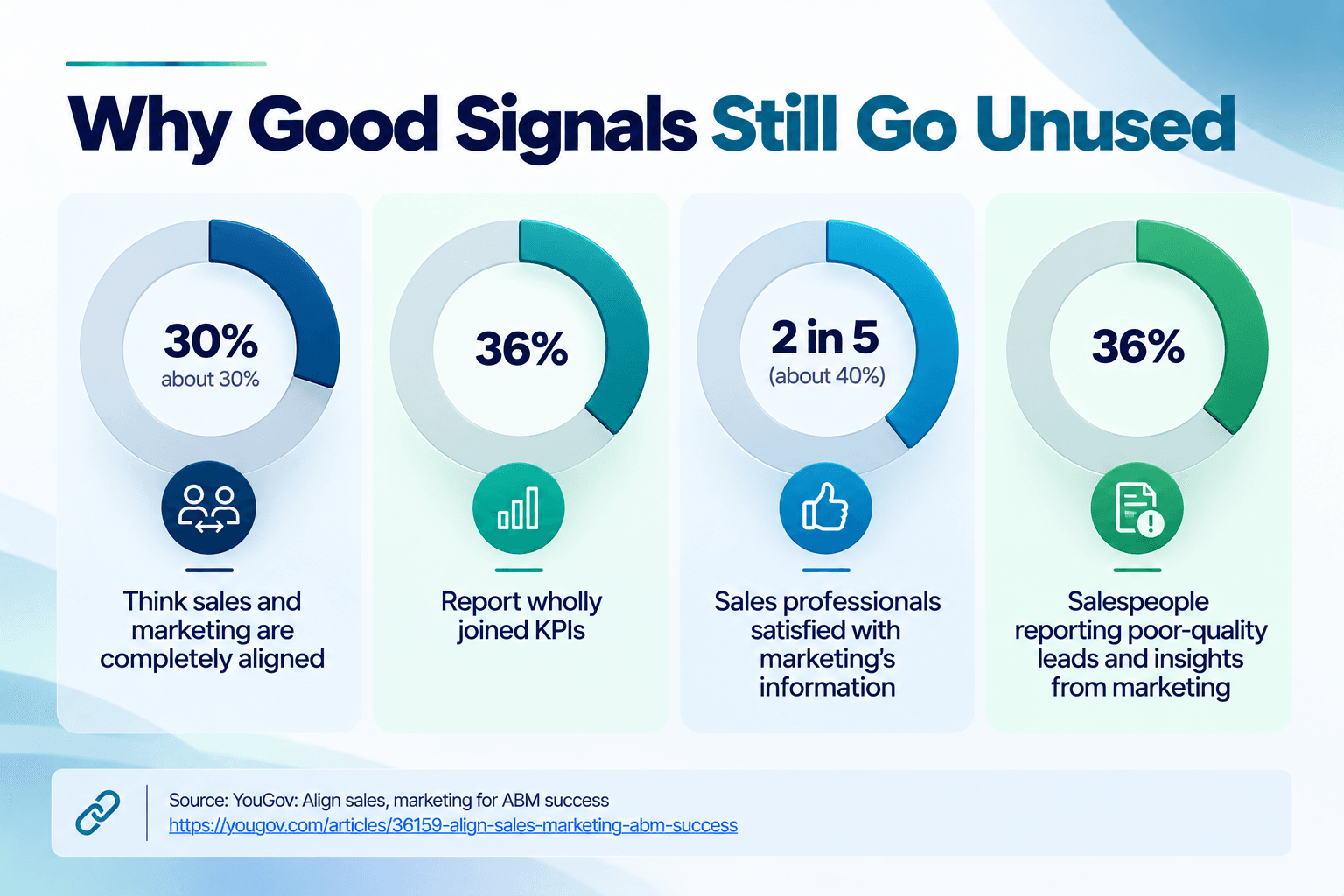
Many sales teams do not know enough about the ABM program’s account engagement to personalize their outreach. Only 49% of salespeople use intent data to personalize prospect communications. Only 38% send personalized communications to top prospects on every touch (Conversica and Renegade Marketing, 2021).
The problem is not that the data is missing. Most ABM programs have dashboards. The problem is format. A dashboard showing aggregate engagement metrics requires the sales rep to translate data into a personalized outreach approach on their own. Most do not. They fall back to the standard cold script. The account that has been engaging for three months receives the same opening as an account that has never heard of the vendor.
The fix is not a better dashboard. It is a weekly account digest in sales-ready format: account name, which buying committee members engaged this week, what they engaged with, and a specific recommended next action. Not a data export. A brief a rep can act on in 60 seconds.
The digest does the interpretation for them and hands the rep the starting point for a personalized outreach. That is the gap between a program that produces engagement and one that produces pipeline.
Failure 3: No ABM-qualified Account Definition
In demand generation, the MQL is the handoff signal. In ABM, the equivalent is the ABM-qualified Account (AQA): an account that has reached a defined engagement threshold that warrants direct sales contact.
Without that definition, sales contacts accounts too early: a single engagement from a junior contact, no purchase trigger. Or too late, when the account has been heavily engaged for months and is already in formal evaluation with a competitor. Both failure modes are common. Both destroy the value of the program at the moment it should convert.
A practical ABM-qualified Account threshold: multi-contact engagement from two or more buying committee roles in a 30-day window, plus either a qualifying trigger event (new CMO, funding announcement, product launch) or a confirmed account stage of evaluating. That combination is the handoff signal. Without it documented before launch, sales either over-contacts or under-contacts, and the program produces neither.
For more on buying committee coverage and how it affects pipeline at the account level, read The Buying Committee Map: Why ABM Programs That Reach One Stakeholder Lose the Deal.
Failure 4: The Follow-up Does Not Match the Engagement Level
An account with three months of multi-contact engagement across editorial and LinkedIn that has reached the AQA threshold does not need a cold SDR sequence. It needs VP-level or MD-level outreach that references specific context from the account’s engagement history.
Meeting acceptance rose from 12% to 47% when accounts received three or more touches within 48 hours of showing buying intent (Demand Loops). Timing matters. But approach matters equally. Generic cold outreach on a warm account signals to the account that the vendor does not know them. It destroys the context the program built.
When a warm account goes cold between the marketing dashboard and the first sales email, the program gets no credit for the work it did. Machintel helps B2B demand generation teams set up the handoff before launch, so sales knows who engaged, what they read, and what to say next. The conversation then starts where the program left off.
The follow-up protocol should specify, by engagement level: what is the appropriate outreach type (SDR email, VP call, MD email), what is the timing requirement, and what engagement context should the outreach reference?
The Handoff Protocol
A functional ABM handoff protocol has four components:
Engagement data in sales-ready format: Weekly account digest by rep: account name, which committee members engaged, what they engaged with, recommended next action: awareness only, SDR outreach, or VP or MD outreach once the AQA threshold is reached.
AQA criteria documented before launch: What constitutes a sales-ready ABM account? Agreed by marketing and sales leadership before activation, documented in the program brief. If this conversation happens after the program launches, it produces retrospective debate about specific accounts rather than an operating principle.
Follow-up protocol by engagement level: Early engagement, a single contact with no trigger: sales awareness only, no outreach. Multi-contact engagement: SDR personalized outreach within 48 hours, referencing the account’s specific engagement. AQA threshold reached: direct VP or MD-level outreach within 24 hours, with context brief included.
Sales feedback loop: After sales contacts an account, what did they learn? Was the account in evaluation mode? Was the content relevant to their actual situation? That feedback refines the AQA criteria and the engagement data interpretation over the program’s life.
Why the Handoff Is the Program's Most Critical Moment
ABM engagement is not revenue. It is the precondition for a sales conversation that can become revenue.
The program’s investment in building account familiarity across editorial, LinkedIn, and direct outreach creates a context in which a sales conversation is more likely to advance. Multiple buying committee members have encountered the vendor through channels they trust, in research contexts they value. That context exists at the account level before the first sales contact.
The handoff converts that context into a sales conversation. Without a functional handoff, the context exists and goes unused. Sales contacts accounts without knowing their history. Accounts disengage. The pipeline never materializes.
The ABM program did its job. The handoff failed to produce the return on it.
Across 4,000+ campaigns annually at Machintel, the pattern is consistent: programs with documented handoff protocols and sales-ready engagement data produce 2.3x higher pipeline conversion from ABM accounts than programs where sales receives raw metrics with no guidance on what to do with them.
The program builds the context. The handoff either uses it or wastes it.
The ABM-qualified Account Definition in Practice
The AQA threshold typically includes three components: multi-contact engagement from two or more buying committee roles, engagement within a 30-day window, and either a qualifying trigger event or a confirmed evaluating stage. Accounts meeting all three criteria move to sales. When an account crosses the threshold, it triggers direct VP or MD-level outreach within 24 hours, with a context brief included. The brief names the contacts who engaged, what they read, and the trigger event or evaluating stage that qualified the account. That keeps the first sales conversation anchored in what the program already built.
FAQs
What is an ABM-qualified account and how does it differ from an MQL?
An ABM-qualified account (AQA) is an account where two or more buying committee roles have shown engagement signals within a 30-day window, plus a qualifying trigger event or a confirmed evaluating stage. Unlike an MQL, which is contact-level, an AQA requires multi-contact engagement at the account level before it is passed to sales.
Why do sales teams default to cold outreach scripts on ABM-sourced accounts?
Sales teams default to cold scripts when they receive only a company name and contact without the engagement context that makes warm outreach possible. The handoff failure is a data packaging problem: the account’s four months of engagement signals exist in the ABM platform but were never formatted for sales consumption.
What should an ABM weekly sales digest include?
Each account entry should include: the account name and tier, the contacts engaged and their roles, the content they consumed, the engagement timeline, a recommended opening line referencing the specific signal, and the next action with a deadline. The digest should cover accounts with active engagement, with AQA-threshold accounts flagged for direct outreach.