Companies using a tiered ABM model report stronger pipeline conversion, such as Cognism’s 47.9% MQL-to-pipeline rate, 24% above its enterprise average. One-to-one ABM suits ACV above $500K, while one-to-many typically sits below $50K. The tier structure concentrates full investment at high-priority accounts while running efficient programmatic motions at lower tiers.
Why Running the Same Program Across 200 Accounts Produces Neither Depth nor Scale
ABM
Oct 8, 2026

300 accounts on the ABM list. The same LinkedIn campaigns to all 300. The same content through the same channels. The same email sequences on the same cadence.
The program was called ABM because it was account-targeted. In practice, it was demand gen with a named account filter applied.
Sales could not tell which accounts were priority. The SDR team worked the list alphabetically because there was no signal to prioritize differently. Three accounts flagged as ABM targets for six months signed with competitors. Two had never had a sales call.
The program had reach. It had no depth at the accounts that required depth.
‘The Flat-List ABM Problem’ is running the same program intensity across all accounts in a list, regardless of deal potential, relationship status, or purchase readiness. Companies using a tiered ABM model report stronger pipeline conversion, such as Cognism’s 47.9% MQL-to-pipeline rate, 24% above its enterprise average (Prospeo, 2026). The tier structure is not a budget constraint. It is the architecture that makes ABM scalable without making it demand gen.
Why Flat Lists Fail
Running the same ABM intensity across all accounts produces two problems simultaneously:
The first: Accounts that warrant deep investment do not get it. A Tier 1 account requires custom content, named stakeholder engagement at multiple buying committee levels, executive peer contact, and a coordinated sales-marketing strategy. That account gets the same LinkedIn campaign and email sequence as 299 others.
The second: Accounts that should be in research mode get too much sales intensity too early. An account with no identified purchase trigger and no relationship foundation does not need a five-step email cadence. It needs editorial presence that builds familiarity before any direct contact is made.
Flat-list ABM applies medium intensity to everything. Medium intensity produces neither the deal quality of genuine Tier 1 ABM nor the reach scale of efficient Tier 3 programs. Running the same intensity across all tiers is the most common silent failure in ABM programs (Digital Applied, 2026).
When sales asks which accounts need attention first and marketing has no clear answer, the whole list ends up worked in alphabetical order. Machintel’s demand generation team works with B2B marketers to sort target accounts by readiness and potential, so effort goes to the right ones first. Sales then gets a short list with a reason behind each name.
Defining the Three Tiers
Tier 1: One-to-One (10-20 accounts)
The highest-priority accounts. Deal size warrants fully custom investment. Content is created for each account specifically, often referencing the account’s industry context, market situation, or known business challenge. Buying committee members are targeted by name, not by job function filter. Executive engagement extends to economic buyer and financial approver levels. Sales and marketing coordinate on an account-specific strategy.
One-to-one ABM suits ACV above $500K, while one-to-many typically sits below $50K (Prospeo, 2026). The deal size justifies the investment.
The most common Tier 1 mistake: the list is too long. If an organization labels 50 accounts as priority Tier 1, it cannot allocate the resources that genuine one-to-one requires across all 50. The tier loses its meaning. Accounts that should receive maximum investment get medium investment. Tier 1 must be a short list: the 10-20 accounts that marketing and sales agree are both winnable and worth the full investment.
Tier 2: One-to-Few (50-150 accounts)
Accounts with strong ICP fit where deal size does not warrant full one-to-one investment, or where there is no identified purchase trigger yet. Content is personalized at the segment level: groups of 10-30 accounts sharing a meaningful characteristic: industry vertical, technology stack, company stage, or buyer persona profile. These groups receive relevant content angles, not generic brand content.
The difference between Tier 2 and demand gen: Tier 2 tracks engagement at the account level and triggers sales contact based on account signals, not on a fixed cadence. An account showing multi-contact engagement over six weeks gets an outreach activation. An account with zero signal stays in the editorial and LinkedIn program, building familiarity until a trigger appears.
Tier 3: One-to-Many (500-2,000 accounts)
The ICP universe. Programmatic editorial distribution and LinkedIn reach the broader account base with content relevant to their function and industry. The primary purpose of Tier 3 is not to produce pipeline directly. It is to identify which accounts are approaching evaluation readiness, so they can be escalated to Tier 2 before a competitor arrives first.
Intent signal monitoring is the core operational requirement at Tier 3. Accounts showing sustained engagement breadth or qualifying trigger events: a new CMO hire, funding round, or market announcement graduate to Tier 2 and receive more intensive treatment.
Escalation Criteria
The tier system only works as an active pipeline if accounts move between tiers based on defined criteria. Without escalation criteria, the tier list becomes static and accounts sit in place indefinitely.
Tier 3 to Tier 2: Two or more buying committee members showing engagement signals in a 30-day window, or a qualifying trigger event: new marketing leadership hire, announced digital transformation initiative, Series B or later funding, vendor replacement announcement.
Tier 2 to Tier 1: Confirmed active evaluation or sales-identified purchase trigger. Sales executive relationship established or realistically reachable. Deal size above the threshold that warrants full one-to-one investment.
Both escalation criteria are defined before the program launches and reviewed quarterly. The question at each quarterly review: which Tier 3 accounts should graduate to Tier 2, and which Tier 2 accounts have purchase triggers that warrant Tier 1 treatment?
Budget Allocation
A practical allocation framework for a tiered ABM program:
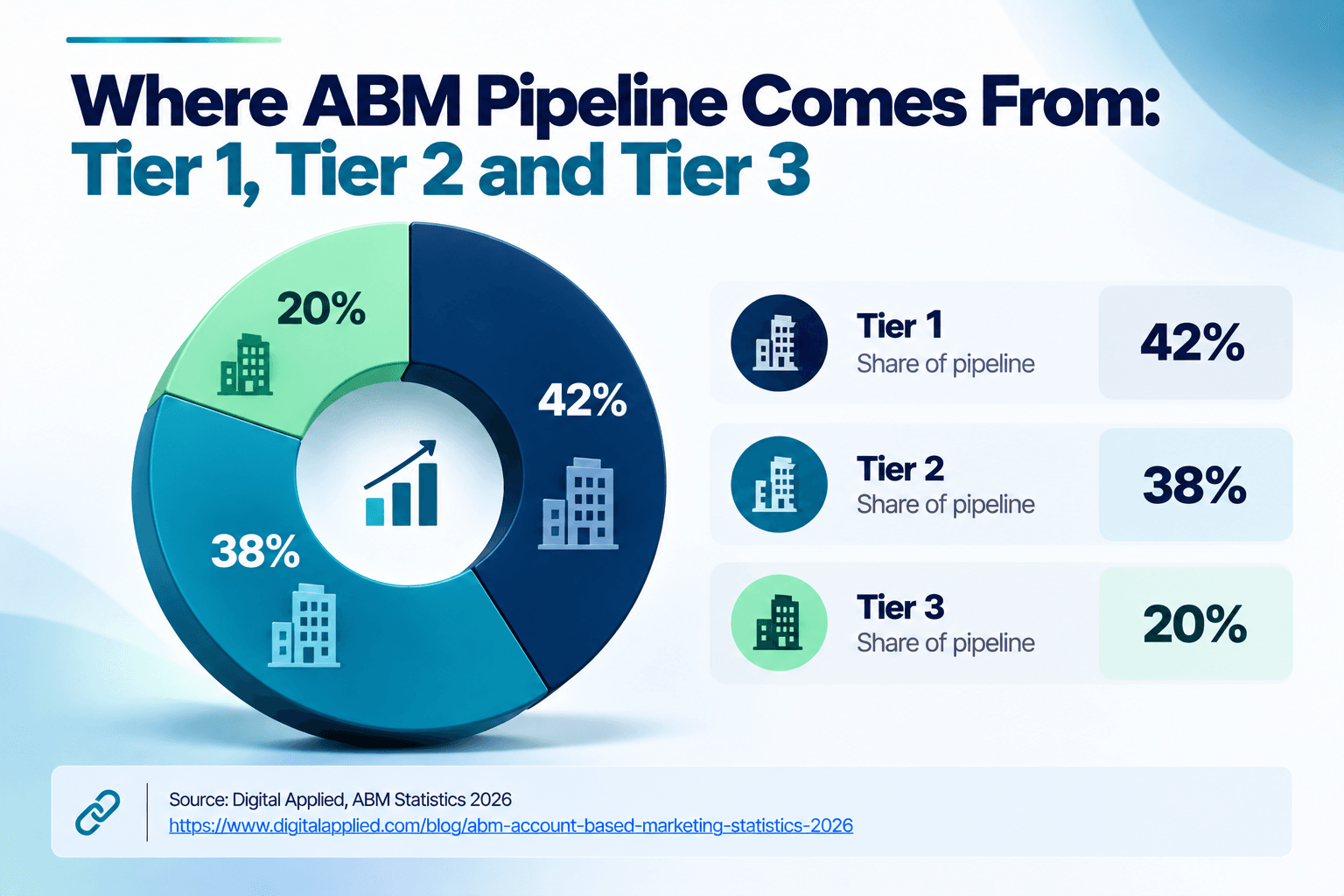
- Tier 1 (10-20 accounts): 40-50% of ABM budget. Per-account investment is highest. Custom content, executive engagement, events.
- Tier 2 (50-150 accounts): 30-40% of ABM budget. Per-account investment is medium. Segment content, multi-channel editorial, account-triggered outreach.
- Tier 3 (500-2,000 accounts): 15-20% of ABM budget. Per-account investment is low. Programmatic editorial, intent monitoring, escalation identification.
The per-account investment ratio across Tier 1 to Tier 3 is roughly 200:25:1 at the midpoints of these ranges. The ratio follows deal potential, not list position. Concentrated investment at the highest-value accounts is the stronger use of a fixed budget than spreading it evenly across the list.
The Sales Alignment Requirement
Tier assignment is the joint exercise most ABM programs skip.
Marketing builds tier lists based on firmographic criteria: company size, industry, technology stack. Sales builds priority lists based on relationship and opportunity assessment. The two lists overlap by 30-50%. The program runs at full intensity on accounts sales is not prioritizing. Sales ignores engagement signals from accounts they are not actively working.
67% of companies say their ABM program improved sales and marketing alignment (Demand Gen Report, 2023). The alignment comes from the tier assignment process, not from a reporting dashboard.
The fix: tier assignment as a joint exercise before program activation. Sales identifies accounts they have a realistic path to in the next 12 months. Marketing validates ICP fit and adds strategic accounts the criteria support. The merged list is tiered together, with explicit buy-in from both functions on each tier assignment. The tier list is reviewed together each quarter.
Without this joint exercise, the tier structure is a marketing artifact that sales does not recognize. With it, the tier list is the shared account strategy that both functions execute against.
What the Tier Structure Prevents
The tier structure prevents three program failures that flat-list ABM produces consistently:
- It prevents resource waste on accounts that do not warrant deep investment. Tier 3 accounts get efficient programmatic reach, not custom content that costs far more per account to produce.
- It prevents under-investment at the accounts that matter most. Tier 1 accounts get the full buying committee treatment, not the same email cadence as 299 accounts that would not justify it.
- It prevents the sales team from being unable to prioritize. When sales asks marketing which accounts need immediate attention, the tier structure and escalation criteria give a clear answer: accounts that have moved from Tier 3 to Tier 2 based on engagement signals, and Tier 2 accounts showing active evaluation signals.
The Sequencing Error Most Tiered Programs Make
Most ABM programs assign tiers based on company size and ICP fit without accounting for where each account is in its buying motion. Fit tells you which accounts are worth pursuing. Timing tells you which are worth pursuing now, and the escalation criteria exist to answer that second question.
FAQs
What are the three standard ABM tiers and how do they differ?
Tier 1 is one-to-one: the top 10-20 accounts receiving fully customized content, dedicated team attention, and direct executive engagement. Tier 2 is one-to-few: 50-150 accounts receiving segment-specific content and structured multi-channel outreach. Tier 3 is one-to-many: 500-2,000 accounts running programmatic ABM with personalized messaging but standard content formats.
Why does running the same ABM intensity across all accounts reduce pipeline productivity?
Same intensity across all accounts means medium intensity everywhere. Tier 1 accounts do not get the investment that builds account depth, and Tier 3 accounts receive more than their qualification warrants. Tier structure concentrates investment where it produces the highest return.
How should account tier assignment be reviewed and updated?
Tier assignments should be reviewed quarterly. Tier 3 accounts showing strong engagement signals or trigger events should be considered for promotion to Tier 2. Tier 1 accounts showing no committee engagement after two quarters should be reviewed for demotion. Sales validation should inform every tier change.