69% of software buyers chose a different vendor than they planned after AI chatbot guidance. Standard ABM channels do not build AI visibility. Independent editorial distribution does, and many ABM programs have not adjusted to AI-mediated research.
The AI Visibility Gap: Why ABM Programs Miss the Buying Committee Member Nobody Tracks
ABM
Oct 12, 2026

In This Article
- The Buying Committee Member Nobody Tracks
- How AI Tools Generate Vendor Shortlists
- Why Standard ABM Channels Do Not Close the Gap
- What AI Visibility Requires from Content
- Extending the Buying Committee Map
- How Editorial Distribution Addresses Both Gaps Simultaneously
- What an AI Visibility Strategy Looks like in Practice
- FAQs
The VP of Marketing was preparing a vendor shortlist for a new demand gen program evaluation.
She did not start with a Google search. She asked an AI tool: “What are the main providers of B2B content syndication and demand generation, and what differentiates them?”
The AI produced a structured response. Four vendors named, with brief positioning summaries. Two she had heard of. Two she had not, but they were described clearly and credibly.
Those four vendors became her shortlist for the buying committee meeting.
A fifth vendor had been running an ABM program at her account for eight months. It had reached her champion. It had built editorial presence in the marketing publications she subscribed to. It was not in the AI’s response. It was not on the shortlist.
Not because she had dismissed it. Because it had never appeared in the place she looked first.
The Buying Committee Member Nobody Tracks
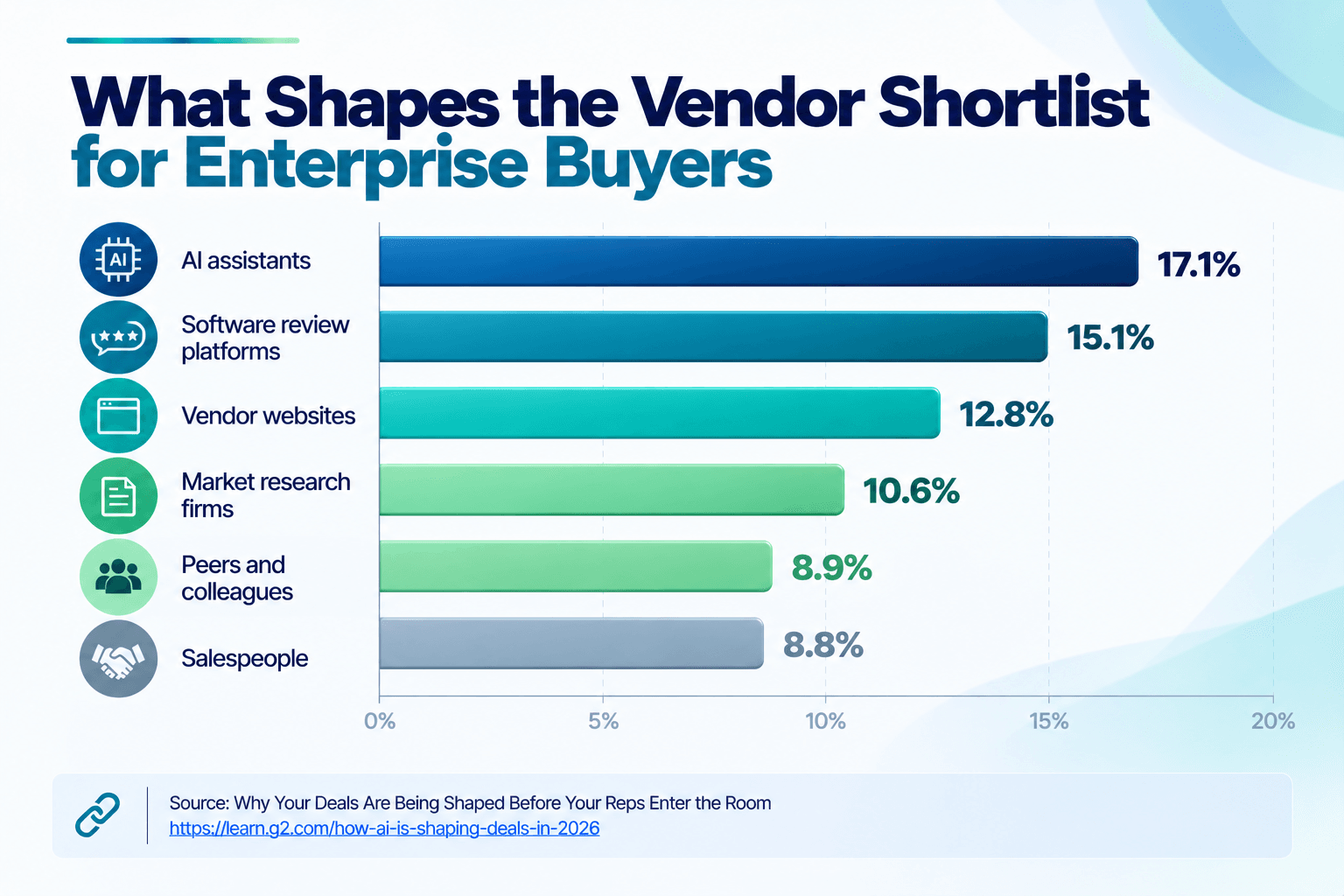
45% of B2B buyers now use AI tools as part of their purchase research, mainly to learn about vendors and products (Gartner, 2025). 94% of B2B buyers now use AI tools in their buying process, up from 89% a year earlier (Forrester, 2026).
The AI tool in that research process functions like an informal committee member. It generates the vendor shortlist before any human makes the first vendor call. It shapes the evaluation framework before the formal evaluation begins. It provides category orientation that determines which vendors get considered and which do not.
‘The AI Visibility Gap’ is the absence of a vendor from AI-generated category responses, producing shortlist exclusion before formal evaluation begins. The ABM program mapped the champion, the economic buyer, the technical evaluator, and the financial approver. It did not account for the AI research advisor that generated the shortlist they all started from.
69% of software buyers chose a different vendor than they planned after AI chatbot guidance (G2, 2026). The shift is not marginal. It determines which vendors are in the room and which are not, before any outreach lands.
Buying Committee Syndication is Machintel’s framework for reaching every decision-maker in a target account before the formal evaluation begins. See how it works.
How AI Tools Generate Vendor Shortlists
Buying committee members use AI tools in two research modes before formal vendor evaluation begins:
The first is category mapping: “What are the leading vendors in demand generation?” “What should I look for in a content syndication provider?” The AI generates a structured response that includes vendor names, positioning summaries, and evaluation criteria. This becomes the informal shortlist and the evaluation framework before any vendor outreach begins.
The second is vendor vetting: “What is [vendor] known for?” “How does [vendor A] compare to [vendor B]?” The AI synthesizes a response from everything it has indexed about the vendor. A vendor with consistent, broad editorial presence across independent publications generates a confident, credible summary. A vendor with thin content presence generates a sparse response that does not build confidence.
The roles most likely to use AI tools this way: technical evaluators building feature comparison frameworks, economic buyers generating category orientation before committing time to vendor conversations, and champions preparing internal evaluation presentations.
The roles that are not directly accessible via LinkedIn ads, cold outreach, or events are precisely the roles most likely to use AI research tools at the pre-evaluation stage.
Why Standard ABM Channels Do Not Close the Gap
LinkedIn advertising does not build AI visibility. AI tools generating vendor shortlists do not check which vendors have LinkedIn ad spend.
Direct outreach does not build AI visibility. AI tools do not incorporate sales emails into category knowledge.
Events do not build AI visibility. Conference attendance does not appear in AI-generated vendor summaries.
The editorial channel is the only standard ABM channel with a direct path to AI visibility. But only at sufficient breadth.
A single piece of content in one publication is not enough to establish consistent AI visibility. Presence across multiple independent editorial sources, addressing category-level questions with consistent positioning, builds the content corpus that AI tools draw from when generating category responses.
84% of links cited by AI tools come from earned sources, not vendor-owned content (Muck Rack, 2026). The weighting toward independent editorial sources means vendor blogs and owned channels are not the primary lever. The primary lever is independent editorial distribution at breadth.
The implication for program design is direct: if the only channels running at a target account are LinkedIn, direct outreach, and events, the AI research layer is completely unaddressed. The buying committee member generating the informal shortlist has no information about the vendor because none of the channels the program is running produce content the AI can index. The program reaches the humans in the room but not the tool they used to decide who was in the room in the first place.
Running a strong program at a target account for months, only to find you were never on the list the committee started with, is a hard thing to discover. Machintel’s demand generation team works with B2B marketers on that gap, placing category-level content in the independent publications AI tools draw from. Your brand then has a better chance of appearing when the committee first asks.
What AI Visibility Requires from Content
Four content characteristics determine AI visibility:
Breadth across independent sources: A vendor present in 10 independent publications carries more AI visibility weight than a vendor with 50 articles on its own blog. The AI tool’s weighting toward independent editorial sources rewards breadth across publications, not depth on owned channels.
Category-level content: AI tools synthesize category knowledge from content that addresses category questions. “What is buying committee syndication?” “How does B2B content syndication work?” “What should demand gen leaders look for in a content partner?” are category questions. Content that addresses them directly is more likely to appear in AI-generated category responses than product-level feature descriptions.
Consistent positioning across sources: When an AI tool encounters a vendor described in consistent terms across multiple independent sources, it generates a confident, coherent summary. Inconsistent positioning across sources creates an uncertain AI representation that does not build buyer confidence.
Question-answerable content structure: AI tools are optimized to answer specific questions. Content structured around answerable questions: problem-solution structures, direct category definitions, FAQ-format explanations. This content is indexed and retrieved more reliably than content organized around brand messaging.
Extending the Buying Committee Map
The standard buying committee map covers champion, economic buyer, technical evaluator, financial approver, and sales leadership.
The complete buying committee map now also covers AI research advisors. These are not people, but they function like one by influencing the shortlist before formal evaluation begins.
The map extension requires three questions:
- Which AI tools do buying committee members at target accounts commonly use?
- What questions are they likely to ask at the pre-evaluation stage?
- What content would need to exist for the vendor to appear credibly in the AI’s response?
Many ABM programs have not adjusted to AI-mediated research behavior (Forrester, 2025). The programs that have adjusted are producing AI visibility as a by-product of editorial distribution breadth and category-level content. The programs that have not are absent from a significant and growing part of the buying committee’s research process.
The gap between those two groups is not a technology gap. It is a content strategy gap. The programs producing AI visibility are not running separate AI optimization programs. They are distributing editorial content at breadth across independent sources with consistent category-level positioning. The AI visibility is a consequence of that approach, not a separate initiative. The programs missing from AI shortlists are, in most cases, running owned-channel content at depth: vendor blogs, ungated resources, and branded materials that AI tools weight below independent editorial sources when generating vendor recommendations.
How Editorial Distribution Addresses Both Gaps Simultaneously
The content that achieves AI visibility is the same content that provides value to economic buyers and technical evaluators reading for category knowledge: independent editorial, category-level insights, consistent positioning across multiple sources.
This is not a separate AI-specific program. It is an extension of the editorial channel objective.
Across 4,000+ campaigns annually at Machintel, the editorial distribution that reaches human buying committee members through the 33-publication network simultaneously builds AI visibility through independent editorial source breadth. Content distributed across multiple independent publications addressing category-level questions accumulates into the content base that AI tools draw from when generating vendor shortlists.
What an AI Visibility Strategy Looks Like in Practice
AI visibility requires editorial content distributed through third-party publications with established domain authority, not vendor-site blog posts. The content investment that builds AI citation presence is the same investment that builds pre-funnel editorial reach: ungated category content placed in publications AI systems index for vendor recommendations.
FAQs
Why do standard ABM channels fail to build AI visibility?
AI tools index publicly available editorial content from third-party publications when generating vendor recommendations. LinkedIn ads, gated content, and direct outreach are not indexed. A vendor running LinkedIn-only ABM has no presence in the AI research session that now precedes most enterprise vendor shortlisting.
What content format builds AI visibility most effectively for B2B vendors?
Ungated editorial content distributed through credible third-party industry publications builds AI citation presence. AI models draw from indexed editorial sources when synthesizing category recommendations. Vendor-site content and gated assets contribute zero to AI citation regardless of quality.
How do you measure AI shortlist inclusion in an ABM program?
Direct AI citation tracking is not yet standardized. Proxy measures include: share of voice in the editorial publications AI systems draw from, inbound inquiry rates from accounts that did not engage with any tracked channel, and qualitative feedback from discovery calls on how the vendor was found.