Intent data without an activation workflow is a dashboard that refreshes weekly and produces a cold call list Monday morning. The account was in active evaluation. The program delivered a spreadsheet. The evaluation ended before the SDR connected. A five-stage activation workflow closes the gap: signal qualification, content syndication, first-party engagement monitoring, SDR briefing with account context, and outcome tracking. Outreach follows within 48 to 72 hours with a content asset, not a product pitch.
B2B Intent Data Activation Workflow: From Signal to Pipeline in Five Stages
Demand
Oct 22, 2026

The intent vendor’s weekly refresh arrived Monday morning: 43 high-intent accounts, 12 of them T1.
An SDR got the spreadsheet at 9am. Started calling at 10am. By Friday: 12 accounts reached, three mild interests, zero meetings booked.
At account 12, the contact picked up, listened for 30 seconds, and said: “How did you get my number? I’ve been talking to your competitor for three weeks.”
The intent signal had been there. The account had been in evaluation for three weeks. The program delivered a spreadsheet and a cold call. The evaluation was already over.
Intent data without an activation workflow is a report. The gap between programs that produce pipeline and programs that produce dashboards is almost always operational, not data quality.
Why Signal Without Workflow Fails
Most intent programs are designed around data acquisition, not data activation. The vendor relationship is established. The dashboard is configured. The account list updates weekly.
What happens next is undefined.
The default answer in most programs: an SDR gets the spreadsheet Monday morning and calls the accounts. No activation layer between signal and outreach. No content delivery to generate first-party confirmation. No qualification threshold. No briefing package with behavioral evidence.
The result is cold outreach on accounts that may or may not be in active evaluation, without the first-party engagement confirmation that would time the call accurately, and without the context the SDR needs to make the conversation relevant.
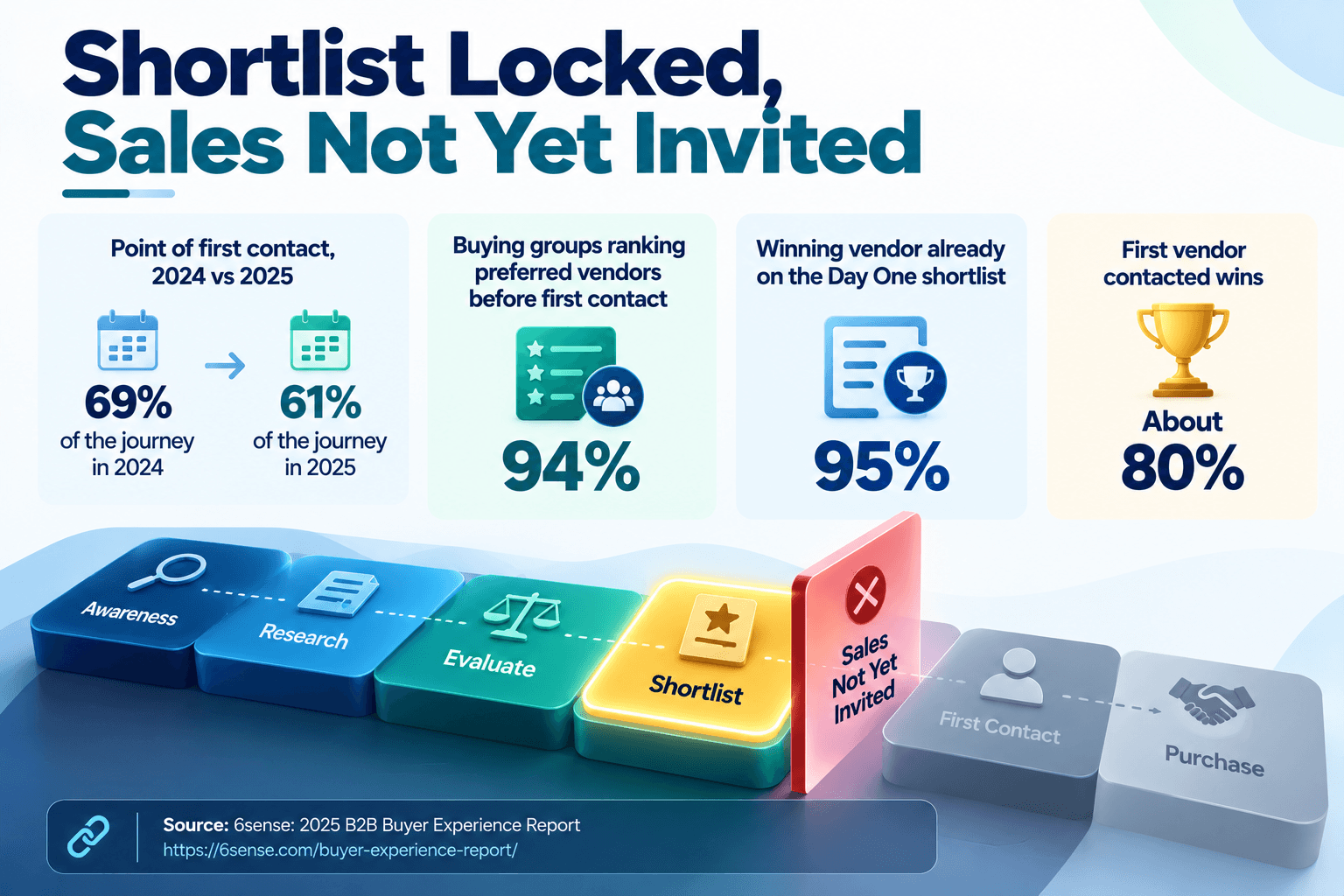
94% of buying groups rank their preferred vendors before first contact with sales (6sense, 2025). The account that has been evaluating for three weeks is not the same prospect as the account that started evaluating yesterday. A weekly list with no recency weighting treats both identically.
This is why programs with high-quality Behavioral Cluster Intent data still underperform on pipeline. The signal is there. The workflow to act on it is not.
Reaching an account only to hear it has been talking to a competitor for weeks is a hard moment for any SDR. Machintel’s demand generation services help B2B marketers act on signals sooner, with relevant content going out before a call is made. The first conversation then starts with something useful to talk about.
Stage 1: Signal Detection and Qualification
Every intent signal that enters the activation queue must pass through a suppression and qualification stack before any action is taken.
Suppression Filters (run in this order)
Active pipeline accounts: Accounts with open CRM deals should not receive intent-triggered activation. The account is in a managed relationship. Duplicate activation creates SDR confusion and potential relationship damage.
Recency suppression: Accounts contacted within the last 60 days do not re-enter the activation queue based on a new intent signal alone. A new signal within 60 days may reflect the same evaluation cycle, not a new one.
Compliance suppression: Contacts who have unsubscribed or opted out are suppressed regardless of intent signal. This is not optional.
Qualification Filters
Multi-contact threshold confirmation: The signal must meet the minimum threshold established in program design: typically two verified contacts in ICP-relevant roles within a 14-day window for mid-market targets. A single-contact signal does not pass to the activation queue regardless of score. (See The Account Aggregation Error for the structural reason this threshold matters.)
Recency scoring: Signals within the last 7 days carry activation priority. Signals aged 8-21 days carry secondary priority. Signals older than 21 days without recent activity are deprioritized unless a new behavioral cluster appears.
ICP tier assignment: T1 accounts (ICP score 80+), T2 (50-79), T3 (below 50). Tier determines the activation path in stages 2 and 3.
Output: A qualified, suppression-cleared account list segmented by tier and signal recency, with specific contacts identified per account.
Stage 3: First-party Engagement Monitoring
Content syndication activation generates a trackable behavioral record. Stage 3 is monitoring that record for the qualifying event that triggers SDR outreach.
Engagement Thresholds for SDR Trigger
- T1 accounts: One contact download or email response from a buying-committee-relevant role triggers SDR activation.
- T2 accounts: One contact download from a relevant role, with the account showing a repeat engagement pattern (two or more sessions), triggers activation.
- T3 accounts: Two contact downloads from relevant roles before SDR activation.
Timing SLA
The SDR outreach window opens within 48 hours of the qualifying engagement event for T1 accounts, 72 hours for T2 and T3 accounts.
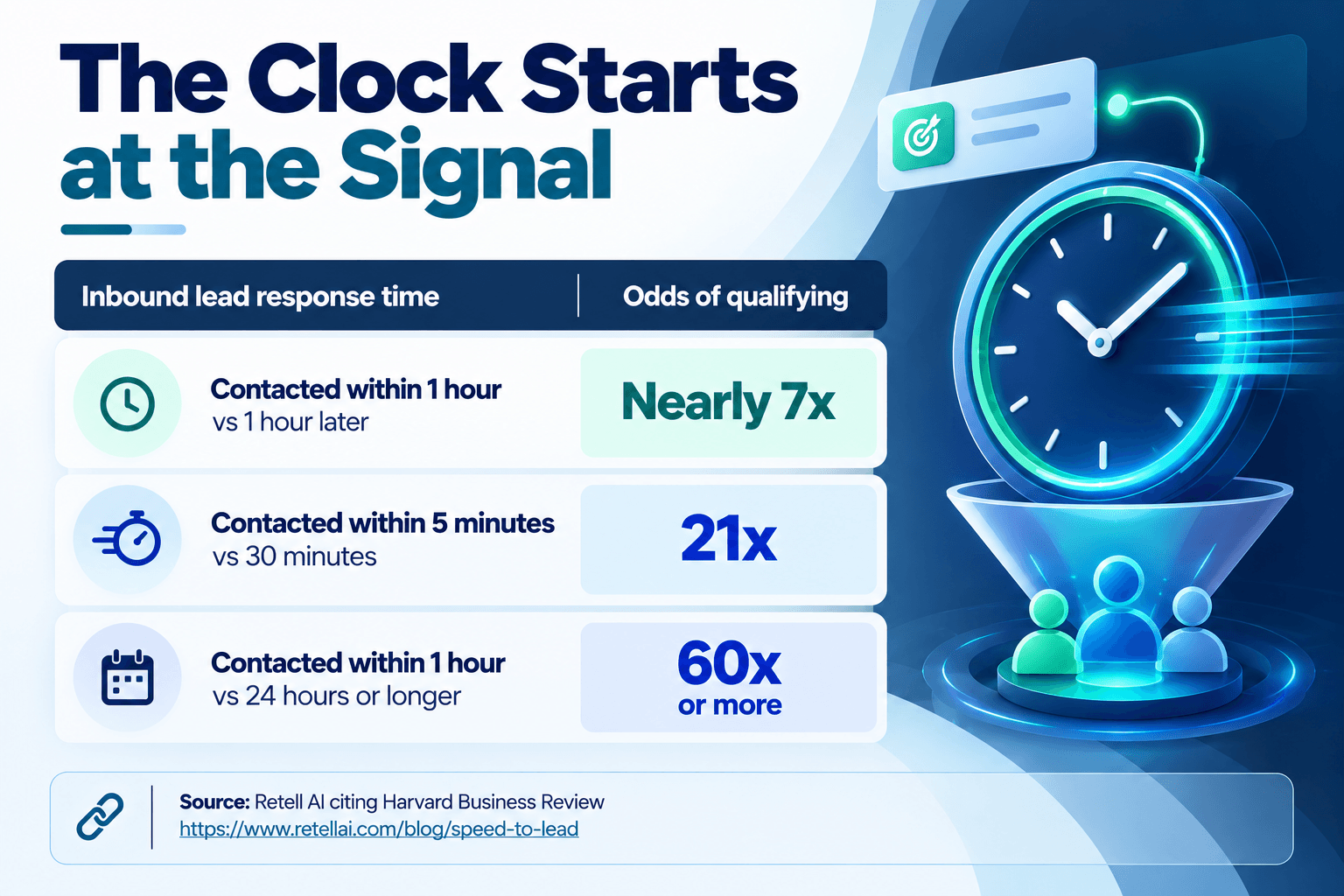
Accounts contacted within one hour of engaging are almost 6x more likely to book a meeting (Drift, 2021). This is not a best-practice recommendation. It is the measured outcome of the timing difference.
A weekly list refresh means the SDR reaches accounts an average of three to four days after engagement, and potentially up to seven days after. The 48 to 72 hour SLA is the outer limit, not the target. Meeting it requires daily monitoring of engagement data, not a Monday morning spreadsheet.
Stage 4: SDR Briefing Package
Once signal quality and timing are fixed, the most common failure in intent activation is handoff quality.
SDRs receive a list with no context about why an account is flagged, which contacts generated the signal, what those contacts have been researching, or how to open the conversation. The result is generic outreach that could apply to any company. The contact has no reason to engage because nothing about the outreach reflects what they have actually been doing.
The briefing package is the mechanism that converts a data signal into a usable conversation. Without it, the intent program carries all the cost of data acquisition and produces little of the pipeline conversion.
Briefing Package Components
- Account summary: Name, tier, ICP score, assigned owner.
- Third-party intent signal: Which contacts and roles showed research behavior, what topics, the time window, recency of the signal, and how the pattern compares to the account’s baseline.
- First-party engagement: The asset the contact downloaded or replied to, the contact’s role, and when it happened.
- Account context: CRM history, prior contacts, relationship notes, any existing account intelligence.
- Conversation entry point: Constructed from the first-party engagement. Specific, not generic.
Conversation Entry Point Construction
The outreach should not be a cold call. It should open with the content the contact engaged with and offer a related asset, not a product pitch. For example: “You downloaded our guide on buying committee mapping last week. Here is a short framework that picks up where it leaves off. Would a walkthrough be useful?”
This references verifiable behavior. It is not a claim about intent. The third-party signal shapes the SDR’s preparation. The first-party engagement shapes the opening line.
Stage 5: Outcome Tracking and Loop Closure
Every outreach outcome feeds back into the activation workflow.
- No response after three attempts (5-business-day SLA): Return account to nurture track.
- Meeting booked: Log the source asset and the engagement event against the opportunity.
- Conversation held, no meeting: Record the reason and set a follow-up trigger on the next engagement event.
- Account not in evaluation: Log it as a false positive so the signal source and threshold can be reviewed.
- Calibration loop: Outcome data informs the workflow parameters, including the multi-contact threshold, recency windows, and tier cutoffs.
Why the Spreadsheet Delivery Model Fails
The spreadsheet delivery model is the default for most intent programs. Weekly or bi-weekly, a list of high-intent accounts is exported from the intent platform and sent to the SDR team.
The model fails for three structural reasons:
Timing: A weekly spreadsheet delivery introduces a lag of up to seven days between signal and outreach. In B2B evaluation cycles, seven days is material. 94% of buying groups rank their preferred vendors before first contact with sales (6sense, 2025). If the delivery cycle consumes up to seven days, the program is already operating with a significant disadvantage.
Context: A spreadsheet list provides an account name and a score. It does not provide: what content the identified contacts consumed, which contacts generated the signal, what job titles are involved, or how the intent signal pattern compares to the account’s historical baseline. SDR outreach based on this context is blind. “I saw you’re interested in marketing automation” is the best it can produce. That opener does not convert.
Workflow integration: A spreadsheet requires a human to move data from the delivery format to the CRM, build a call list, assign the account, and initiate outreach. Each handoff introduces delay. For accounts in active evaluation, every day of delay is a day competitors are in conversation.
The alternative workflow is built around event-triggered automation. When ‘Behavioral Cluster Intent’ signals reach threshold, the account enters the suppression stack automatically. If it clears suppression, it moves to content syndication activation, which generates first-party confirmation. First-party confirmation triggers CRM update and SDR task assignment, with a pre-built briefing package, within 48 to 72 hours.
No spreadsheet. No manual handoff. No seven-day lag.
Machintel builds this workflow into program delivery. The signal identifies the account. The workflow is what determines if the program reaches it before the evaluation is over.
FAQs
What is the difference between topic taxonomy intent and behavioral cluster intent?
Topic taxonomy intent flags an account when company IPs visit pages tagged to a category. Behavioral cluster intent tracks multiple named contacts at the same account consuming related content across sessions within a time window. The first is a page view counter. The second is a buying signal.
How can a B2B marketer identify which type of intent data they are purchasing?
Ask the vendor three questions: what percentage of signals are contact-level versus IP-level, what is the multi-contact threshold required before an account is flagged, and what is the signal latency between behavioral activity and delivery. A vendor selling behavioral cluster intent can answer all three precisely.
Why do false positive rates matter in intent data programs?
False positives consume SDR capacity without producing meetings. With 40-60% false positive rates typical of third-party intent data, a team working 100 intent signals per week spends 40-60 hours on accounts that were never in evaluation (Abmatic). That is the direct cost. The indirect cost is the pipeline that was not built with those hours.