94% of B2B buyers now use AI in their buying process. Third-party intent data captures web-based behavioral signals but cannot see what happens inside ChatGPT, Perplexity, or Claude. The AI research phase precedes web-based evaluation for a growing share of buyers. By the time a behavioral cluster signal fires, the AI shortlist may already be formed. Programs that add content optimized for AI search citations extend their presence into the phase that precedes measurable signals.
AI Search Blind Spot in B2B Intent Data: The Evaluation Phase Most Providers Cannot Measure
Demand
Oct 26, 2026

The SDR had 34 high-intent accounts on her call list. T1 priority. All showing Behavioral Cluster Intent signals in the demand gen and marketing automation category. The signals were verified: multiple contacts, correct job titles, 14-day research window confirmed.
She called the first seven, two answered, and zero moved to identification. The accounts were real, the intent signals were accurate, and the buyers had been researching the category.
Most of that research had happened in ChatGPT.
The conversations had occurred. The shortlists had been built. By the time the third-party intent signals registered, the evaluation was at a different stage than the signals suggested. The AI research phase was invisible. What the intent system recorded was the web-based activity that followed it.
The signals were not wrong. They were incomplete.
What Intent Data Actually Measures
Every third-party intent data provider measures behavioral signals from the open web. Page views against monitored domains, content downloads from publisher networks, form completions, engagement with syndicated content. The infrastructure is built on web crawling, content network participation, and IP-to-company resolution.
This infrastructure is designed to capture one specific category of buyer behavior: research conducted through web-based channels. When a buyer visits a vendor website, reads a comparison article, or downloads a whitepaper, the action generates a signal. When a buying committee member researches a category through a search engine and lands on monitored content, the action generates a signal.
What it does not capture is research conducted in AI search environments. When a buyer asks Claude, ChatGPT, Gemini, or Perplexity which vendors solve a specific problem, no web event is generated. No page view. No IP address registering against a domain. No form completion. The research happened. It was detailed, specific, and evaluative. The intent infrastructure recorded nothing.
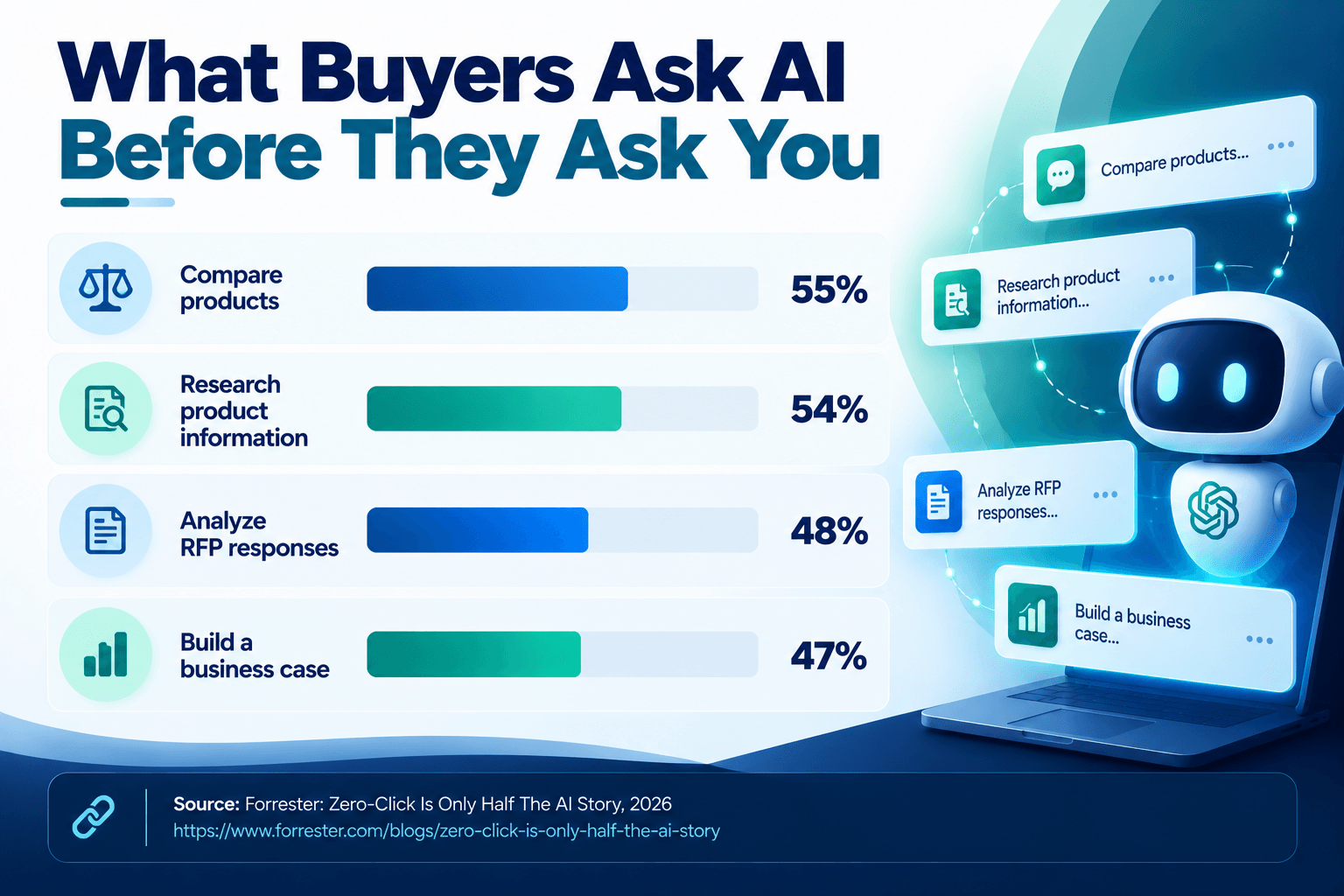
The Scale of the Shift
Forrester research shows that 94% of B2B buyers use AI during their buying process. About two-thirds of B2B buyers use GenAI as much as or more than search when researching vendors (Responsive, 2025).
These are not marginal adoption figures. They describe a buyer population that has added a research channel to its evaluation process, and that channel is invisible to most intent data programs simultaneously.
The intent data industry has not built measurement infrastructure for AI search behavior. The signals generated in AI conversations are closed to third-party collection by design. The AI systems do not publish query logs. The conversations are private. The API calls that generate AI responses do not create trackable web events against vendor domains. This is not a gap that will be closed with a product update. It requires a structurally different measurement approach that does not yet exist at scale.
Three Outcomes from AI Search
When a buyer uses AI search to research vendors, three outcomes are possible:
Outcome A: cited, visits. The AI response includes your brand. The buyer visits your website. A first-party signal is generated. This is the best case. The AI research is invisible, but the downstream outcome creates a detectable signal.
Outcome B: cited, no visit. The AI response includes your brand. The buyer does not visit your website in the evaluation window and moves to direct outreach or another channel. No first-party signal. No third-party signal. The evaluation happened without a trace.
Outcome C: not cited, excluded. The AI response does not include your brand. The buyer builds their initial shortlist without you and completes their evaluation criteria before visiting your website. No signal of any kind. You were evaluated and excluded.
94% of buying groups rank their preferred vendors before first contact with sales (6sense, 2025). For the share of buyers using AI search to build those shortlists, Outcome C is where the evaluation ends. Most intent data programs will not show such an account as in active evaluation, because little web-based research activity was generated before the shortlist was finalized.
What 'Low Intent Signal' Now Means
The conventional interpretation of a low or absent third-party intent signal is: this account is not in active evaluation. The AI search shift changes that interpretation.
A low or absent third-party intent signal now has two possible meanings. The account is not evaluating. Or the account is evaluating in AI search channels where no web signal is generated.
These two situations require different responses. An account that is genuinely inactive warrants monitoring but not activation. An account that is actively evaluating in AI search channels warrants immediate activation, because the shortlist formation window may already be closing.
Third-party intent data alone cannot distinguish between them. The absence of a signal is not evidence of the absence of evaluation. Responsive research shows nearly two-thirds of buyers use GenAI as much as or more than search, so the signal-free period is a critical evaluation phase.
Not knowing whether a quiet account is simply inactive or already researching in AI tools leaves any demand gen team guessing where to spend its time. Machintel’s demand generation team works with B2B marketers on that blind spot, building presence in the places buyers ask before any web signal appears. That helps your brand show up in the research even when no signal is there to show it.
The First-party Indicator
When AI search generates downstream traffic to your website, the first-party signal is the only indicator that AI research occurred. Analyzing first-party traffic patterns can reveal probable AI search activity.
Direct traffic without a referring domain: AI search often produces direct traffic or referrals without specific keyword attribution. An ICP account arriving as direct traffic with no prior signal history warrants investigation.
High-specificity page visits with no prior engagement: A first-time visitor from a named account going directly to a specific use case page, a pricing page, or a competitor comparison page suggests prior AI-assisted research. Buyers who have already done AI research arrive at conversion pages directly rather than browsing awareness content.
Short visit cycles on high-intent pages: Buyers arriving post-AI-research know what they are looking for. They visit fewer pages in less time and focus on decision-relevant content.
These are imperfect indicators. They do not confirm AI search activity. They flag accounts where AI search activity is probable, allowing the sales team to treat the account as further along in evaluation than the third-party intent data suggests.
AEO as Intent Program Design
Answer Engine Optimization is the practice of structuring content to appear in AI search responses. From a demand gen perspective, AEO is not a content marketing exercise. It is an intent data strategy.
If AI search is where many buyers research vendors, then presence in AI responses is the functional equivalent of visibility in the web-based content channels that third-party vendors monitor. The difference is how that presence is built: through content and positioning strategy rather than purchased as a data subscription.
A buyer who asks an AI assistant “which content syndication vendors should I evaluate for a mid-market B2B SaaS program” and receives a response that includes Machintel has encountered the brand in an evaluative context. That encounter has intent data characteristics: specific, evaluative, occurring during an active research session. It generates no third-party signal. It is real buyer attention in the research phase.
The content factors that tend to support AI citation are: specificity and depth on use cases and positioning, third-party citations in analyst and editorial content, structured data and schema that supports AI extraction, and recency for AI systems with retrieval capability. These are buildable from within. The AI search presence that precedes web-based evaluation can be developed through structured content investment.
What This Means for Program Design
Third-party intent data programs that treat web-based signals as complete coverage of buyer research behavior have a structural blind spot. The blind spot grows as AI search adoption increases.
This does not make third-party intent data less valuable for the signals it does capture. Web-based research activity still generates signals. The accounts showing behavioral cluster signals are still likely to be in active evaluation. The activation workflow for those signals is still worth running precisely.
What changes is the interpretation of the absence of signals, and the design of demand gen programs to account for the research phase that precedes web-based evaluation.
A program designed for the current buyer environment has three components working simultaneously. Third-party behavioral cluster intent monitoring for the web-visible evaluation phase, with multi-contact threshold and ICP pre-filtering. AEO content investment to build AI search presence in the category queries buyers use before web research begins. First-party signal analysis to detect downstream indicators of AI search activity from ICP accounts.
The programs that run only the first component are optimized for an earlier buyer journey. That web-based research still happens. It is now layered with an AI-first research phase that those programs may not see.
The Honest Limitation
There is no established intent signal for AI search today. There will not be one through the existing infrastructure model. The signals do not exist in a form accessible to third-party collection.
The honest position for intent data programs is that they measure behavioral signals from the web-visible research phase and do not measure AI-assisted research. For buyers who use GenAI as much as or more than search, those signals capture a later phase of a process that began without them.
That limitation does not invalidate the signal. It defines its scope. Programs that understand the scope design around it: by building AI search presence before the third-party signal appears, by using first-party patterns to detect probable AI research activity, and by treating low signal accounts with ICP fit as warranting investigation rather than deactivation.
The SDR’s 34-account call list was not wrong. The accounts were evaluating. The evaluation had begun where no intent system was watching. The answer is not to distrust the signal. It is to build presence in the research channel the signal cannot see.
FAQs
What is the difference between topic taxonomy intent and behavioral cluster intent?
Topic taxonomy intent flags an account when company IPs visit pages tagged to a category. Behavioral cluster intent tracks multiple named contacts at the same account consuming related content across sessions within a time window. The first is a page view counter. The second is a buying signal.
How can a B2B marketer identify which type of intent data they are purchasing?
Ask the vendor three questions: what percentage of signals are contact-level versus IP-level, what is the multi-contact threshold required before an account is flagged, and what is the signal latency between behavioral activity and delivery. A vendor selling behavioral cluster intent can answer all three precisely.
Why do false positive rates matter in intent data programs?
False positives consume SDR capacity without producing meetings. At the 40-60% false positive rates typical of third-party intent data, a team working 100 intent signals per week spends 40-60 hours on accounts that were never in evaluation (Abmatic). That is the direct cost. The indirect cost is the pipeline that was not built with those hours.
Sources
- Forrester: The State Of Business Buying: Risk-Averse Buyers Demand Proof, Not Promises, 2026
- Responsive: Inside the Buyer’s Mind: What Shapes B2B Decisions Today, 2025
- Business Wire citing 6sense 2025 B2B Buyer Experience Report, 2025
- Abmatic: Intent Data vs First-Party Signals, Which Should Drive Your ABM Strategy, 2026