Your CRM gives the deal to the last touch and ignores everything before it. That leaves you with the ‘Attribution Credibility Gap,’ and I don’t think a new report can close it. A model that everyone agrees on before programs run can. Below, I’ll walk you through the ‘Four-Stage Pipeline Attribution Model’. It builds attribution that finance accepts, not attribution that only your own team finds plausible.
B2B Marketing Attribution Pipeline: Close the Credibility Gap
Demand
Nov 22, 2026

Here is a situation I think many marketing leaders will recognize.
The CFO asks a specific question: which marketing programs contributed to the deals that closed last quarter?
You have an answer. It is not the one the CFO is looking for.
The CRM shows last-touch attribution on most of the deals. You know that does not represent what actually happened. The account that closed in Q3 had 12 marketing touches across nine months: a content syndication contact in Q4 of the prior year, three nurture emails over six months, a retargeting sequence in Q2, and a webinar in Q3. The CRM attributes the deal to the final webinar. The syndication program that created the first contact is invisible.
You know marketing contributed more than the attribution model shows. Finance does not believe the number you present without evidence. The budget review becomes a negotiation instead of a planning conversation.
This is the ‘Attribution Credibility Gap’.
Why the Attribution Problem Persists
I think the ‘Attribution Credibility Gap’ exists for a structural reason, not a technology reason. Many B2B marketing stacks can track multi-touch, account-level attribution with existing tools. It is not in place because it needs an agreement between marketing, sales, and finance on the attribution model before programs run. That conversation almost never happens at the right time.
Look at what happens when attribution is discussed after deals close. Every team favors the model that shows its own contribution. Marketing credits content programs and nurture sequences. Sales credits SDR outreach and the account executive relationship. Finance trusts neither model, because both look self-serving. Marketing then falls back on last-touch, because it is the only model the CRM produces by default. Everyone in the room knows it is wrong.
My view is simple: have the architecture conversation before programs launch. The model is then agreed and neutral before anyone knows which programs they will want to credit. The data is collected in the right format from the start. At budget review, the evidence comes from a model all parties signed off on before the data existed.
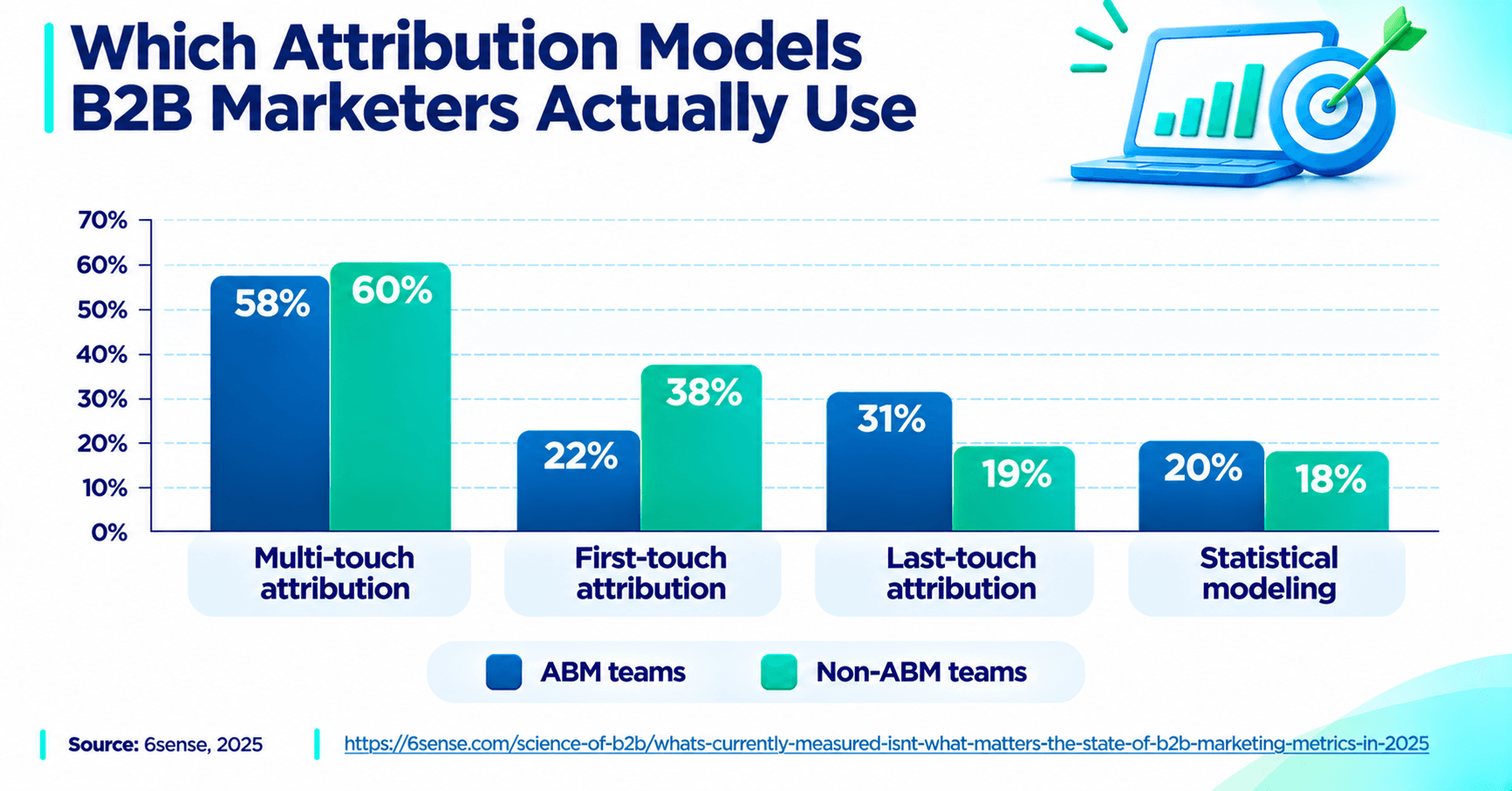
Why Last-touch Fails B2B
Last-touch attribution was designed for short, simple purchase cycles. A buyer sees an ad, clicks, buys. The click is the purchase driver. The ad gets the credit.
B2B deal cycles are structurally different. A typical complex B2B deal involves six to 10 decision-makers (Gartner). It takes 6-12 months from first marketing touch to close (Dreamdata, 2024). Marketing’s contribution is spread across that timeline. A content syndication program that creates the first contact at a named account works on a different timeline from the accelerator event that contact attends in the month before close.
Last-touch attribution credits the deal to the final touch. Everything before it is invisible. In a nine-month deal cycle with 12 marketing touches, last-touch attribution misrepresents 11 of those touches entirely.
This distorts budget decisions in a predictable way. Programs that build early account awareness and create the first contact at named accounts get cut, because they do not show up in attribution reports. Programs that run just before close get disproportionate credit and budget, whatever their actual influence. Over time, investment concentrates in the wrong programs. The measurement model rewards the wrong inputs.
Presenting a number you know understates your team’s contribution, with no way to prove it, is an uncomfortable position for any marketing leader. Our demand generation services help B2B marketers set up programs so each account’s touches are recorded from the first one. The evidence is then there when finance asks.
Why Retrofitting Attribution after the Fact Does Not Work
When attribution is challenged, the usual instinct is to pull the data and build a better model after the fact. Download the deal list, map the CRM touches to each opportunity, apply multi-touch weighting, and present the result as evidence.
I don’t think this works. It produces contested data, not credible data, for two reasons.
First, the data does not exist at the account level if programs were never designed to track at the account level. Touches logged against individual contacts cannot be rolled up to the account without heavy manual reconstruction. What you get is partial data. It overstates the contribution of programs with better tracking and understates the rest.
Second, and more important, a multi-touch model presented after deals close comes from the team that benefits from it. Finance and sales have no reason to accept a model they did not agree to. They have every reason to question one built after the fact to show marketing’s contribution favorably.
Attribution credibility requires that all parties agree to the model before the data exists. That is what makes the evidence hold up under finance review.
Planning your next program? Talk to our demand generation team about setting up account-level tracking before launch.
The Four-stage Pipeline Attribution Model
At Machintel, attribution architecture is a mandatory step before any program starts. It is part of our ‘Pipeline-First Program Design’. The ‘Four-Stage Pipeline Attribution Model’ is the framework we use across 4,000+ campaigns annually. It builds attribution that finance accepts instead of disputes.
Stage 1: Account-level Program Mapping
I want every marketing touch logged at the account level, not the contact level. Each account record should show which program delivered the touch, which content was consumed, the date and engagement type, and whether the touch was part of a nurture sequence or a one-off program.
Everything else depends on this. Without it, stages two through four cannot produce credible evidence, because the touchpoint record is incomplete or cannot be verified.
Setting this up is a configuration decision in your marketing stack, and it has to be made before programs launch. Many B2B MAP and CRM combinations can support it with existing tools. The only choice is when: configure it before programs run, or try to rebuild it after deals close.
Stage 2: Buying Window Definition
I don’t think every touch in an account’s history should count toward pipeline. A content download from three years before the deal closed is not relevant. The buying window is the agreed time period in which touches count as pipeline-contributing.
For most B2B technology buyers, the relevant buying window opens months before opportunity creation. This is consistent with the research showing that buyers spend roughly eight months researching before first seller contact (6sense, 2025).
Agree the buying window with sales and finance before programs launch.
Stage 3: Multi-touch Weighting
Weighting decides how much credit each touch earns toward the deal. Common models are first-touch, last-touch, linear, time-decay, and position-based. Each answers a different question, so choose deliberately.
For long B2B cycles, I think the model has to credit three things: the first-touch program that created the account contact, the nurture touches that kept the account engaged, and the late-stage touch that accelerated the deal. A single-touch model credits only one of them.
Marketing, sales, and finance should set the weighting together before programs launch and apply it the same way to every deal. Once it is agreed, no team gets to adjust the weights after seeing which programs they want to credit.
Stage 4: Stage-gated Contribution Reporting
Report contribution at the stage gates of the pipeline, not as a single number at close. At each gate, such as opportunity creation, stage progression, and closed-won, the report shows which accounts moved forward, which programs touched them, and the credit each program earned under the agreed model.
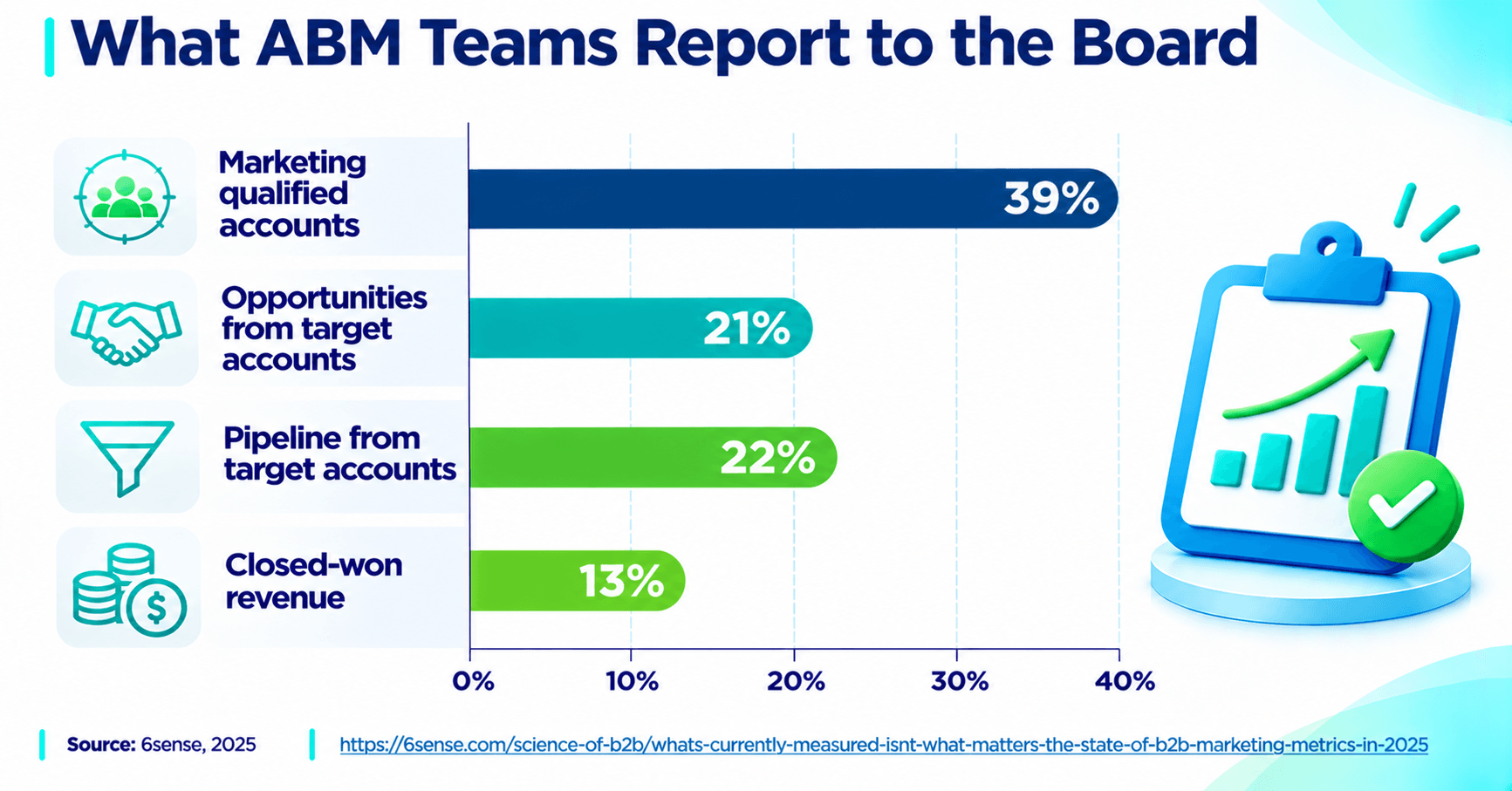
Now go back to the CFO’s question about last quarter’s closed deals. The answer is a report: each closed deal, the programs that touched the account, and the weighted credit each earned. Finance can discuss that format directly.
What We See Across 4,000+ Campaigns Annually
Teams that can defend their numbers to finance and teams that cannot often run similar programs. The difference is not the programs. It is whether the attribution model was agreed before the first program launched.
Across 4,000+ campaigns annually at Machintel, I see the same pattern. When account-level tracking, the buying window, and the weighting model are set in the program brief, the budget review starts from a report. When they are not, it starts from an argument about whose numbers to believe.
Our Digital Demand Creation and Capture (D2C2) framework integrates demand creation with demand capture. The first-touch program that reaches an account before it is in market and the late-stage program that captures it are recorded against the same account from the start. That shared record lets finance see both contributions, not only the last one.
Closing the Attribution Credibility Gap
The ‘Attribution Credibility Gap’ closes when the attribution model is agreed before programs run, not built after deals close. The ‘Four-Stage Pipeline Attribution Model’ covers the four decisions to agree first: account-level tracking architecture, buying window definition, multi-touch weighting, and stage-gated reporting format.
The CFO conversation that works is the one where all parties have already signed off on the attribution model. The evidence at budget review comes from that model. You are not defending yourself against a model finance never approved.
Marketing’s pipeline contribution is real. Building the attribution architecture to show it is the work.
Start your next program with an attribution model finance has already approved. Contact us today.
FAQs
What is the difference between last-touch and multi-touch attribution in B2B?
Last-touch attribution credits the final marketing interaction before a deal closes. Multi-touch attribution spreads credit across the marketing interactions within an agreed buying window. That matches how B2B deals run: 6-12 months from first marketing touch to close (Dreamdata, 2024).
Why does B2B pipeline attribution require pre-program agreement?
When a model is built after deals close, every team reads the data in its own favor. If you agree on the attribution model, buying window, and weighting before programs run, finance accepts the evidence instead of contesting it. Nobody knew which programs they would want to credit when the model was agreed.
How long should the buying window be for B2B marketing attribution?
I would suggest starting from this: for most B2B technology buyers, the relevant buying window opens months before opportunity creation. Buyers spend roughly eight months researching before first seller contact (6sense, 2025). Agree the specific window with sales and finance and apply it the same way to every deal.