Many B2B syndication programs renew without independent verification. The ‘Audit Gap’ is why programs producing below-benchmark results continue for years: CPL is the only metric vendor reporting includes, and it omits the measures that reveal actual program quality. The ‘Five-Dimension Syndication Audit’ covers contact quality, engagement integrity, audience sourcing, conversion performance, and contract and SLA compliance.
How to Audit Your B2B Content Syndication Vendor: A Five-dimension Framework
Content
Nov 12, 2026

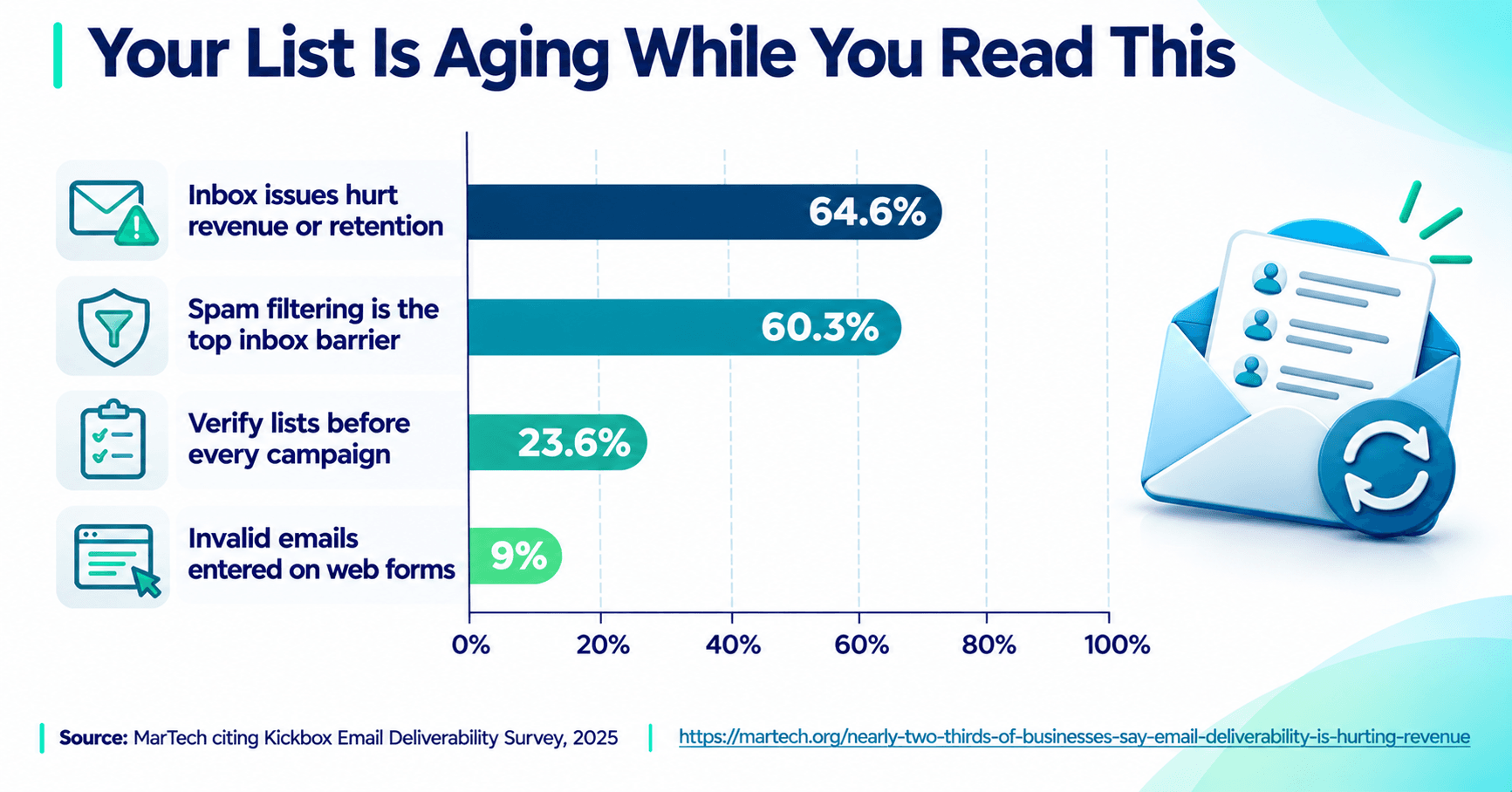
Many B2B content syndication programs are never audited against an independent quality standard. The cost per lead (CPL) is tracked. The lead count is tracked. The actual email deliverability, engagement freshness, contact accuracy, and conversion contribution are rarely if ever independently measured.
The ‘Audit Gap’ is the space between what vendor reporting covers and what independent verification would reveal. It exists for predictable reasons: marketers do not always know what to measure, vendor reporting is accepted at face value, the CPL metric does not surface quality problems, and there is implicit risk in auditing a vendor the team depends on. The result is programs that renew based on feel rather than facts, and quality problems that compound over multiple campaign cycles without being identified.
This framework covers five audit dimensions, four execution phases, and specific benchmarks for each metric. It is designed to be run client-side, with vendor involvement limited to data requests until the findings conversation.
Why CPL Is an Incomplete Quality Metric
Cost per lead is a program efficiency metric. It measures how much the program spent to generate each contact. It does not measure what those contacts are worth.
A program delivering contacts at $40 CPL with 15% email deliverability failure, 25% CRM duplicate rate, and 0.8% SDR engagement rate is a significantly underperforming program at any price. A program delivering contacts at $80 CPL with 96% deliverability, 4% CRM match, and 4.5% SDR engagement rate is producing measurable pipeline contribution. The CPL does not distinguish between these two outcomes.
The quality metrics that CPL cannot capture are: contact accuracy (does the email reach an active professional at the stated company?), engagement integrity (is the engagement record a reliable representation of what the contact did?), audience sourcing (where did the contact come from and how recently were they verified?), and conversion performance (what happened to these contacts in the CRM after delivery?).
Each of these dimensions requires a different measurement approach and has a different set of benchmarks.
Hearing from sales that a syndication program is not working, with only CPL to confirm or challenge it, makes the next budget conversation hard. Machintel’s demand generation services help B2B marketers run campaigns where CRM and SDR results are reviewed alongside the program from the start. The discussion then moves from opinion to evidence.
The Five Audit Dimensions
Dimension 1: Contact Quality
Contact quality covers three sub-metrics. Email deliverability is the percentage of delivered contacts whose email addresses accept delivery without bounce. Acceptable threshold: above 90%. Red flag range: 85-90%. Disqualifying: below 85%. A program delivering contacts with deliverability below 85% is sourcing from lists that have not been recently verified.
Job title accuracy is verified by cross-referencing delivered contacts against LinkedIn. The stated title should match the current LinkedIn profile. A mismatch rate above 15% indicates that the contact data was collected at a previous role and has not been updated. Company verification is the confirmation that the stated company is the contact’s current employer. Mismatch rates above 10% are a red flag for stale data sourcing.
Dimension 2: Engagement Integrity
Engagement integrity audits the reliability of the engagement record accompanying each contact as a representation of what the contact actually did.
Three indicators identify integrity problems:
Timestamp clustering is a reliable indicator of fabricated or low-quality engagement. Organic engagement produces distributed timestamps across the campaign window. Engagement records that cluster within narrow time windows, particularly at round-hour intervals, indicate programmatic click behavior rather than genuine content consumption.
Engagement specificity refers to the verifiable behavioral detail present in the engagement record: session duration, scroll depth, specific content sections accessed. Vendor reports that provide only a download confirmation without behavioral detail are not verifiable. Engagement records that include session duration below 30 seconds for long-form content indicate the content was not read.
Deduplication verification confirms that the same contact has not been submitted across multiple campaigns or time periods. Cross-referencing the delivered list against the CRM and against prior campaign deliveries from the same vendor should produce a match rate below 10%. Match rates above 20% indicate the vendor is drawing from the same pool across campaigns.
Dimension 3: Audience Sourcing
Audience sourcing covers where the contacts came from and what data rights the vendor has to deliver them. Three questions produce the sourcing picture:
Publisher disclosure: Is the vendor able to name the specific publishers or content properties where the contacts engaged? Vendors who cannot provide publisher-level sourcing may be aggregating from co-registration networks or buying contact data from secondary sources. This matters for data privacy compliance and for understanding the quality context of the engagement.
First-party versus third-party data: Did the contact engage directly with vendor-owned content, or was their data purchased from another source? First-party engagement is more reliable and generally compliant with consent frameworks. Third-party sourced contacts carry greater data quality and compliance risk.
Suppression capability: Can the vendor suppress delivery against your existing CRM, current customers, and named competitor accounts? Programs without suppression capability deliver contacts you already have or cannot convert, wasting budget and creating compliance risk.
Dimension 4: Conversion Performance
Conversion performance is the CRM-side audit: what happened to the delivered contacts after they entered the marketing pipeline?
CRM match rate is the percentage of delivered contacts who already exist in the CRM. Acceptable: below 10%. Red flag: 10-20%. Disqualifying: above 20%. High CRM match rates indicate the vendor is not suppressing against your existing database, which means the program is delivering contacts you already know.
Bounce rate in the CRM (email bounce after delivery to the marketing automation platform, or MAP) provides an independent check on the vendor’s deliverability claims. If the vendor reports 95% deliverability but the MAP shows 20% bounce rate on the delivered list, the deliverability claim is not accurate.
SDR engagement rate is the percentage of delivered contacts who respond to or engage with SDR follow-up. Acceptable: 3-5%. Red flag: 1-3%. Disqualifying: below 1%. Low SDR engagement rates indicate that the contacts are not in an active research context and are not receptive to the follow-up conversation the program was designed to produce.
Pipeline contribution rate is the percentage of delivered contacts who progress to an opportunity in the CRM within 90 days of delivery. This metric requires a 90-day tracking window after the campaign closes, and the benchmark is the rate of your other demand generation sources over the same period. Programs with zero pipeline contribution within 90 days are not producing contacts with genuine commercial intent.
Dimension 5: Contract and SLA Compliance
Contract compliance covers what the vendor agreed to deliver and what they actually delivered. Three areas require verification:
Replacement policy: The contract should specify what happens when contacts do not meet quality standards. The replacement policy should cover bounce rate thresholds, job title inaccuracy, and company mismatch. Verify that replacements were provided on the timeline specified and that the replacement contacts met the same quality criteria as the original delivery.
Reporting completeness: The contract should specify what reporting the vendor provides and at what frequency. Verify that all contracted reports were delivered and that the data in the reports is internally consistent. Inconsistencies between summary metrics and contact-level data are a red flag.
Delivery against specifications: The contract should define the contracted volume, the targeting criteria such as job title, company size, and geography, and the delivery timelines. Verify that the contacts delivered matched these criteria and that volume and timing met the agreed terms.
The Four-phase Audit Execution
Phase 1: Data Collection (Week 1)
Pull from your own systems: Vendor contract and SLA, including replacement and reporting records. CRM export of all contacts delivered by the vendor in the past 12 months, with current status (active, bounced, converted, dead). MAP export of bounce rates and engagement metrics for the same contact set. SDR activity log showing contact and response rates by campaign.
Request from the vendor: Publisher-level sourcing data for each campaign, engagement timestamps with behavioral detail, suppression confirmation logs showing what lists were used, and the original data sourcing attestation.
Phase 2: Independent Validation (Weeks 2-3)
Run the contact list through an independent email verification tool. Cross-reference job titles against LinkedIn for a sample of 10-15% of the delivered list. Check timestamp distributions for clustering patterns. Calculate CRM match rate, bounce rate, and SDR engagement rate from your own data, without relying on vendor reporting. Check replacement and reporting records against the contract terms.
Phase 3: Conversion Analysis (Week 4)
Pull the 90-day CRM window for all contacts from the audit period. Calculate pipeline contribution rate and opportunity creation rate by campaign. Compare these rates against other demand generation sources in the same period. A syndication program that produces a pipeline contribution rate significantly below other sources is underperforming relative to its budget allocation.
Phase 4: Vendor Conversation
Present findings factually, by metric, with benchmarks. The vendor response to audit findings is itself informative. Vendors who engage with findings, explain discrepancies, and provide corrective measures are different from vendors who dispute the methodology or attribute poor metrics to factors outside the program. The response quality is a signal about the vendor relationship going forward.
What Audit Results Reveal by Program Type
Publisher-based syndication programs typically produce distributed timestamps, deliverability above 92%, CRM match rates below 10%, and SDR engagement rates of 3-5%. Database CPL programs produce clustered timestamps, deliverability of 80-90%, CRM match rates of 15-35%, and SDR engagement rates of 0.5-2%. Co-registration networks produce the weakest results across all five dimensions.
The ‘Audit Gap’ closes when the ‘Five-Dimension Syndication Audit’ measurement framework exists and is applied consistently. Programs that are audited against objective benchmarks produce factual data for the vendor conversation, the renewal decision, and the internal case for adjusting budget allocation. Programs that are never audited continue at whatever quality level the vendor maintains, visible only when the pipeline gap becomes large enough to force a review.
The audit is most useful when run before a program renewal rather than during performance review. By the time a program reaches performance review, the budget has been committed, the delivery has occurred, and the recycled contacts are already in the SDR queue. The audit at renewal stage identifies whether the next program should use the same vendor and structure or requires renegotiation.
The five dimensions inform that renegotiation specifically.
Teams can use Behavioral Cluster Intent to qualify accounts before delivery, reducing the probability of low SDR engagement by targeting accounts already in an active research phase.
Want to run the audit on your current syndication program? Talk to our team or explore our demand generation services.
FAQs
What is a B2B content syndication vendor audit?
It is an independent check of the contacts a vendor delivered, measured against benchmarks that vendor reporting does not cover. It reviews contact quality, engagement integrity, audience sourcing, conversion performance, and contract and SLA compliance, using data from your CRM, marketing automation platform, and SDR activity log.
Why is CPL not enough to judge a syndication vendor?
CPL measures what the program spent per contact, not what each contact is worth. A $40 CPL program with poor deliverability, a high CRM duplicate rate, and low SDR engagement can underperform an $80 CPL program with strong results on all three.
When should a team audit its syndication vendor?
Before a program renewal, while the findings can still shape the next contract. The audit runs in four phases: data collection, independent validation, and conversion analysis take about four weeks, followed by the vendor conversation.