Most B2B lead scoring models combine engagement signals, intent signals, and buying stage signals into a single threshold. The ‘Signal Routing Gap’ is what happens when these three signal types are summed rather than routed separately: intent signals that should trigger account prioritization instead raise a contact’s score, the contact eventually crosses an MQL threshold weeks later, and the follow-up arrives long after the research window closed.
Intent Data Vs Engagement Data: Why Conflating Them Breaks B2B Lead Routing
Content
Nov 8, 2026

Marketing generates the MQLs. Sales rejects them. Marketing questions sales follow-up. Sales questions the qualification criteria. The conversation loops, and the pipeline gap stays open.
This pattern is common enough to be a B2B cliche. It is also misdiagnosed. The problem is not that marketing generates bad leads or that sales applies wrong criteria. The problem is the ‘Signal Routing Gap’: three fundamentally different signal types being treated as one input in a lead scoring model, producing routing decisions that do not reflect actual buyer readiness.
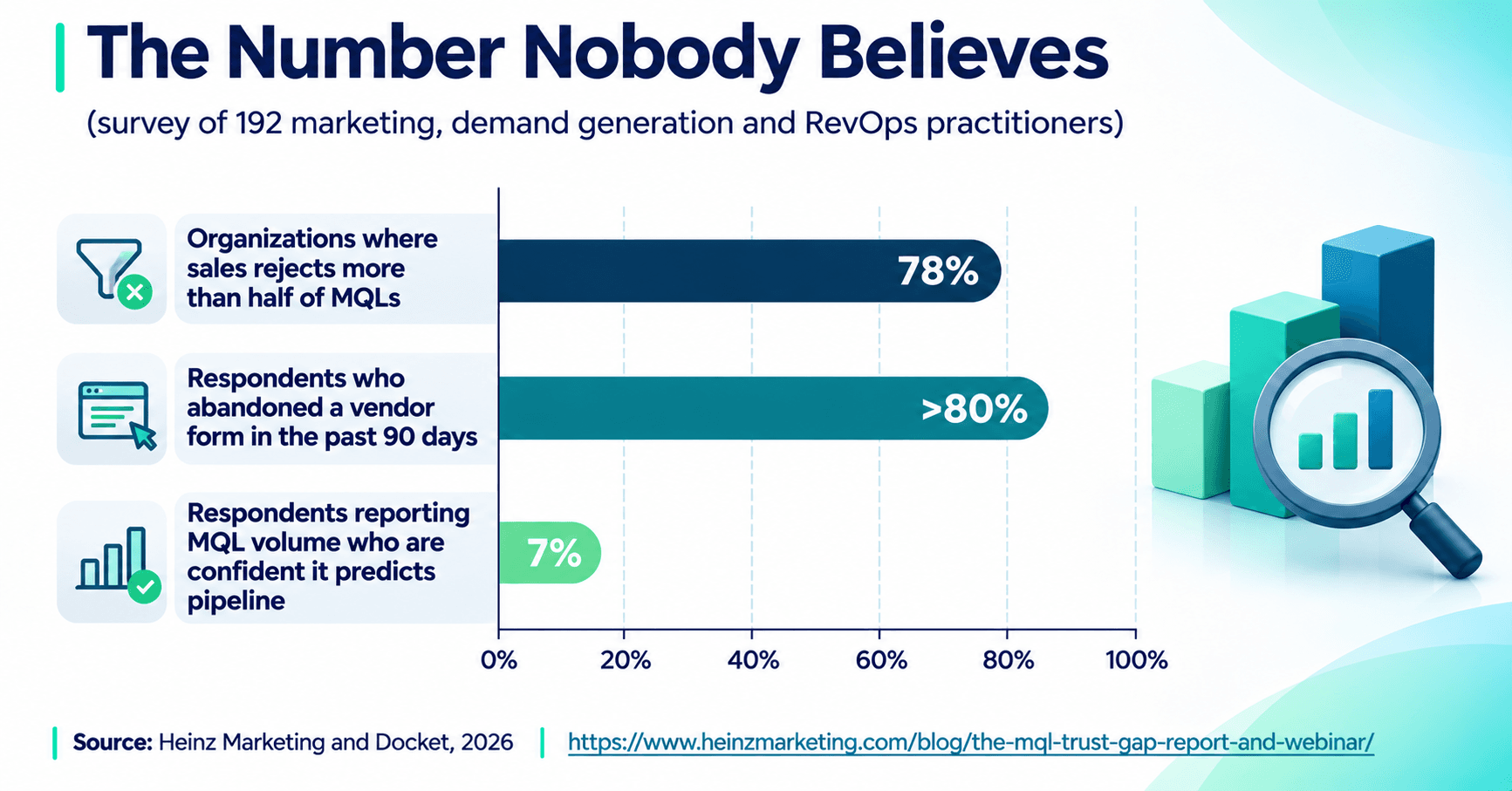
Sales rejects more than half of the MQLs marketing sends at 78% of organizations (Heinz Marketing and Docket, 2026). Both teams are right from their position. In many cases, the lead scored high and the buyer was not evaluating. The scoring model added up signals that mean different things, and routed the contact to sales based on a combined score that did not accurately represent purchase readiness.
The Three Signal Types and What They Actually Measure
Understanding the ‘Signal Routing Gap’ requires defining each signal type precisely:
Engagement signals measure behavioral activity: What a contact has done. Content downloads, email opens, webinar attendance, page visits, asset views. Engagement signals are contact-level and behavioral. A contact who downloads three whitepapers on demand generation attribution is demonstrating topic interest. They are educating themselves. They may or may not be in an active purchase evaluation.
Engagement signals are necessary for demand generation programs but not sufficient for intent determination. High engagement tells you a contact is interested in a topic. It does not tell you if they are evaluating vendors, have budget allocated, or have an active initiative underway.
Intent signals measure probabilistic research activity: What an account might be researching based on inferred behavior. Third-party keyword tracking, account-level content surge data, review site visits, competitor searches. Intent signals are predominantly account-level, not contact-level. A company showing a surge in demand generation keyword searches may have one analyst writing an internal research report. The intent signal is real. The active buyer may not exist.
Intent signals are also frequently commoditized, since the same intent data is sold to multiple vendors simultaneously.
Buying stage signals measure active evaluation confirmation: What a contact has explicitly communicated about their purchase process. Demo requests, pricing inquiries, direct sales contact, qualifying form responses that state a timeline or initiative. Buying stage signals require no scoring model inference. The contact has self-qualified. The routing decision is immediate.
Why Scoring Models Fail When These Signals Are Combined
Most B2B lead scoring models assign point values to engagement behaviors and add an intent data layer. A contact who opens three emails (15 points), downloads two assets (20 points), and appears on an account showing intent surge (30 points) reaches a 65-point MQL threshold and routes to sales.
The problem: each of those signals means something different, and their combination does not produce a signal that accurately represents purchase readiness.
The email opens and content downloads tell you the contact is in the topic area. The intent surge at the account level may reflect one employee’s research behavior, not an active buying committee. A combined score crossing a threshold does not confirm that this specific contact is ready for a sales conversation.
The scoring model is doing arithmetic on signals with incompatible meanings. The result is an MQL that looks qualified from the scoring dashboard and unqualified to the SDR who calls them.
Four structural failures compound this:
Arbitrary thresholds: The MQL threshold (the score at which a contact routes to sales) is typically set based on historical conversion data or negotiated between marketing and sales. It is not derived from a validated relationship between score value and purchase readiness. A contact at 65 points is not meaningfully different from one at 60 points if the threshold is 65.
Slow decay rates: Engagement signals age but do not disappear from scoring models at the rate at which they lose commercial relevance. A content download from four months ago is still contributing points to a current score. The contact may no longer be in an active research phase.
Account-level intent applied to individual contacts: Intent surge data is account-level. The individual contact routed to sales may not be the person driving the research activity that produced the intent signal. The contact receiving the SDR call has no context for why they are being called.
Commoditized intent data: When the same intent signal is sold to many vendors, the accounts showing intent are contacted by multiple SDR teams acting on identical information. The contact’s experience is not a single relevant outreach. It is a surge of vendor calls that can produce opt-outs rather than conversations.
Seeing a lead score climb, only for sales to reject the lead after one call, is a frustrating loop for marketing and sales alike. Machintel’s demand generation team works with B2B marketers to separate what each signal means, so interest, account research, and stated readiness each lead to the right next step. Sales then calls with a clear reason to start the conversation.
What Correct Signal Routing Looks LikeWhat Correct Signal Routing Looks Like
Each signal type warrants a different routing response:
Engagement signals route to nurture: A contact who downloads content on a relevant topic is most likely a research-stage buyer. The correct response is topic-matched content delivered over 30-60 days, not an SDR call. The nurture sequence continues the conversation the engagement started. It does not jump to a sales offer.
Intent signals route to account prioritization, not individual outreach: When an account shows intent surge, the correct response is to flag the account for sales awareness and begin or accelerate a content-based account nurture sequence. The intent signal is a reason to prioritize the account. It is not a trigger for individual SDR outreach to a specific contact on the account unless that contact has also demonstrated engagement.
Machintel’s Behavioral Cluster Intent framework helps teams prioritize accounts where several buying committee members are researching a relevant category, so nurture is focused on those accounts instead of every engaged contact.
The combination of account-level intent and contact-level engagement is a meaningful signal: A contact at an account showing intent surge who has also recently engaged with relevant content is a reasonable trigger for a sales alert, not an automatic MQL. Either signal alone is insufficient for outreach.
Buying stage signals route to immediate sales handoff: A demo request, pricing inquiry, or direct sales contact requires no scoring. The contact has communicated their readiness explicitly. Routing delays, nurture sequences, or MQL scoring applied to buying stage signals are friction in the pipeline. These contacts should reach sales within hours, not days.
The Buyer-confirmed Signal That Reduces Inference
The highest-fidelity buying stage signal is the one the buyer produces directly: a statement of their initiative, timeline, and context.
Content syndication programs that include qualifying fields in the gated content form produce this signal. A contact who downloads a piece of content and answers qualifying questions (“What initiative is driving this research?”, “What is your timeline?”, “What is your current approach?”) has provided a direct signal that needs little inference and no scoring model interpretation.
The contact has told the program what they are working on and what they need. The follow-up can be calibrated to their stated context from the first interaction, not after a nurture sequence produces enough behavioral signals to infer their stage.
This is the model Machintel’s syndication programs are built on: content that reaches buying committee members at ICP accounts, with qualifying fields that capture what each buyer says about their initiative. The ‘Signal Routing Gap’ narrows when the program is designed to elicit direct signals rather than infer them from accumulated behavioral data.
The Routing Framework in Practice
Before the next MQL threshold is set or the next lead scoring model is calibrated, three questions produce the right framework:
What signal type is each scoring input? Classify every scoring behavior as engagement, intent, or buying stage before assigning it a point value. Signals of different types should not be summed without considering what the combination actually represents.
What routing decision follows from each signal type? Engagement routes to nurture. Intent routes to account prioritization. Buying stage routes to immediate sales handoff. If the scoring model is combining these into a single threshold, the routing logic is collapsing distinctions that matter.
Is the intent data contact-level or account-level? Account-level intent applied to individual contacts produces outreach the contact has no context for.
The practical implication of the signal routing framework is that marketing automation needs to support three distinct routing paths, not a single MQL threshold. Most MAP configurations use a threshold-based model: when a contact’s cumulative score crosses a number, the contact becomes an MQL and routes to SDR. That model fits a simpler setup where contacts come from one source and engage through one channel.
Modern B2B buyer behavior produces all three signal types simultaneously. An account generates third-party intent signals while an individual contact downloads a piece of content and a qualifying field response arrives from a webinar registration. The scoring model that adds these signals together produces a number, but that number cannot show which signal should drive which action.
The ‘Signal Routing Gap’ is not primarily a technology problem. It is a definitional problem. Defining each signal type correctly, routing each appropriately, and designing programs that produce direct buyer-confirmed signals where possible produces demand generation programs that convert rather than programs that simply score. The scoring model has no opinion about what signals it sums. That decision belongs to the team that builds the model. Getting the signal definitions right before setting the scoring thresholds is precisely where the pipeline gap either opens or closes.
Want to see what correct signal routing looks like in a live program? Talk to our team or explore our demand generation services.
FAQs
What is the Signal Routing Gap?
The ‘Signal Routing Gap’ is what happens when engagement, intent, and buying stage signals are summed into one score instead of routed separately. Intent signals that should prioritize an account raise a contact’s score instead, the contact crosses the MQL threshold weeks later, and follow-up arrives after the research window has closed.
Why does combining intent and engagement signals in one lead score increase MQL rejection?
The two signals mean different things, so adding their points together produces a number that does not reflect purchase readiness. A contact can cross the MQL threshold on email opens, downloads, and an account-level intent surge while the buyer is still only researching, and sales rejects the lead.
How should B2B teams route engagement, intent, and buying stage signals?
Engagement signals route to nurture, intent signals route to account prioritization, and buying stage signals such as demo requests or pricing inquiries route to immediate sales handoff. A contact with both account-level intent and recent relevant content engagement is a reasonable trigger for a sales alert.
How can Machintel help fix lead routing?
Machintel works with B2B marketers to classify each signal, set routing rules for nurture, account prioritization, and sales handoff, and design syndication programs with qualifying fields where buyers state their own initiative and timeline.