87% of B2B marketers say ABM outperforms other marketing investments. Yet most ABM programs plateau or get abandoned before maturity, with only 15% well established. The failure is not strategic. It is three specific execution errors: the account list was built on firmographics without intent signals, the program runs on a single channel, and there is no buying committee map. Any one of these is sufficient to produce activity without pipeline. Most failing programs have at least two. The fix is sequencing: start with the account list, layer in channels, and finish with the committee map.
Why ABM Programs Fail: Three Execution Errors That Kill Pipeline Before It Starts
ABM
Sep 30, 2026

In This Article
- The Program That Worked and Did Not Work
- Failure Mode 1: The Account List Was Built on Firmographics
- Failure Mode 2: Single-channel Activation in a Multi-channel Buying Process
- Failure Mode 3: No Buying Committee Map
- Why the Gap Between Aspiration and Execution Persists
- What Getting All Three Right Looks Like
- FAQs
The Program That Worked and Did Not Work
The VP of Marketing had been running the ABM program for eighteen months. The dashboard showed what success was supposed to look like: high-value accounts engaging with content, click-through rates above benchmark, sales-qualified leads up 30% versus the prior year. The executive team approved the budget renewal.
Then the CMO asked how many of those 200 target accounts were in pipeline.
The answer was four.
The ABM program had worked by every metric the team tracked. It had not worked by the metric that mattered.
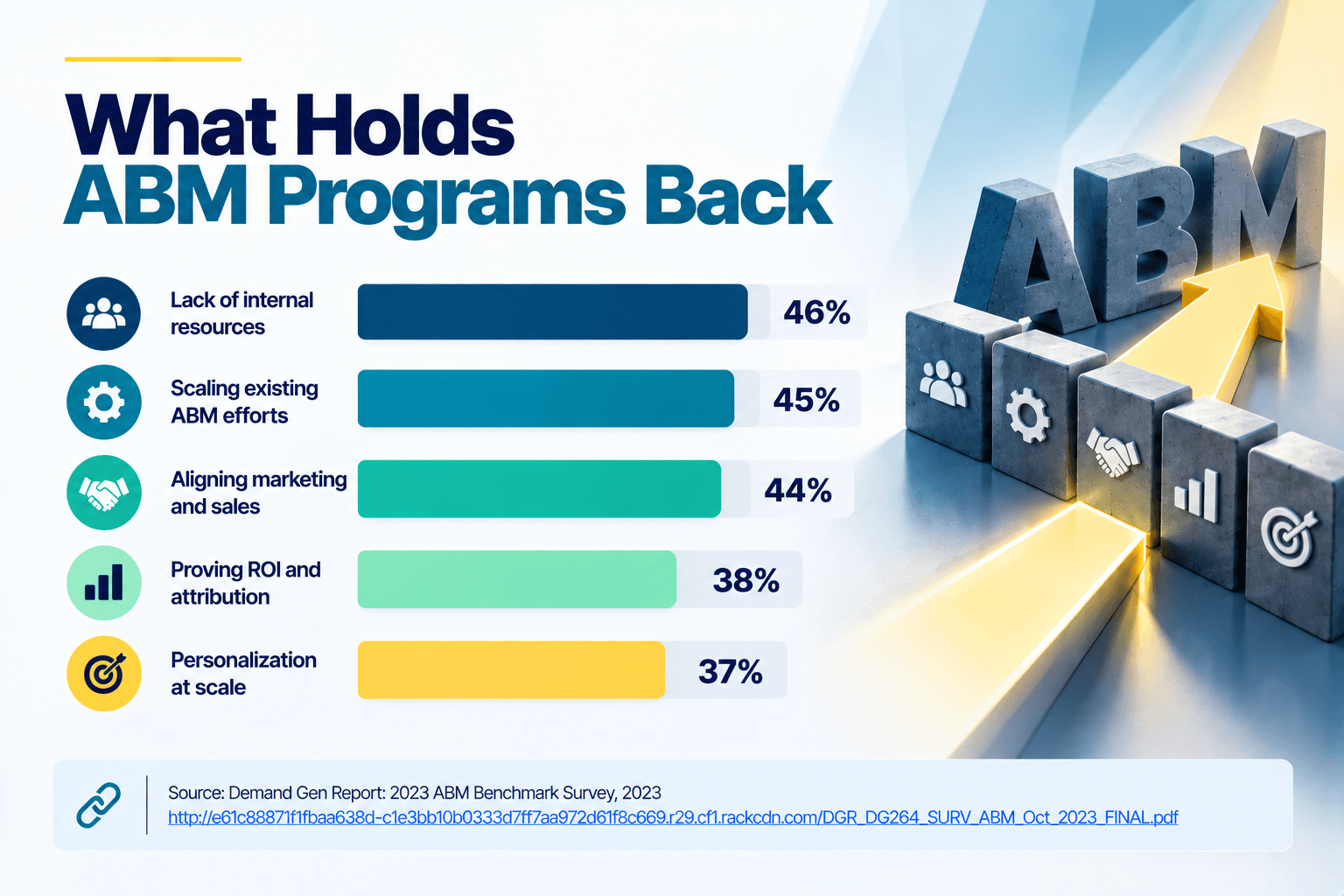
This situation is not unusual. 87% of B2B marketers say ABM outperforms other marketing investments (ITSMA). And only 15% of ABM programs are well established, as most plateau or get abandoned before maturity (ForgeX, 2025). Both statistics are true at the same time because ABM as a strategy is sound and ABM as it is typically executed is broken.
‘The ABM Execution Gap’ is the structural problem where ABM programs are approved at the strategy level and then simplified at execution in ways that systematically remove the inputs that produce pipeline. The failure is not random. It is predictable. The same three errors appear consistently in programs that generate engagement data without producing revenue.
Buying Committee Syndication is Machintel’s framework for reaching every decision-maker in a target account before the formal evaluation begins. See how it works.
Failure Mode 1: The Account List Was Built on Firmographics
Many ABM account lists are built from a firmographic filter, such as B2B technology companies with 200 to 2,000 employees, North American headquarters, and revenue between $20M and $500M. Every company matching those parameters enters the list.
The problem with this approach is that it produces a profile segment, not a target set. A profile segment describes which companies look like buyers. It says nothing about which of those companies are currently in market, have a purchase trigger active, are researching the category, or are on the sales team’s genuine near-term priority list.
Only 57% of ABM teams use behavioral or intent signals to build their account lists (Demand Gen Report, 2021). The programs running against fit-only lists produce engagement at companies that fit the profile. Those companies may or may not be buying. When evaluation closes and the team looks back at the accounts that converted to pipeline, they find that the engaged-but-not-buying accounts were in passive research mode throughout.
A qualified ABM account list layers three distinct inputs:
- First - ICP firmographic fit: This is the necessary starting filter. Accounts that do not match the ICP are out. But passing the ICP filter is not sufficient on its own.
- Second - Intent signal data: Behavioral signals showing the account is actively researching the category: consuming relevant content, visiting competitor sites, showing increased search activity around category keywords. This narrows the ICP-fit universe to accounts currently in motion.
- Third - Sales qualification: Accounts the sales team has identified as genuine near-term opportunities based on direct knowledge, relationship context, or pipeline timing. This layer adds sales judgment to the signal data, capturing high-priority accounts that may not yet show behavioral signals but represent known opportunities.
Failure Mode 2: Single-channel Activation in a Multi-channel Buying Process
Most ABM programs start with LinkedIn and stop there. LinkedIn is one channel in a B2B buying committee’s research environment. It is where the Demand Gen Manager spends professional development time. It is not where the CFO evaluates vendor financial stability, where procurement reviews compliance documentation, or where the technical evaluator compares implementation complexity across shortlisted vendors.
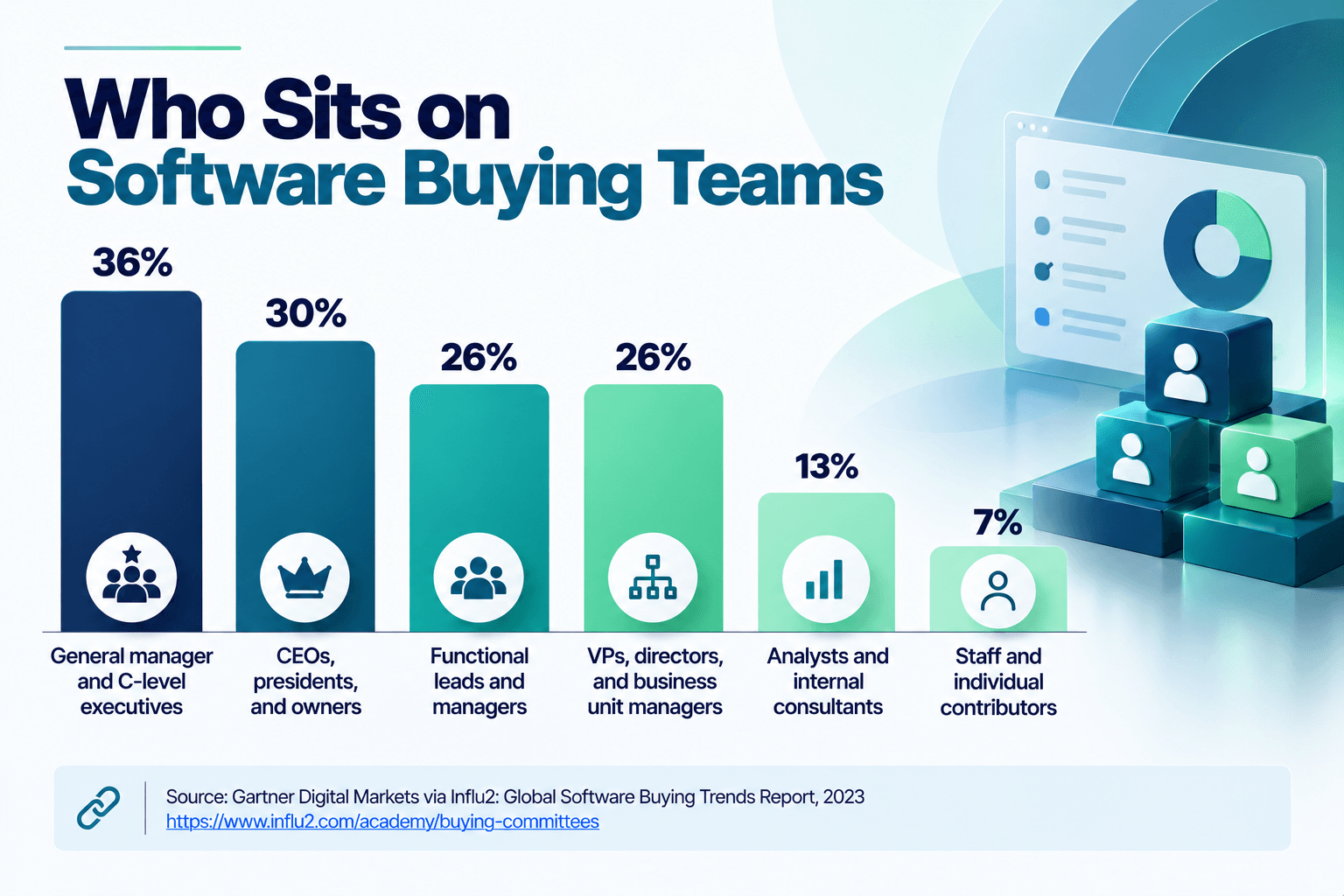
A typical B2B buying group includes 13 to 17 stakeholders (Demandbase, 2026). Each uses different channels for different parts of their research. The champion is active on LinkedIn and reads category editorial content. The economic buyer reads analyst reports and industry publications. The financial approver evaluates vendor credibility through peer referrals and financial media. The technical evaluator assesses options through practitioner communities and technical publications. Procurement reviews vendor-sent materials for compliance.
Single-channel ABM produces single-context engagement data. It confirms that the champion, or whoever manages the LinkedIn feed, saw the content. It says nothing about the economic buyer, the financial approver, or the technical evaluator. When sales opens a conversation, they are entering cold with every stakeholder except the one person the LinkedIn campaign reached.
Failure Mode 3: No Buying Committee Map
ABM without a buying committee map is targeted lead generation. If the program reaches one person per account, it reaches the one contact whose engagement can be tracked through the channels the program is running. The other decision stakeholders remain invisible.
Many ABM teams have no documented buying committee map for their top target accounts. They are activating campaigns against accounts without knowing who at each account makes the decision, what role each person plays, or what content is relevant to each stakeholder’s specific concern in the evaluation.
A buying committee map for a B2B tech purchase typically identifies six primary roles:
- Champion, who will use the product and initiates the evaluation
- Economic buyer, who controls the budget and signs the decision
- Financial approver, who validates the commercial terms
- Technical evaluator, who assesses implementation fit
- Procurement buyer, who reviews vendor materials for compliance
- Sales leadership, whose pipeline is affected by the tool’s performance
Each role has a different concern. Each needs different content. Each is reachable through different channels.
Programs that map to this committee and activate content accordingly produce account-level engagement data: which roles engaged, in which channels, with which content. Programs that do not map the committee produce contact-level engagement data from whoever clicked, with no visibility into how much decision influence that contact actually holds.
Why the Gap Between Aspiration and Execution Persists
Building a proper ABM account list requires intent data infrastructure most marketing teams do not have in place. Running multi-channel ABM requires coordinating budget and content across LinkedIn, content syndication, editorial distribution, and direct outreach, which is harder to attribute than a single-channel program. Building a buying committee map requires either active sales collaboration or enrichment data, both of which take organizational alignment to establish.
Most ABM programs are approved at the strategy level and then simplified at execution to what is manageable with available resources and current team structure. The intent data access that would improve account list quality is a separate procurement conversation. The multi-channel budget requires coordinating across multiple vendors. The buying committee map requires getting sales to agree on who the decision stakeholders are at each account.
Each simplification feels reasonable in isolation. Collectively, they convert an ABM program into a targeted lead gen campaign with an ABM label and ABM-level budget expectations. The engagement metrics look right. The pipeline does not materialize. The program gets restructured or cancelled.
What Getting All Three Right Looks Like
Programs that produce pipeline from ABM show three consistent characteristics. The account list layers ICP fit, intent signals, and sales qualification. The channel mix activates across the channels the different buying committee roles use for research. The committee map aligns content to stakeholder concerns by role, not just by account.
At Machintel, the Buying Committee Syndication approach addresses all three inputs. Account selection layers firmographic ICP fit against 550M+ verified contacts and intent signal data before any account enters the activation queue. Content syndication through 33 owned editorial publications reaches the buying committee in research mode, across the channels where different roles are conducting research, not just in one LinkedIn feed. Buying Committee Syndication activates content across multiple stakeholders per account, producing account-level engagement data across roles rather than single-contact click data.
Across 4,000+ campaigns annually, the programs that produce pipeline are the ones that get all three inputs right. The programs that produce engagement without pipeline are the ones that simplified at least one. The sequence is what determines the outcome.
FAQs
What are the three most common ABM execution errors?
The three errors are: an account list built on firmographic filters without intent signals, single-channel activation that reaches only the champion, and no buying committee map.
Why do ABM programs with good engagement dashboards still fail to produce pipeline?
Engagement at the contact level, clicks, email opens, form fills, does not indicate account-level buying intent. Pipeline requires multi-contact engagement at specific accounts over time, not single-contact activity at scale.
How long should a well-structured ABM program run before evaluating pipeline results?
B2B enterprise ABM programs typically produce early signals at 3-6 months and closed-won revenue at 12-18 months (Geisheker Group, 2026). Programs evaluated against pipeline in the first 90 days are measuring before the buying cycle has time to complete.
Sources
- Hinge Marketing citing ITSMA: Why A B2B Account-Based Marketing (ABM) Strategy Must Be A Priority
- ForgeX: 5 ABM Maturity Milestones Every GTM Team Should Be Driving Toward, 2025
- NetLine citing Demand Gen Report 2021 ABM Benchmark Survey
- Demandbase: The state of ABM in 2026
- Geisheker: The Ultimate ABM Marketing System for B2B Companies in 2026