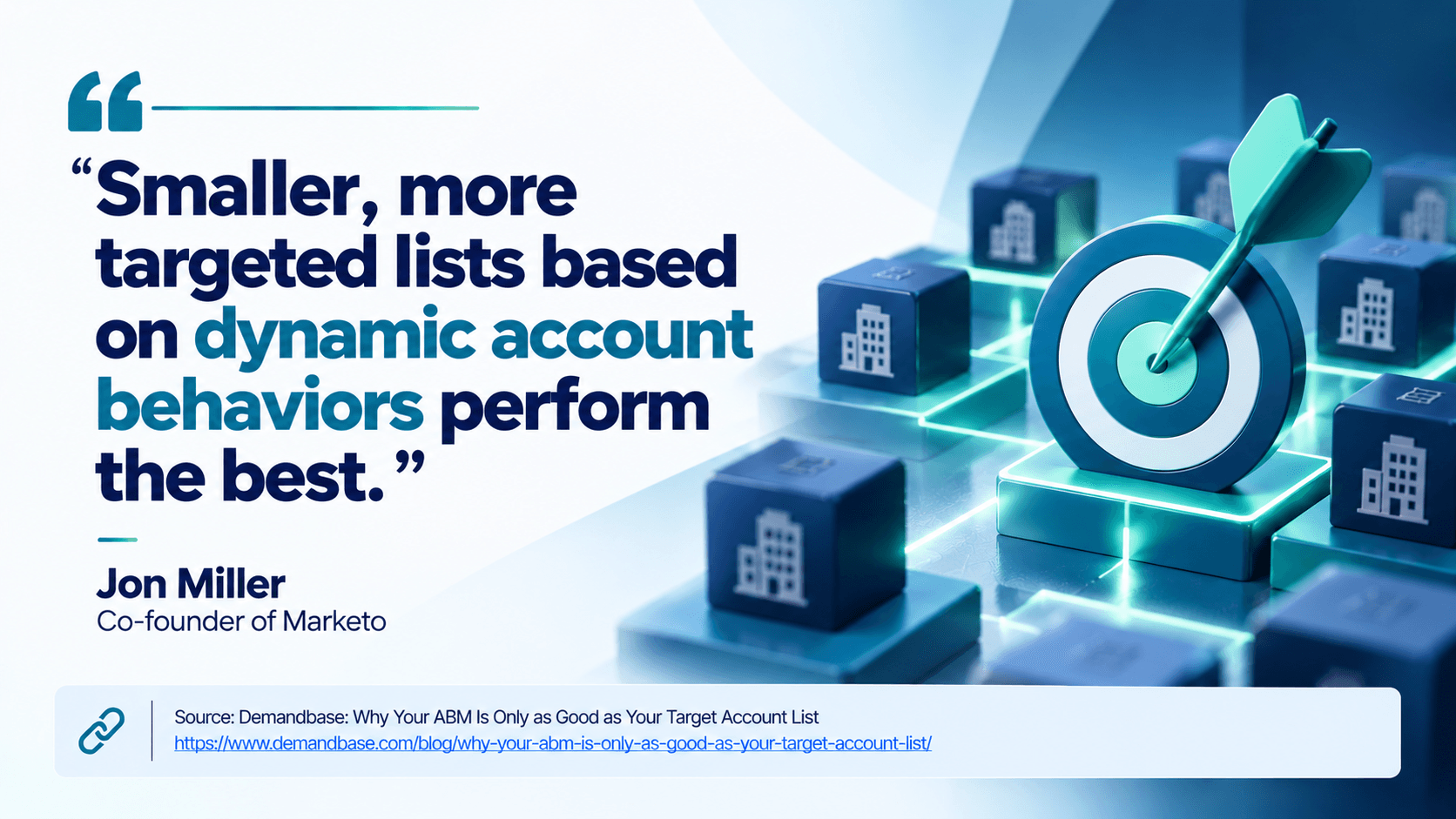
Only 57% of ABM teams use intent signals to build their lists (Demand Gen Report, 2021). Teams running smaller lists tend to see stronger pipeline results. The causal mechanism is execution depth: ABM cannot be run with depth at scale. A firmographic segment of 500 companies that match an ICP profile is not the same as a qualified set of 50-150 accounts that are in market, validated by sales, and genuinely achievable in the current quarter. ‘The Account List Problem’ is not a data problem. It is a methodology problem that most programs inherit at inception and never fix.
The ABM Account List Problem: Why Most Lists Are Too Large and Too Demographic to Work
ABM
Oct 4, 2026

The Dashboard That Looked like Success
The Demand Gen Director pulled up the ABM dashboard for the quarterly review. The account list had 460 accounts. Engagement was spread across 180 of them. Twelve had been passed to sales. Three were in active pipeline conversations.
When the CMO asked why so few accounts were converting, the answer was: “We’re reaching them, but they’re not responding the way we’d expect.”
The actual answer was simpler. The list had been built from a firmographic export, and most of the 460 accounts had never been in market.
‘The Account List Problem’ is the structural issue where ABM programs launch against account lists that are too large to execute against with depth and too demographic to be reliably predictive of purchase intent. The result is a program that produces engagement data spread thinly across many accounts, with pipeline concentrated in a handful that were in market by coincidence rather than design.
Buying Committee Syndication is Machintel’s framework for reaching every decision-maker in a target account before the formal evaluation begins. See how it works.
Three Account List Types and Their Pipeline Outcomes
Most ABM account lists fall into one of three types. Each produces different pipeline outcomes.
Type 1: The Firmographic Segment
Built by filtering a database against ICP parameters: industry, company size, revenue, geography. Every company matching the filter enters the list.
This list identifies which companies look like buyers. It does not identify which ones are buying. The average list of this type contains 300-500 companies. Most are not in market at any given time. A small fraction is. The program produces engagement data distributed across all 300-500, with no reliable mechanism to determine which engagements represent genuine purchase intent versus passive exposure.
The engagement metrics often look reasonable. The pipeline consistently does not match the engagement volume. Only 57% of ABM teams use intent signals to build their lists (Demand Gen Report, 2021).
Type 2: The Intent-layered List
Starts with firmographic ICP fit, then applies intent signal data: behavioral signals showing the account is actively researching the relevant category. Common intent signals include increased content consumption on category topics, competitor site visits, relevant search activity, and content download patterns that indicate active evaluation.
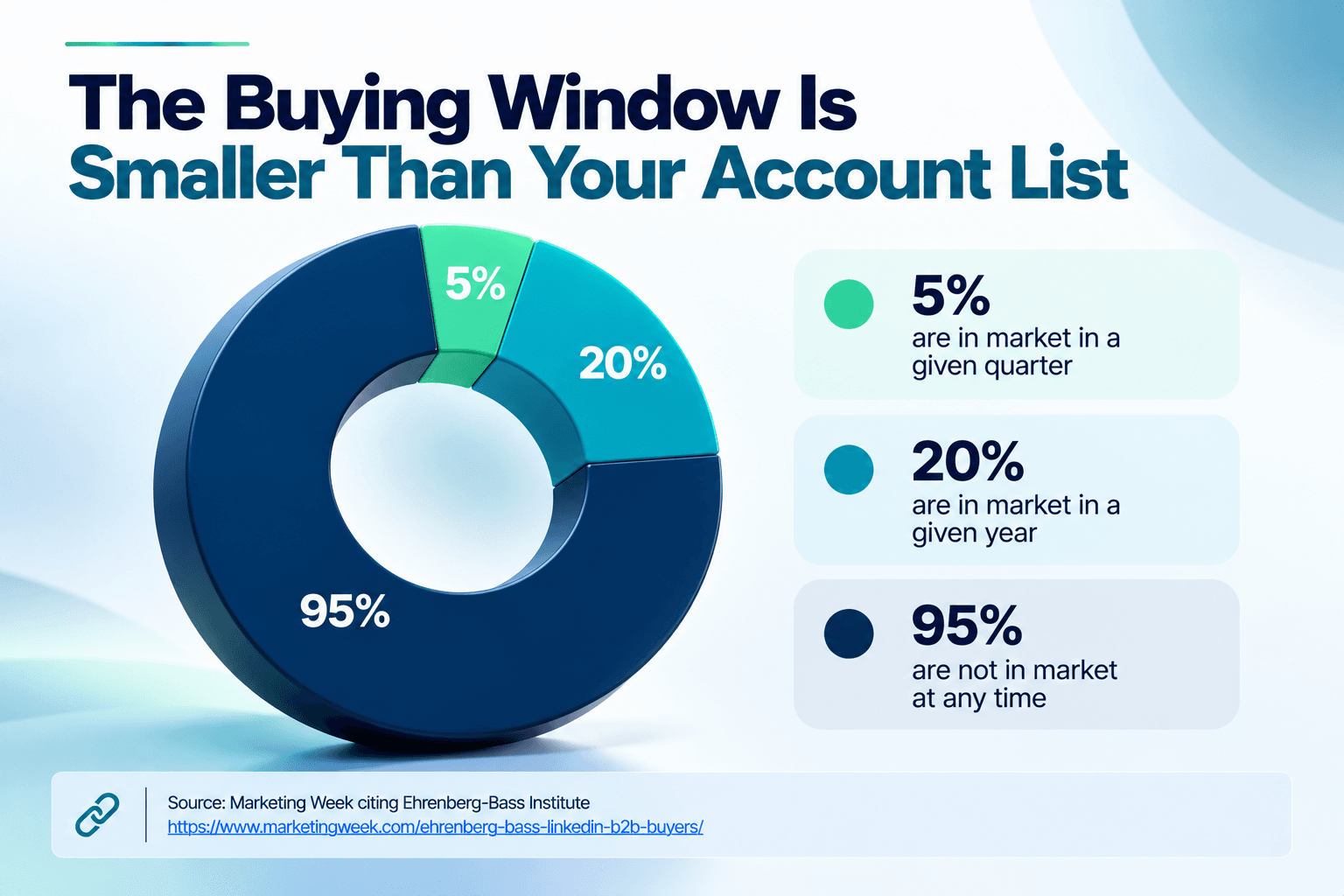
Intent filtering typically shrinks the firmographic universe to the accounts in market. The resulting list is smaller and substantially more predictive. Only about 5% of target accounts are in market at any given time (Demandbase). The engagement rate is higher than Type 1 because the accounts being reached are actually in market.
This list requires quarterly refresh. Intent signals decay. An account showing strong research behavior in Q1 may have completed their evaluation by Q3. A static intent-layered list becomes progressively less accurate with every quarter it runs without updating.
Type 3: The Qualified Account Set
An intent-layered list further validated through a joint marketing and sales review. Marketing brings ICP fit and intent signals. Sales brings relationship context, pipeline timing, and account situation awareness. The joint review produces a set both functions have agreed represents genuine near-term opportunity.
These lists typically contain 50-150 accounts. Teams running against them tend to see stronger pipeline results. ABM programs with sales-validated account lists are more likely to produce pipeline-attributed revenue.
The Refresh Problem: Why Static Lists Fail over Time
39% of B2B marketers say account selection is one of their biggest ABM challenges (The Insight Collective, 2025). A significant part of that challenge is the static list problem: most account lists do not change until someone notices they are not producing results.
Named account lists are updated quarterly by 52% of organizations (Marketing LTB, 2026). The rest may be running programs against an account universe that is 6-12 months stale.
Intent signals, company buying cycles, and sales priorities all change within a quarter. A company actively researching demand gen solutions in January may have signed with a competitor in March. An account that looked low-intent in Q1 may have hired a new CMO in April and entered active evaluation mode. A static list misses both of these changes and continues activating spend against accounts that have either already decided or are not yet in motion.
The practical requirement: account list review every quarter at minimum. The review should add accounts showing new intent signals, remove accounts that have made a decision or gone quiet for two quarters, and adjust tier assignments based on updated engagement data and sales priority changes. The account list is a living document, not a spreadsheet created at program launch and maintained on inertia.
Keeping an account list fresh every quarter, on top of everything else a marketing team carries, is easy to put off. Machintel’s demand generation services take that work on with B2B marketers, reviewing intent signals and sales priorities as the quarter changes. The list then stays useful without becoming one more task for your team.
The Sales Alignment Gap
ABM account lists built without sales input carry a structural problem at handoff. When marketing passes an engaged account to sales, the first question sales asks is: is this account on our priority list? If it was not on sales’ radar, the handoff produces friction.
Sales teams involved early in ABM planning see 2.1x higher win rates (Marketing LTB, 2026). The mechanism is alignment: sales follows up faster and more effectively on accounts they selected or co-selected than on accounts marketing identified independently and passed over.
The fix requires involving sales in account selection at the start of each program cycle. A quarterly account review, where marketing presents intent signal data and recent company triggers, and sales validates or redirects based on pipeline context, produces a list both functions are invested in. The alignment created in that conversation is what converts engaged accounts into pipeline conversations rather than handoff friction.
The Tier Structure for Larger Programs
When program scale requirements exceed the depth that can be applied uniformly across all accounts, a tier structure allows execution quality to be preserved at priority accounts while maintaining lighter-touch coverage at a broader set.
Tier 1, covering 10-20 accounts, receives maximum execution depth: complete buying committee mapping, full channel coverage, personalized content aligned to each committee role, and direct sales involvement on all accounts. These are the accounts most likely to close within the current or next quarter.
Tier 2, covering 50-100 accounts, receives high execution depth: buying committee targeting across multiple stakeholders, multi-channel activation, and standard content with role alignment where achievable. Sales is involved on a rotation basis rather than for every account simultaneously.
Tier 3, covering 100-300 accounts, receives a programmatic ABM motion: account-targeted content syndication, LinkedIn company targeting, and automated nurture sequences. Minimal direct sales involvement until an engagement threshold triggers escalation to Tier 2.
This structure applies maximum resources where they have maximum pipeline impact, while maintaining brand presence and engagement data at a broader account set. The tier allocation is revisited quarterly as intent signals and sales priorities change.
What a Qualified Account Set Looks like in Practice
At Machintel, the account qualification process runs in three layers before any activation begins. Firmographic ICP fit validates that the account matches the target profile. Intent signal data, integrated from behavioral data sources, narrows the universe to accounts actively researching the relevant category. A joint review with the client’s sales team validates the remaining accounts against pipeline context and sales priority.
The output is typically a qualified set of 50-150 accounts that both marketing and sales have agreed represent genuine near-term opportunity. This set is refreshed every quarter: new accounts are added as they show intent signals, accounts that have gone quiet or made a decision are removed, and tier assignments are adjusted based on updated engagement data.
The tier structure maps to Machintel’s T1/T2/T3 program design:
- T1 accounts receive full buying committee syndication: multiple stakeholders, multiple editorial channels, account-level engagement measurement.
- T2 accounts receive multi-channel content distribution across the buying committee.
- T3 accounts receive content syndication with engagement monitoring and automated escalation when a threshold is crossed.
FAQs
Why do large ABM account lists underperform smaller, more qualified lists?
Large lists built on firmographic filters spread program investment across accounts with no verified buying intent. Teams running smaller lists with intent and fit validation tend to see stronger pipeline results because resources concentrate where buying probability is highest.
What data sources should inform ABM account selection beyond firmographics?
Intent signals from co-op publisher networks, account-level engagement from editorial content, sales-validated accounts with existing relationships, and trigger events such as funding rounds, leadership changes, or hiring signals add qualification depth that firmographic filters cannot provide.
How often should an ABM account list be refreshed?
Quarterly refresh is standard. Accounts showing no engagement signals after two quarters should rotate out. Accounts showing strong intent or trigger signals not on the current list should rotate in, keeping list size in the qualified range.