94% of B2B buyers used AI tools in their research in 2025. Most demand gen platforms see no signal from those sessions. They still produce shortlists. This is ‘The Citation Gap’: vendors missing from AI-generated answers miss the research session that most influences the initial shortlist. AEO, or answer engine optimization, is the content strategy built to close it. Without it, vendors stay invisible in a channel that now shapes the majority of B2B shortlists.
AEO and B2B Pipeline: What the AI Research Session Means for Demand Generation
Demand
Sep 23, 2026

In This Article
- The Shortlist That Formed Before Any Vendor Was Contacted
- How AI Research Sessions Form B2B Shortlists
- The Citation Gap: Why Most Vendors Are Absent
- Why Traditional SEO Does Not Drive AEO B2B Pipeline
- The Pipeline Consequence for Demand Gen Programs
- What We See Across 4,000+ Campaigns Annually
- Final Thoughts
- FAQs
Consider a prospect who arrived at a discovery call with a shortlist of four vendors already prepared.
When the sales rep asked how they had identified the vendors, the answer was direct: “I asked ChatGPT.”
One AI query. Fifteen minutes. A shortlist that shaped the entire evaluation.
The prospect had not visited a single vendor website before that call. No form fill. No intent signal. No campaign touchpoint. No trackable anything. The shortlist was built in a conversation that left no footprint in most demand gen platforms.
This is ‘The Citation Gap’: the structural problem where B2B vendors are absent from the AI-generated answers buyers consult before forming shortlists, while their demand gen programs have no signal that the research happened at all.
The Shortlist That Formed Before Any Vendor Was Contacted
The story above is not an outlier. It is a pattern that has become standard across B2B buying.
94% of B2B buyers used AI tools in their research in 2025 (Forrester, 2026). 66% of B2B buyers regularly use AI to research vendors. 45% say AI significantly shaped their vendor shortlist (Semrush, 2026).
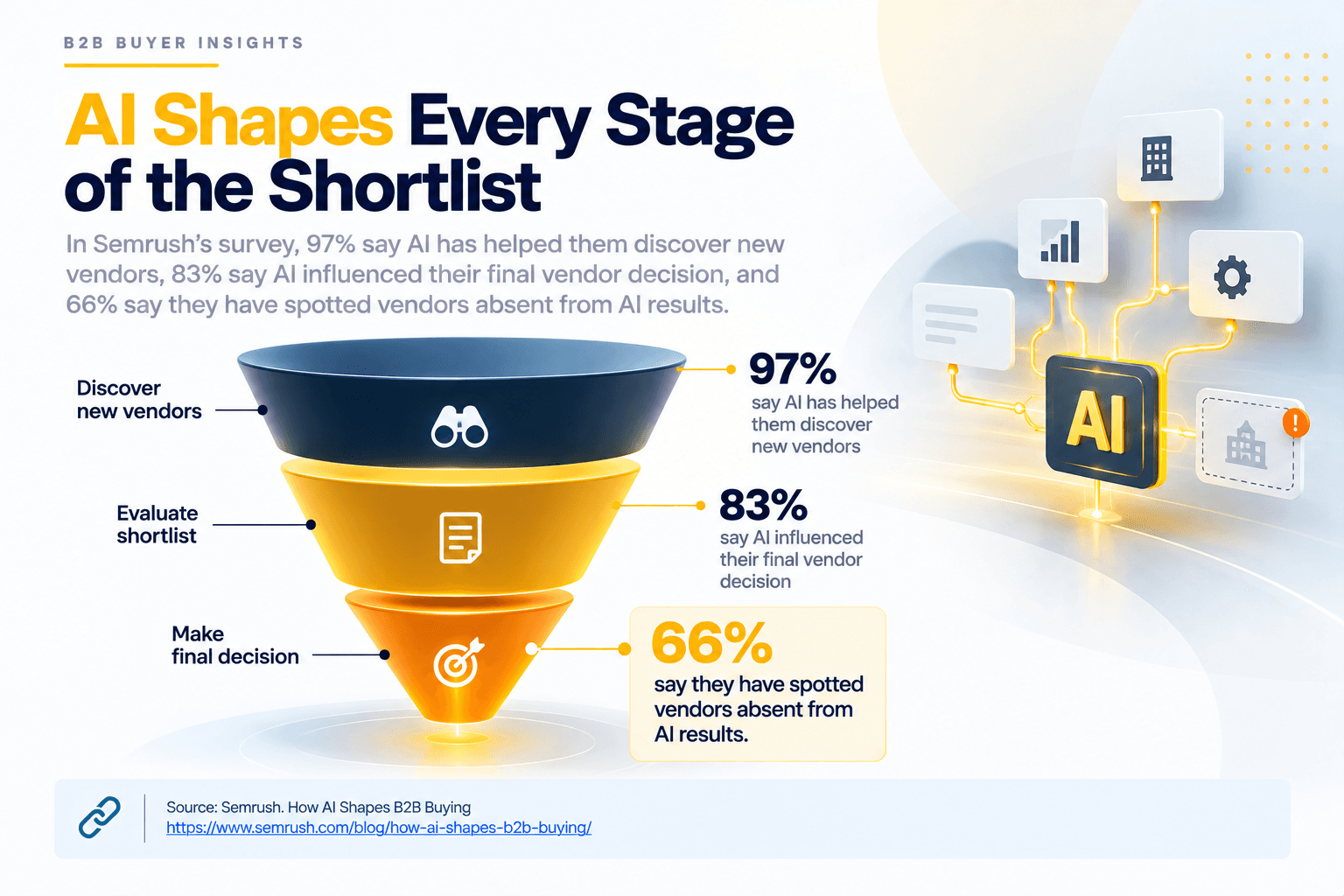
The buyer who queried ChatGPT about demand generation vendors and built a shortlist from the response did something that has become routine. They used an AI tool to compress what used to be hours of research into minutes. They got a synthesized answer naming vendors, describing positioning, and comparing approaches. They formed initial views of each vendor from that answer, without visiting any website.
The demand gen programs for every vendor named or not named in that answer received no signal. The most influential research session in the buyer’s process generated no data for any vendor.
The Pre-Funnel Presence Framework is Machintel’s framework for building B2B vendor presence in the channels buyers use before they contact any vendor. See how it works.
How AI Research Sessions Form B2B Shortlists
Understanding AEO B2B pipeline impact requires understanding how buyers actually use AI tools for vendor research.
A typical AI research session for a B2B vendor evaluation works as follows. The buyer identifies a category need. They query an AI tool: “What are the best B2B demand generation companies for SaaS companies?” or “Compare content syndication vendors for enterprise tech marketing.”
The AI synthesizes an answer from content it has indexed and data it has been trained on. The answer names a handful of vendors. It describes their positioning, use cases, and differentiation. The buyer reads the answer, forms an initial view of each vendor, and may run follow-up queries for specific comparisons.
By the end of the session, the buyer has a mental shortlist. It was built in minutes, from an AI interface, without visiting a single vendor website, without filling out a single form, and without generating any trackable signal.
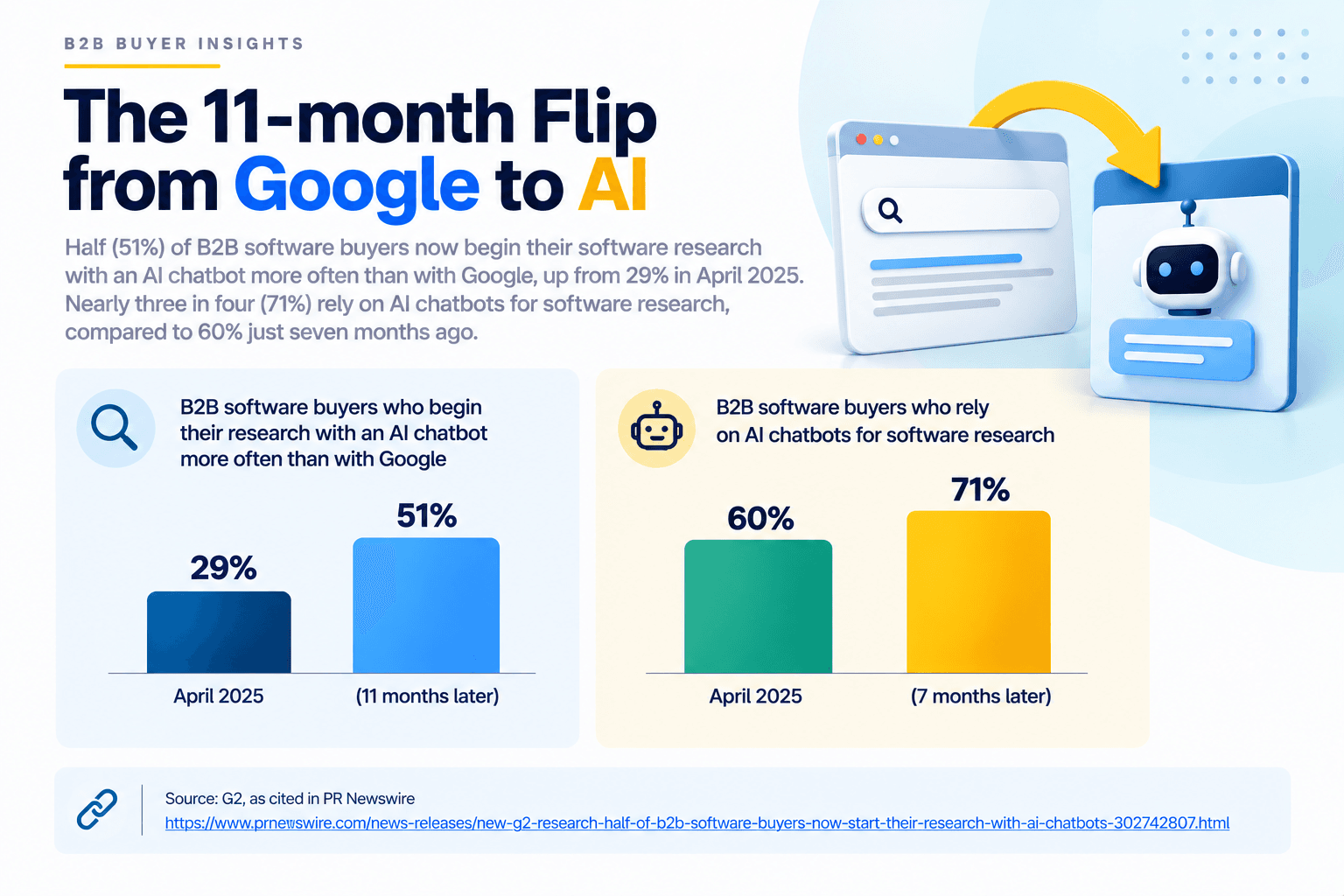
AI chatbots are now the top source shaping B2B software shortlists (G2, 2026). For buyers who start their research in AI, the AI is not informing the shortlist. It is building it.
68% of Google searches now end without a click as Google answers on the page (SparkToro, 2026). Top-ranking organic CTR fell 58% when AI Overviews appeared (Ahrefs, 2026). The research behavior is shifting at a rate that has outpaced most demand gen program adaptation.
For a broader look at the research channels where shortlists form, see Buyers Ask AI, Not Google: AEO Demand Generation Keeps You Cited.
The Citation Gap: Why Most Vendors Are Absent
Not all vendors appear in AI-generated answers with equal frequency. The factors that influence AI citation:
Editorial authority: AI models apply source quality signals when synthesizing answers. Content appearing in trusted third-party editorial environments, industry publications, and credible B2B media tends to be cited more often than content on vendor-owned pages. Vendor websites are promotional by design. AI models treat them differently from editorial sources.
Answer structure: Content designed to directly answer category questions, with clear question framing and specific, detailed responses, tends to be cited more often than promotional content optimized for conversion. An article that directly answers “what does content syndication actually do” in editorial form is more likely to be cited than a vendor landing page.
Distribution breadth: Content appearing across multiple high-authority sites, not only one vendor’s property, tends to be indexed more broadly and cited more consistently. A vendor whose category expertise appears in five practitioner-trusted publications has more content in the relevant index than a vendor whose expertise appears only on their own site.
Topic coverage: Vendors whose category expertise is documented across multiple editorial environments, covering category questions from multiple angles, tend to have higher citation probability than vendors with thin or promotional content in the index.
92% of B2B teams are experimenting with or operationalizing GEO (GNW, 2026). Yet the median B2B brand appears in just 3% of relevant AI Overviews (Walker Sands, 2026). Most B2B content investment still sits in assets that will not be cited when buyers research in AI.
Why Traditional SEO Does Not Drive AEO B2B Pipeline
Search engine optimization and answer engine optimization require different approaches. Understanding the distinction matters for demand gen investment decisions.
Traditional SEO optimizes for ranking in search results: keyword density, backlinks, page authority, technical site health. The goal is to appear near the top of a list of results the buyer can choose from. The buyer controls the click.
AEO optimizes for citation in synthesized answers: authoritative editorial content on specific questions, third-party endorsement established across multiple credible sources, topic authority documented across editorial environments, and answer-structured content that AI can extract and paraphrase accurately.
A vendor with excellent traditional SEO will rank well in search results. That same vendor may not appear in AI-generated answers if their content is concentrated on their vendor site, is written in promotional rather than editorial style, or does not directly address the category questions buyers ask AI tools.
The buyers who move through the research phase without clicking any search results, satisfied by the AI-generated answer they received, are not in the segment that traditional SEO reaches. They are in the segment that AEO reaches. As the proportion of research sessions handled by AI grows, the proportion of buyers reachable only through AEO grows with it.
Most B2B content budgets still favor the first approach while buyers are shifting to the second.
The Pipeline Consequence for Demand Gen Programs
The AEO B2B pipeline impact is specific and measurable through the shortlist formation lens.
92% of buyers say AI has shaped their vendor shortlist (Semrush, 2026). With 94% using AI tools in their research, most initial shortlists now have AI research as a significant input (Forrester, 2026).
Vendors absent from AI-generated answers are absent from a research phase that influences the majority of shortlists. They are not starting from zero in a market evaluation. They are starting from zero in the research phase that precedes the evaluation, competing to get on a shortlist that may already have been substantially formed before their program detected any activity.
The win rate differential from research-phase absence applies here directly: 95% of B2B deals go to a vendor already on the buyer’s Day One shortlist (6sense, 2025). AI research is research-phase. Presence in AI answers is presence during the research phase.
The programs optimized to capture declared intent, paid search, intent data, retargeting, are built for a research process where buyers announce themselves. For the 94% of buyers who used AI tools in research in 2025, many of the most influential research sessions happened before any announcement was possible.
What We See Across 4,000+ Campaigns Annually
Machintel runs 4,000+ campaigns annually across B2B tech and SaaS. The programs that produce the most consistent pipeline are present in the research channels buyers use before declaring intent. That increasingly includes AI search.
Machintel’s 33 owned editorial publications serve as distribution infrastructure for client content in the editorial environments that support AI citation. Third-party editorial content distributed through credible industry publications meets the source quality criteria AI models apply when synthesizing answers. Client content distributed through the publication network appears in editorial environments that tend to be indexed and cited more often than vendor-site content for category research queries.
This is not a guarantee of AI citation. It is a structural advantage over vendor-site-only content distribution. The buyer asking an AI tool to compare demand generation vendors receives an answer synthesized from the available indexed content. Clients with editorial distribution through trusted publications have more of the relevant content in the index.
Without AEO, programs stay invisible in a research channel that now shapes the majority of B2B shortlists. ‘The Citation Gap’ is not closing on its own. It widens as AI research adoption grows and vendors in editorial environments pull further ahead of those concentrated on their own properties.
The shortlist that forms in an AI session is real. The vendor absent from that session is unlikely to be on it. The demand gen program that has no signal the session occurred cannot respond to something it cannot see.
Final Thoughts
AI research is now where B2B shortlists begin. Closing ‘The Citation Gap’ means being present before buyers declare intent. Every AI session your program cannot see is a shortlist forming without you. Contact Machintel to close the gap before the next one forms.
FAQs
What is AEO and how does it differ from traditional SEO for B2B pipeline?
Answer engine optimization (AEO) structures content to be cited by AI tools when buyers ask category research questions. Unlike SEO, which targets keyword rankings, AEO targets AI synthesis quality: the vendor whose content AI models draw from when answering “which vendors should I evaluate for demand gen?”
Why does gated content fail to build AI citation presence?
AI tools cannot index content behind a form. A vendor’s research report, regardless of quality, contributes zero to AI synthesis if it requires contact details to access. Publicly indexed editorial content, especially on credible third-party publications, builds the strongest AI citation presence.
How long before AEO investment produces shortlist inclusion?
AEO builds over months, not weeks. Content distributed through editorial networks early is indexed and available for AI citation when buying committees begin research.
Sources
- Forrester: B2B Buyers Make Zero-Click Buying Number One, 2026
- Semrush: How AI Tools Shape the B2B Buying Process: A Survey of 600+ US Business Professionals, 2026
- G2: The Answer Economy: How AI Search Is Rewiring B2B Software Buying, 2026
- SparkToro: In 2026, Less than One Third of Google Searches Still Send a Click
- Ahrefs: Update: AI Overviews Reduce Clicks by 58%, 2026
- Walker Sands: Introducing the B2B AI Search Visibility Benchmark, 2026
- Demand Gen Report: GNW, 2026
- 6sense: The B2B Buyer Experience Report for 2025