Most B2B content teams treat AI as a content generator. The teams producing credible, pipeline-moving content treat it as a production accelerator. The difference is the ‘Practitioner Input Gap’: AI cannot simulate operational experience. The four-stage model keeps practitioner judgment at the brief and review stages while AI handles research synthesis, structure, and format repurposing.
AI-assisted B2B Content Production: The Model That Maintains Authority Without Sacrificing Volume
Demand
Oct 28, 2026

A demand gen director reads two pieces on buying committee intent data on the same afternoon.
The first is well-structured. The sources are current. The sections follow a logical sequence. It reads smoothly. She reads it to the end.
The second opens with a specific scene: a program that failed because the intent data was filtering at the account level rather than identifying which contacts in the buying committee were actually researching. The piece makes a counterintuitive claim about why most intent programs miss this. It supports the claim with data from a specific campaign type and names the fix.
She shares the second one. Not the first.
The first piece was produced faster. The second contained something the first did not: an observation that could only have come from someone who has actually run the program and seen the failure mode in practice.
Consumer research points the same way. 50% of consumers can correctly identify AI-generated copy, and 52% become less engaged once they suspect it (Bynder). The flaw is not technical. It is the absence of specific operational experience.
The Trade-off That Does Not Have to Exist
B2B content teams using AI tools face a perceived choice. Produce more content faster using AI, accepting that the output will be smoother but thinner. Or produce high-authority content slowly, maintaining the practitioner voice that builds credibility with experienced buyers.
The teams that use AI most effectively have stopped accepting this trade-off. They are not using AI to generate finished content at scale. They are using it to accelerate the production of content that still requires human judgment, practitioner experience, and editorial authority to be credible.
Behavioral Cluster Intent data tells us something relevant here: the B2B content that generates buying-committee-level engagement has consistent characteristics. It makes a specific claim. It supports the claim with evidence that is non-obvious. It sounds like it came from someone who has done the work. Content that lacks these characteristics generates lower engagement from experienced practitioners regardless of how well it is produced technically.
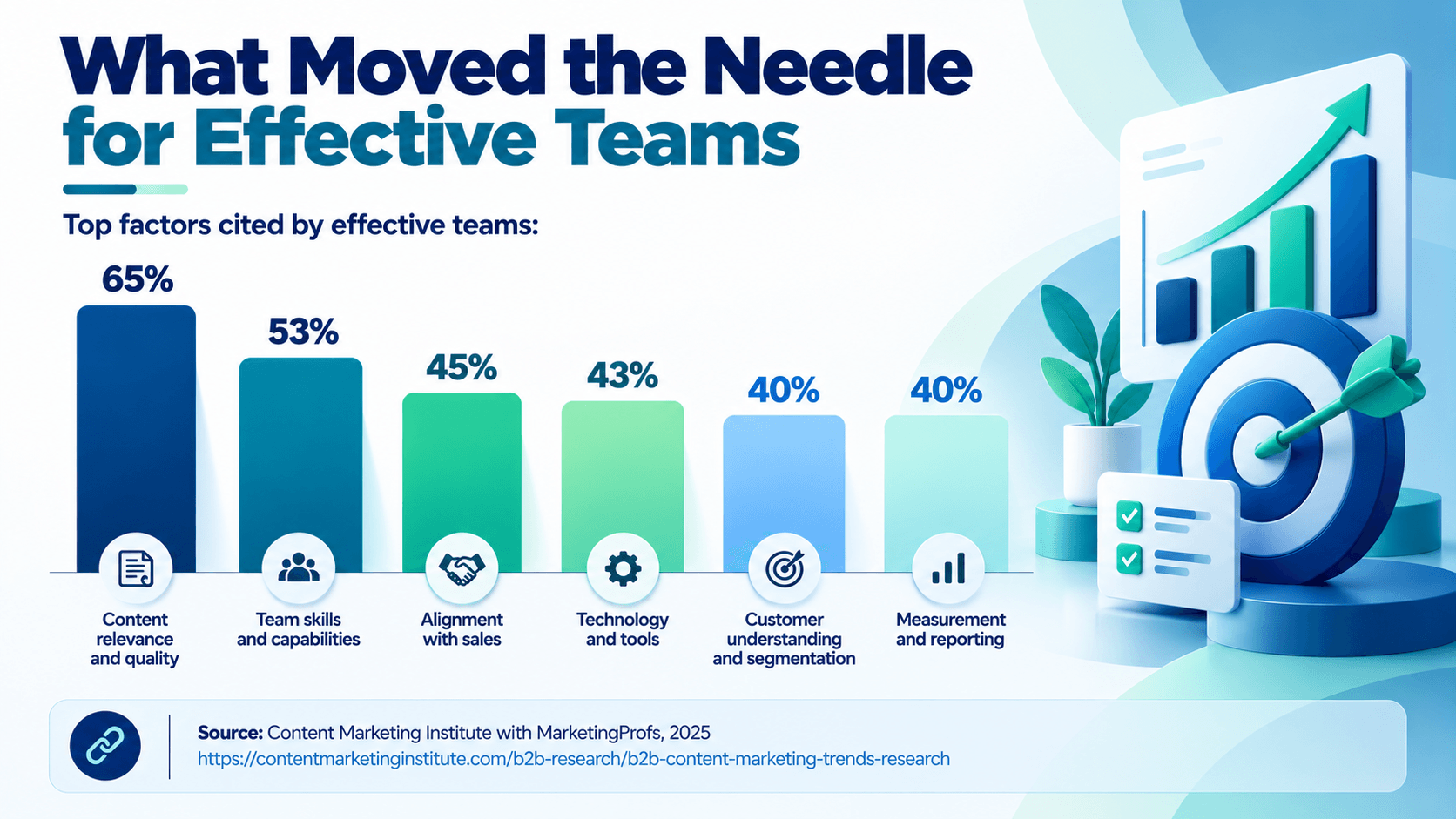
What AI Does Well in B2B Content Production
AI handles three tasks in content production that are better done with AI assistance:
-
Research synthesis: AI tools can process large amounts of source material quickly: analyst reports, industry surveys, competitor content, interview transcripts. The synthesis of research inputs into a structured argument is faster with AI assistance. The practitioner brings the hypothesis and the evaluative judgment. AI handles the research synthesis that tests and supports it. The resulting content is better-sourced and produced more efficiently than either approach alone.
-
First-draft structure: For content with defined structures, blog posts with consistent section formats, email sequences with established patterns, LinkedIn posts with a set formula, AI produces a first draft that follows the structure and populates it with relevant content. The first draft requires practitioner review. But the structural draft eliminates the blank-page problem and reduces the production cycle significantly.
-
Format repurposing: AI is effective at reformatting existing content across surfaces: turning a long-form article into an email, converting a webinar transcript into a LinkedIn post, adapting a whitepaper section into a blog piece. The core argument exists already. AI handles the format adaptation. This is where AI provides the most unambiguous efficiency gain without quality trade-offs.
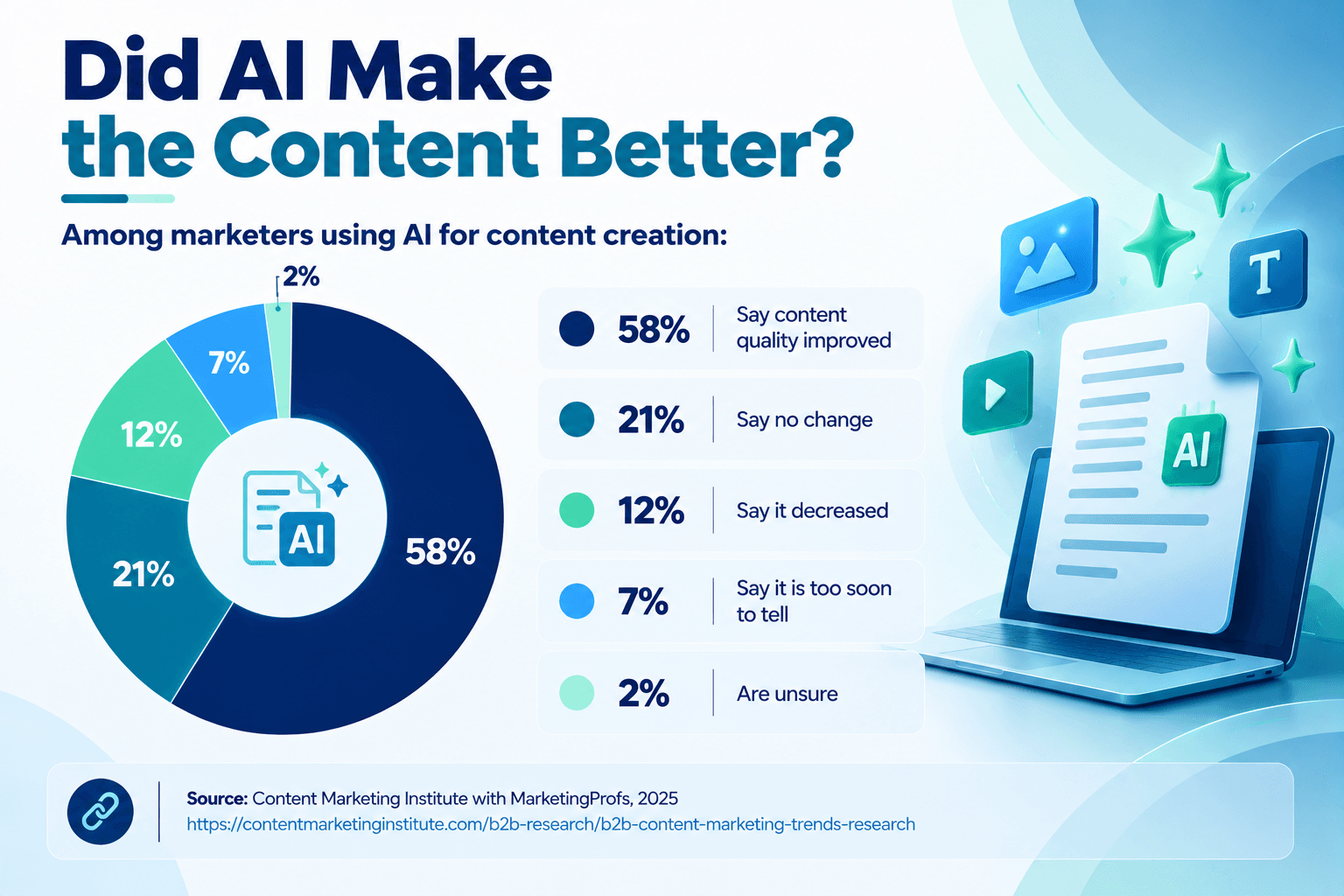
What AI Does Poorly in B2B Content Production
AI has three consistent failure modes in B2B content for experienced practitioner audiences.
- Practitioner experience simulation: Experienced B2B buyers read vendor content in their category regularly. They have a calibrated sense of what an observation sounds like when it comes from someone who has run a program versus what it sounds like when it comes from a system that has processed many articles about programs.
The specific detail, the scene that precedes the argument, the named failure mode from a client engagement, the counterintuitive claim that only makes sense if you have seen the data yourself: these elements make B2B content credible to a peer audience. AI cannot produce them from training data. Content produced entirely by AI for a demand gen audience reads like a well-structured summary of the category. The audience notices.
-
Proprietary methodology and differentiation: If a brand’s content positioning depends on a proprietary framework, that framework must originate from actual practice, not from AI synthesis of existing industry frameworks. AI produces frameworks that resemble what already exists in the category. Owned concepts like ‘Buying Committee Syndication’ or ‘Pipeline Accountability Model’ have value in positioning because they reflect a specific way of thinking developed from doing the work. AI cannot generate these. It can articulate them once they exist.
-
Sustained voice consistency: Established voice profiles for specific practitioners require sustained editorial input to maintain. AI tends to revert toward the average of similar content it has been trained on. Voice drift in AI-assisted content is a production management problem that requires editorial oversight. Without an explicit editorial check, the practitioner’s voice degrades across a content program.
Watching a brand’s voice slowly drift toward sounding like everyone else is a quiet cost that is hard to spot until readers stop responding. Machintel helps B2B demand generation teams keep original thinking at the center of their content and place it in front of the accounts that matter. Your content then stays recognizable, and credible, to the buyers you want.
The Four-stage Production Model
The production model that works for B2B demand gen content has four stages. Total production time: 60-90 minutes for a 1,000-1,500 word piece with a strong practitioner voice, compared to 4-6 hours without AI assistance or 20 minutes for an AI-only piece that lacks credibility.
Stage one: Practitioner input brief: This is where most AI-only workflows fail: the ‘Practitioner Input Gap’. The content creator defines the core argument, the opening scene, the counterintuitive claim, and the proof points from experience. This brief takes 15-20 minutes from someone who knows the subject. It is the practitioner’s thinking. It is not AI-generatable and should not be treated as an optional step.
The brief provides everything AI cannot: the specific claim that only comes from operational experience, the scene that makes the argument concrete, the voice guidance that prevents drift, and the proprietary insight that differentiates the piece from category-average content on the same topic.
Stage two: AI first draft: With the brief as input, AI produces a structured first draft following the defined format. The draft populates the structure with relevant supporting content, synthesized research, and secondary points. This step produces a document that is 60-70% of the finished piece.
Stage three: Practitioner edit: The practitioner reviews the draft, adds the specific observations and experiential claims that only they can contribute, adjusts tone to match their voice, and removes content that sounds like category summary rather than original argument. This edit step is where the piece becomes credible to an experienced audience. It is not optional and it cannot be delegated to an editorial layer alone.
Stage four: Editorial quality check: Before publication, a pass for voice consistency, structural compliance, content accuracy, and mechanical quality. For content with specific rules, banned words, link requirements, and format specifications, this check can be partially AI-assisted. Editorial judgment handles the substantive review.
The Credibility Calculus
B2B content credibility comes from three sources: institutional authority from the brand’s track record, practitioner authority from the specific person’s experience and voice, and argument quality, where the specific claim being made is accurate, specific, and non-obvious.
AI can accelerate the production of arguments. It cannot generate institutional authority or practitioner authority. It can produce content that appears credible at first read. It loses credibility on closer inspection by experienced practitioners who recognize the absence of specific operational experience.
In a demand gen audience, where readers have built programs, managed budgets, and evaluated vendors, the credibility threshold is higher than in most other B2B content markets. Generic-sounding AI content does not just fail to build authority. It actively signals that the brand does not have the depth it claims.
The production model that works is the one that uses AI where it adds value, without eliminating the practitioner layer that creates credibility with experienced buyers. The demand gen director who shared the second piece over the first was not consciously judging AI versus human content. She was responding to the presence of something specific that only someone who has done the work could have written.
That is the standard. The production model is the path to meeting that standard at scale, consistently, across an entire content program.
Closing the ‘Practitioner Input Gap’ does not require a complete overhaul of an existing content program. It requires inserting practitioner judgment at two specific stages: the brief and the review. Every other stage can run at AI-assisted speed without sacrificing the authority that makes B2B content worth reading.
The practical test is simple. Take the last five content pieces the program produced. Can a senior practitioner in the relevant domain look at each one and point to a specific observation, data point, or operational example that only someone who has run the work would know?
Machintel’s content programs use a brief template that requires practitioner input before production begins.
Want to see what a practitioner-led content program looks like at scale? Talk to our team or explore our demand generation services.
FAQs
Where should B2B teams use AI in content production?
AI works best on research synthesis, first-draft structure, and format repurposing. Practitioner judgment stays at the brief and the edit, where operational experience shapes the argument.
What goes into a practitioner input brief?
The brief holds the core argument, the opening scene, the counterintuitive claim, and the proof points from experience. It also carries voice guidance and the proprietary insight that sets the piece apart. It takes 15-20 minutes from someone who knows the subject.
How can teams keep a practitioner’s voice consistent in AI-assisted content?
AI drifts toward the average of similar content, so the brief should state the voice explicitly. The practitioner edit then removes anything that sounds like category summary, and the editorial check confirms voice consistency before publication.